Recent Australia Day polling revealed something significant about the national mood. Support for keeping Australia Day on 26 January has risen sharply, with a clear majority of Australians now opposed to changing the date. After several years in which many of our political elites imagined and applauded a country they thought was increasingly uneasy with its national story, the public appears to be moving in the opposite direction – towards greater affirmation rather than retreat.
That shift is unlikely to be accidental. It reflects, at least in part, a renewed sense of shared national sentiment – a recognition that, whatever our disagreements, Australians remain attached to the idea of a common cultural or civic inheritance. Moments of collective shock and grief always clarify these kinds of instincts. The Bondi massacre was one such moment. In the face of horror, people do not fragment; they tend to rally. Australians collectively said, ‘This is not who we are.’ And they look for signs of shared belonging rather than reasons to dismantle it.
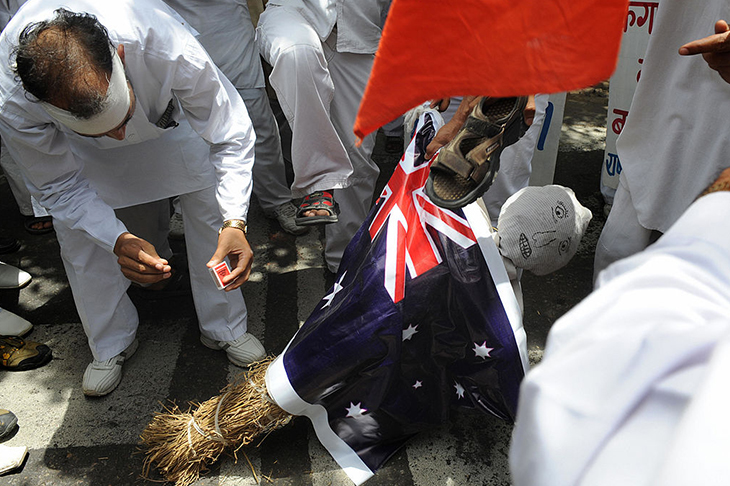
It is therefore unsurprising that in parts of our political discourse there is flirtation with the idea of criminalising flag burning. The impulse is entirely understandable.
To be clear, flag burning is offensive. It is designed to repulse and shock. It shows contempt for a precious national symbol that many Australians associate with sacrifice, service and shared history – including those who have served under it, fought for it, or buried loved ones beneath it. But understandable feelings do not always translate into a legal remedy. Personal revulsion is not a sufficient reason to reach for the criminal law, and confusing the two leads us badly astray.
When the issue of flag burning arose during the Howard years, the response from John Howard was unequivocal. He made it clear that he found the act distasteful, but he rejected any move to criminalise it. Such conduct, he argued, amounted to political expression, however crude, and criminalisation would only turn ‘yahoo behaviour’ into martyrdom rather than engendering respect for the flag. That instinct from Howard was classic conservative restraint. He understood that the law has limits, and should not – and in reality could not – be an instrument for enforcing reverence.
That history matters, particularly right now. Few issues have so persistently unsettled the conservative side of politics in recent years as freedom of speech. The long, still unresolved battle over Section 18C of the Racial Discrimination Act exposed deep concern about laws that punish mere offence. Who could forget the outrage when George Brandis made the unremarkable observation that ‘people have a right to be bigots’? More recently, the Coalition’s internal convulsions over the Albanese government’s group hate laws has revealed just how entrenched – and combustive – those concerns remain.
Against that backdrop, it would be extraordinary for conservatives now to pivot toward criminalising flag burning as a standalone offence. The incoherence is obvious. Just by itself, burning a flag is not violence. It is not intimidation. It does not, of itself, harm another person or their property. It is a political declaration of contempt. It is simply a statement which says, ‘I hate my country’.’ If that is not political expression – much as it is offensive – it is difficult to know what is.
None of this is to say that all conduct surrounding flag burning must be tolerated. Existing laws already deal with destruction or damage to national monuments such as arson, property destruction, public endangerment and intimidation. A person who damages property, endangers others, incites violence or engages in threatening behaviour can be dealt with under those laws. But that is regulation of conduct which harms others, not the suppression of political speech. Criminalising flag burning by itself crosses that line.
In the United States, the Supreme Court has long treated expressive conduct – including flag burning – as a form of political speech which is unambiguously protected by the Constitution. The Court has repeatedly held that the state may not prohibit expression simply because it finds the message offensive or unpatriotic. This is not an endorsement of flag burning; it simply restrains the government from criminalising it.
Australia’s constitutional framework is different, but it heads in the same direction. We have an implied freedom of political communication grounded in the text and structure of our Constitution. While it is not a personal, positive right in the American sense, it does have some bite. Laws that burden political communication must be justified, proportionate and directed to legitimate ends. A law that simply criminalises flag burning as a symbolic act would struggle badly under our test. It would not be judged to be directed to protecting people from harm; it would be judged to merely protect the state from offence.
However, the deeper mistake here is cultural rather than legal. There is a temptation to think that respect for national symbols can be compelled – that if only the law were firm enough, reverence would follow. However this confuses compelled obedience with true allegiance. The law can prohibit conduct; but it will never generate respect. Indeed, when it tries, it often achieves the opposite.
History suggests that symbolic bans tend to elevate fringe provocateurs into causes célèbres. They transform acts of juvenile contempt into acts of supposed deep political resistance. Worse still, they signal a lack of confidence in the very symbols they are meant to protect. A flag that requires criminal sanction to command loyalty becomes diminished.
We Australians are not as brittle a people as some seem to fear. Public attachment to national symbols – and to the idea of the nation itself – appears to have strengthened, not weakened, and it has done so organically. People respect their country and rally to shared symbols not because they are compelled to, but because they choose to – particularly when those symbols are mocked or demeaned.
Let them burn our national flag. And let us respond with the ridicule their theatrics deserve. History suggests that every flag burning disgusts the vast majority of people, and cements, rather than weakens, public attachment to that national symbol. Leave flags alone and the result will surely be more people waving flags, and more people rallying to them.
Got something to add? Join the discussion and comment below.
You might disagree with half of it, but you’ll enjoy reading all of it. Try your first month for free, then just $2 a week for the remainder of your first year.