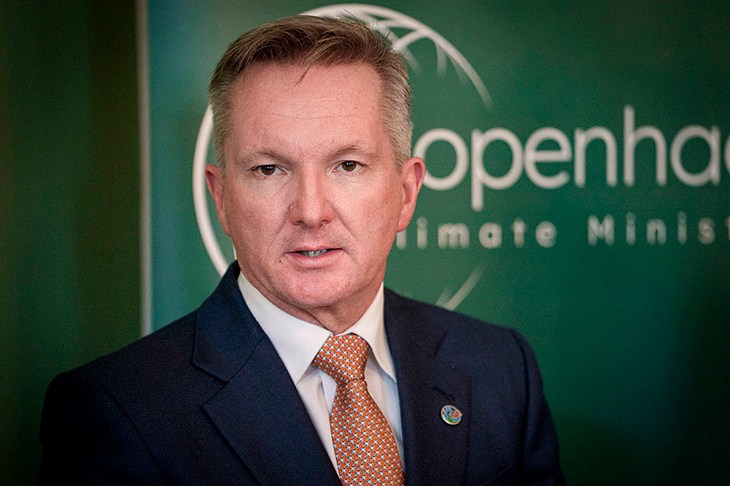
Is anyone surprised that the invitation of president for negotiations Chris Bowen – B1 to Speccie readers – to his pre-Cop party in Fiji has been declined by most heads of government? What was he thinking? Hasn’t he heard that most countries have moved on from CLIMATE CHANGE, concerned about more important things like keeping a lid on cost-of-living pressures and ensuring the security of their citizens?
Of course, if you spend the whole year trying to bully reluctant leaders to undertake self-destructive actions – nothing like rising electricity prices and a few blackouts to keep everyone cheerful – hanging out with B1 and his zealous advisers at a resort in Fiji is unlikely to be the invitees’ idea of a good use of time, let alone fun.
But like an Oscars ceremony, there is a need to fill empty seats. So B1’s team has taken to inviting an assortment of ring-ins, including various trade unionist buddies from around the Pacific. Mind you, we aren’t allowed to know who’s coming, even though Australian taxpayers are forking out around $20 million for the party.
(I have this great idea: B1 should conduct a lottery among Speccie readers to allocate fully paid slots to the Fiji gig. If the proceedings get too dull, as they surely will, we could all meet up around the pool and order multi-coloured cocktails with little umbrellas. At least we won’t be worried about the island sinking into the sea.)
In the meantime, B1 has been doing some local bullying by trying to insist that all the states and territories sign up to his plan about powering AI data centres. OK, the additional demand for electricity from these AI centres is potentially equal to the entire household demand from Victorian and New South Wales.
But B1 thinks that these extra electrons can be sourced from intermittent renewable energy plus a bit of backup from gas, even though the gas industry is close to being dead in the water because of B1’s antipathy to this source of energy.
Sadly for B1, the political leaders of Queensland and Northern Territory were not much taken by his plan. Rather, they quite rightly think the decisions about energy sources for proposed AI data centres in their locales to be theirs to make.
B1 hoped that a bit of grandstanding and intimidation would convince these independent souls to go along with his clever scheme. But Albo apparently wasn’t up for the fight.
Let’s not forget here that the real decisions rest with the private sector investors who will need to commit hundreds of millions of dollars – maybe even billions – to these data centre investments. There is a need for affordable reliable energy as well as many megalitres of water, among other things. And judged by developments in the US, these data centres are proving to be massively unpopular with local communities. So that’s another potential barrier.
My advice is to beware the hype about data centres. There is a long way to go before we see many final investment decisions being signed off by boards and construction commencing. And any boost to local productivity is even further into the distance.
In the meantime, B1 continues with his fanatical ways, supported by some state governments, but not all. Company reporting season has seen a clear shift away from the climate commitments of some of our largest resource companies. This is in line with overseas developments.
Oil and gas giant Woodside announced in August that it had turned its back on its Scope 3 target as well as ditching $5 billion of investments in ‘new energy’ projects, including green hydrogen. (I still get a chuckle typing green hydrogen. Presumably B1 has given up on that dream, but who knows?)
Scope 3 emissions are those generated by a company’s customers. If a gas company supplies a steel company and the steel company emits a lot of greenhouse gases, then these are counted as Scope 3 emissions.
The whole idea is completely bonkers because it’s simply not possible to control what customers get up to. But the real point is that it’s inconsistent with the Paris climate agreement because including Scope 3 emissions involves massive double counting. (Note to Jimbo: you need to take Scope 3 emissions out of the corporate climate reporting that currently applies.)
Talking about walking away from corporate climate spending, it’s worth mentioning here Twiggy’s Fortescue. We don’t hear much about green hydrogen from this climate hero these days, although he is still working on electric trucks at his iron ore facilities. And he is still targeting net zero for the company by 2030, notwithstanding the fact that the company’s emissions increased by 5 per cent in the past financial year.
Then there is BHP and Rio Tinto, our largest resource companies, that have cancelled massive amounts of ‘decarbonisation’ projects. Proposed spending is now around 20 per cent of the plans announced in the early-2020s.
It’s worth noting here that BHP’s plan to expand its Olympic Dam operation has been put on hold because of the lack of affordable and reliable energy as well as the insistence on renewables by the South Australian government. The company has redirected its investment to South America.
The climate obsession that captured so many companies in the early-2020s has now almost disappeared, not that many US oil and gas companies ever climbed on board the wagon in the first instance.
There was BP declaring that it was moving on from being an oil major and concentrating instead on new forms of energy. The board even agreed to call it by a different name – Beyond Petroleum. Oh please, spare us!
But having pissed a great deal of shareholder money up against the wall going beyond petroleum – another offshore wind farm, anyone? – the chair, the CEO and most of the board were rolled. BP has gone back to concentrating on being an oil and gas company. The current plan is to spend $US10 billion developing the oil and gas side of the business and to cut $US5 billion from its energy transition spending.
The Norwegian gas major, Equinor, also had a go at transforming itself by investing in alternative energy projects. But having been burned operationally and financially, this company is also returning to what it knows best.
In the meantime, some of the world’s coal companies are powering ahead – geddit? In fact, Glencore is now likely to list on the Australian Securities Exchange. A recent bond issue to fund a new coal export terminal in NSW was oversubscribed by nearly ten times the required $200 million.
But B1 is like a toddler covering his ears, refusing to listen to any wise advice being given to him. He is on a mission to save the planet, one windmill and one solar panel at a time. He simply ignores what’s going on overseas – the loss of government interest in the energy transition, the large-scale retreat from decarbonisation spending by corporates and the rapid investment in nuclear. But let’s hope he enjoys his time in Fiji – maybe he could stay there.
Got something to add? Join the discussion and comment below.
You might disagree with half of it, but you’ll enjoy reading all of it. Try your first month for free, then just $2 a week for the remainder of your first year.