Sydney’s working class look hungry.
By that I mean, they are getting noticeably thinner.
My advice to the political class is to disembark the Commonwealth car and take a trip on public transport through the CBD. A bus. A train. A tram. Something that puts you on the pavement with ordinary people. Have a really long look at the mannerisms of those who keep Australia afloat. They’re shrinking along with the scope of their lives.
This thinness is not to be confused with the skeletal Ozempic chic of the wealthy beach-side, leafy, Teal-ish suburbs. At great cost, there are corners of suburbia resembling war-era prison camps where affluence is measured by the absence of padding beneath yoga leggings. Starvation has become social currency amongst a class brainwashed into feeling guilt for their success. There is probably a criticism of cultural Marxism to be made here.
In contrast, the working class look hungry because they are. As socialism intensifies inside an economy, the excess fat melts off the taxpayers who carry the heaviest burden. Those are not necessarily the group paying the most tax. It means the societal class where the margin between earnings and essential costs has gotten thinner and the addition of tax creates tangible changes to economic behaviour. Not only is this imbalance cruel, it typically overlaps with key productive private sector workers. These are net creators, not consumers. Business owners. Employees. Suppliers. And they are in danger of going extinct.
The poorer they get, the less money there is for the rest of the nation. A nation which is leaning, ever more heavily, toward living off the state whether through welfare or the public service.
The bigger the state, the bigger the problem.
We used to call the over-taxed, under-appreciated workers the Forgotten People. The famished. And yet as I re-read Menzies’ post-war Forgotten People lectures in the sobriety of our post-truth era, the vision of conservatism, democracy, taxation, and government control offered by the great-grandfather of the Liberal Party is more nuanced and less devout than imagined. Like his inheritors, he is not a free speech purist or against the overbearing arm of government. No doubt his somewhat contradictory philosophy was shaped by the difficulty of the war years.
Valiant as his efforts were to salvage Australia, it is worth considering that history is not a best-practice guidebook. It is a record of what was tried. Just because post-war government interference worked, it does not follow that it was the correct or only approach. We must be careful not to copy-paste someone else’s solutions from a world that no longer exists.
The lesson here is that our age is unique. We are living through the creation of new political ideologies that have yet to be properly defined. The template of the past fits poorly over the puzzle of Australia’s future.
Conservatives and Labor cannot continue to recycle systems of politics from over a hundred years ago. Technology and culture have changed us as a people. It has also changed the nations we exist in competition with. What Menzies said or Marx penned from a friend’s living room is largely irrelevant.
Very few consider that Populism’s success across the West may tie to its uniqueness. Evolution drives humans to disobey and diverge, as if we were born to run alternate answers in every possible situation. We are contrary creatures. Our politics is not working and so the rebellion continues. Attempting to ban Populism or force people back into the mould is unlikely to offer major parties their desired status quo. Forcing citizens into action, as is taxation’s primary directive, usually comes with chaotic unintended consequences. It is like charging a battlefield to force retreat instead of the Blue Heeler which makes suggestions to the heels of the herd.
Here, instead, are observations from which you may draw your conclusions.
It takes a while for the slim pickings of socialism to manifest.
Long before people skip meals, they change mid-value discretionary purchasing trends. Bad economic policy manifests in a very particular section of retail sales.
Mid-price clothes, makeup, shoes, costume jewellery … these are all the first things to suffer. Brands marketed at the middle and working classes as a treat rather than a necessity close down first. Shoppers tend to return to higher-value, longer-lasting, and better quality products to justify the purchase. Instead of five beautiful party shoes, they will purchase one pair of expensive walking shoes. They’ll buy a proper winter coat instead of half a dozen office dresses.
The impact of a slight economic downturn is dramatic enough to shut thousands of businesses. Covid, excess taxes, increases in business costs, and inflexible employment law removed the option to adjust pricing or adapt their products. They were the canaries left to die before having their feathers plucked and stuffed into cushions for the Lodge.
We saw these retail warning signs start over a decade ago. They escalated after the economic evisceration of Covid lockdowns and inflationary government debt. It was the change in disposable income and the cumulative effect of each taxpayer’s unique economic position that drove the collapse.
And so it was that gaps appeared in the High Street and Westfield shopping centres. Many have been filled with tobacconists, Turkish barbers, foreign food stores, dodgy-looking convenience shops, or simply left boarded-up. These are wounds.
Then came the cancellation and consolidation of streaming apps. Even giants such as Netflix have re-configured their pricing and accessibility options. YouTube received a boost. The worst hit were expensive traditional cable services that left their transition into the app market a little late. Massive changes in advertising models continue to reshape the media landscape … advertising which is tied to the earlier collapse of retailers who are chasing customers on social media.
Tourism was next. For as long as possible, people kept hold of their international adventures while local long weekends in B&Bs and regional hotels suffered. Working harder and longer made the cost and effort of short-term escape a calculation endlessly nudged toward staying home.
When faced with an economic choice between Uber Eats and the gym, the gym lost. Those who had been holding on to decades-old New Year resolutions decided to cut their losses. Those weekly fees could be put toward their increasingly expensive food deliveries.
And so you might imagine that staying in, eating more, and doing less might lead to a bit of plumpness. For a while, that might have been the case, however, at some point the economics tip over.
Paying for petrol, parking, and even public transport starts to add up.
As an excessive long-time walker, I remember when it happened. The footpaths filled. Not just with joggers attempting to replace their gym memberships, but with office workers. Rushed, militant, purposeful walkers. Masses of them. People didn’t start walking and cycling because they felt guilty about their carbon footprint, they did it because they were getting uncomfortably poor.
This mobilised workforce used to spend their money on half a dozen coffees a day, cafe lunches, and drinks on a Friday night. Twenty years ago, even low-income workers could afford to spend several hours at a bar with their friends. Today, young workers complain they cannot afford a single drink, let alone a meal. They do not go out, they go home. They walk, they work, they walk, they sleep, and they are still skint.
Our capital cities are well into this last stage. Exhaustion can be felt in the air. Economic stress manifests in boarded-up shops and disintegrating public spaces. The joy, once felt in our people, is giving way to misery and anger.
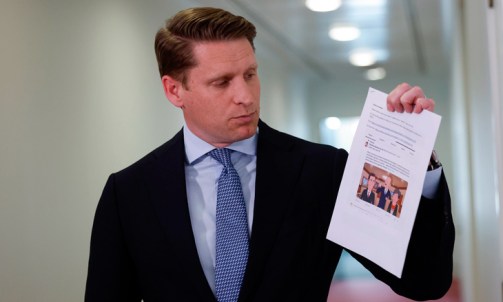
Albanese and Taylor often call this grievance.
For the Populists, it is reality.
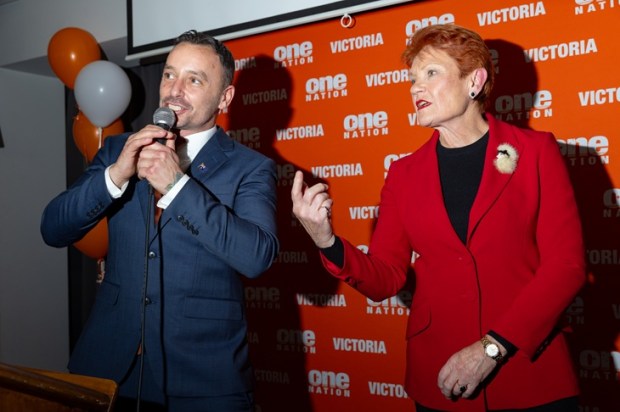
The tired and hungry cross political lines. It is not a clean left or right divide. This makes the problem difficult for a two-party system of government to understand let alone solve. The emergence of a third party and a third political ideology was inevitable. One Nation is a solution made necessary by a system error. Fighting One Nation doesn’t make the cause of its rise go away.
There is a way for the major parties to survive this, and it is astonishing to me that none of the high-paid geniuses in Canberra have worked it out.
As one of the hungry workers on Jim Chalmers’ diet, I have no interest in helping the people who stole my lunch.
Alexandra Marshall is an independent writer. If you would like to support her work, shout her a coffee over at donor-box.