‘The nonsense was over at last,’ wrote the Lithuanian-Polish poet Czeslaw Milosz in 1939, as a period of uncertainty gave way to the horrors of the second world war. Charlotte Higgins quotes these words at the beginning of Ukrainian Lessons, describing the outbreak of full-scale war in Ukraine after eight years of ‘local’ warfare in the Donbas and the annexation of Crimea. From the first pages of this profound study of the impact of war on culture, replete with life stories, the author places the Russo-Ukrainian conflict within the context of global cultural history and geopolitics. References to Rwanda in 1994 and the bloody events in Londonderry in 1972 are in no way out of place.
Artists, writers, musicians and filmmakers begin to perceive culture not only as a victim but as a weapon
Higgins, a celebrated arts journalist, took up her first Ukrainian assignment in September 2022 and found herself both ‘inside’ the war and inside Ukrainian culture, which, like everything else, had become the target of Russian drones and missiles. The same autumn she began taking language lessons online from a teacher living in Ternopil.
Her latest book is about Ukrainian culture, which is at war with Russian culture, and has regularly fallen victim to Russian imperialism. It is filled with the stories of artists, writers and poets whose voices I recognise, and is organised not in chapters, but in ‘lessons’, each with a date.
Higgins regards her experiences surrounded by such figures in the war-torn country as an education, something akin to a fascinating course of lectures during which you see artefacts at the precise moment that attempts are being made to destroy them. The way our attention is drawn to all manner of things that could disappear at any time makes Ukrainian Lessons far more than just another book about the war.
The title is significant. We get miniature language lessons – which create a rhythm and a vivid sense of Higgins’s involvement in the events she describes. But we also learn much from her conversations with the writers and poets she meets, who explain what the war is doing to the language and culture – how metaphors disappear and why literary experimentation, so familiar in peacetime, becomes an atavism. War inflicts pain on everything it touches. It is precisely this wounded reality that becomes the raw material of culture. Artists, writers, filmmakers and musicians begin to perceive culture not only as a victim but also as a weapon. ‘No metaphors work against a man with a machine gun,’ says the Lviv-based poet Halyna Kruk during one of her events. Then, in a conversation with Higgins, she adds: ‘I’m sorry that poetry doesn’t kill.’
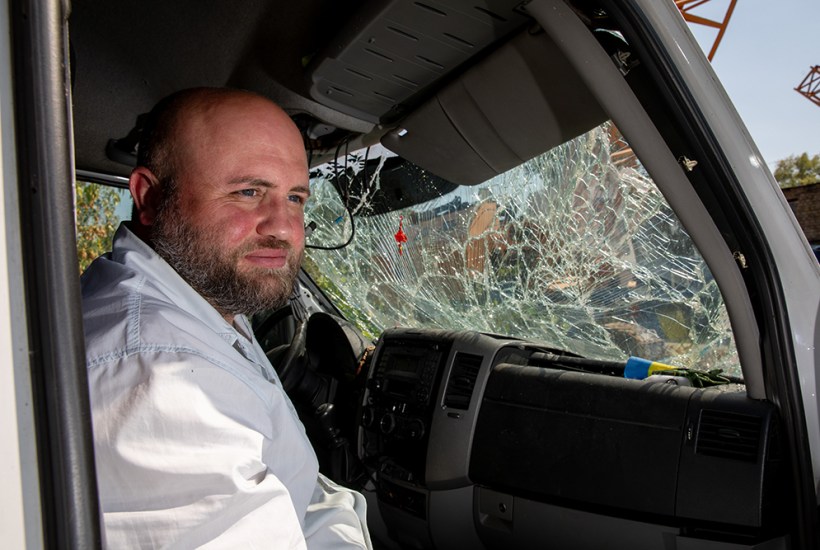
No matter how hard these people try to ‘arm themselves’, culture remains a victim of war. But its wounds encourage the most unlikely characters to rush to its aid. Among the many inspiring stories told here, those of the volunteers who rescue works of art and archives from war zones stand out. We hear of two friends, Leonid Marushchak and Arif Bagirov, who, without official instructions or permits, risked travelling 22 times to the besieged historic city of Bakhmut to retrieve treasures. Bagirov, a self-proclaimed former hooligan, entrusted his life to the more decisive Marushchak, who drove his wife’s Mini into places that had become mainly accessible only by tank.
On another perilous trip, having swapped the Mini for a more spacious Mercedes Sprinter, the two drove to the city of Lysychansk to save the contents of a small museum devoted to the Ukrainian poet Volodymyr Sosiura, including his hat. Higgins asks Bagirov whether he was afraid to die. He answers:
I told myself, ‘Listen, Arif, these are your last days. You might as well live them brightly. Make your death beautiful. And if I die for the sake of Volodymyr Sosiura’s hat? That would have been the most beautiful death of all.
This book is full of vibrant, energised personalities – the sort you don’t often meet in peacetime. They emerge against a backdrop of ruins, fires and death, which they ignore. The threat to Ukraine’s heritage is described with the urgency of a thriller. Ukrainian Lessons conveys a message from all the brave people Higgins meets – those still alive, and those, like the novelist Victoria Amelina, who did not survive to see its publication.
Got something to add? Join the discussion and comment below.
You might disagree with half of it, but you’ll enjoy reading all of it. Try your first month for free, then just $2 a week for the remainder of your first year.