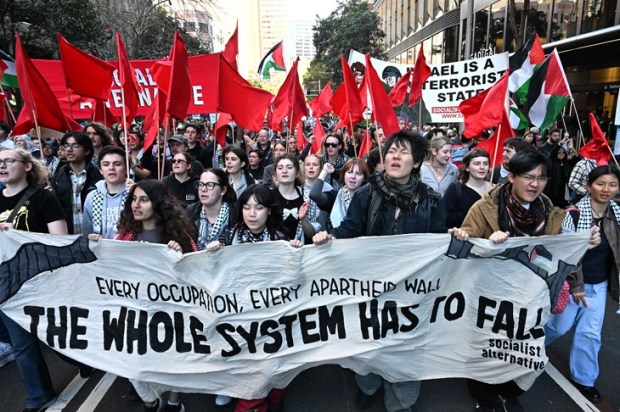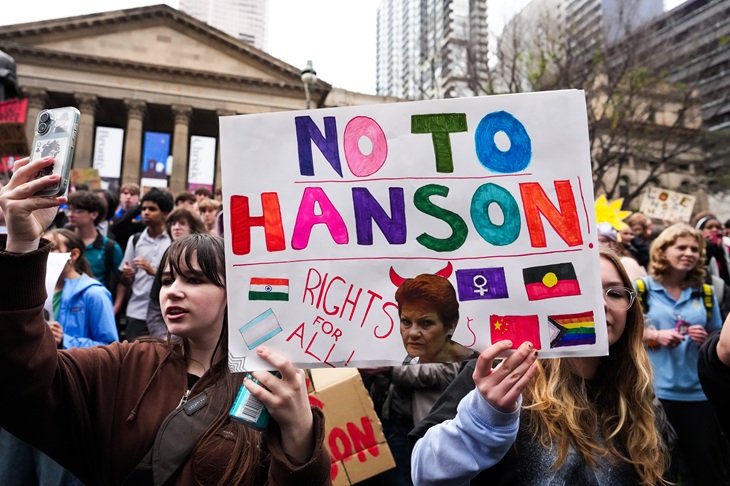
Last Thursday afternoon, thousands of Australian students walked out of classrooms in eight cities to protest Pauline Hanson.
High schoolers, who could not yet vote, joined university students who can, but rarely feel heard by the politicians on offer. Together they marched under banners reading: ‘Stand Up Against the Far Right’ and ‘Students Say No to Hanson’. The National Union of Students called the action. Barnaby Joyce blamed ‘socialist teachers’. Hanson herself, responding on X, suggested the students should instead be protesting the cost of living. For once, she may have stumbled into a point.
Not about herself. About energy. Specifically, about all that steam – and whether anyone has thought to build an engine for it.
The walkout has a precedent. In July 1998, thousands of students staged an almost identical national protest against Hanson, rallying in eight cities. By October, she had lost her seat. The lesson the organisers appear to have drawn is that mass truancy works.
One Nation’s primary vote has ballooned from around 8 per cent at the 1998 federal election to 26 per cent on the latest Roy Morgan, the party again leading Labor nationally. Repeating the 1998 playbook against an opponent three times the size is the political equivalent of bringing a slingshot to a siege. The tactic was designed for a fringe candidate on 8 per cent, not a movement polling neck and neck with the major parties. The price the students are paying (a missed afternoon of instruction) no longer buys what it once did.
Which raises the question The Spectator Australia’s headline writers will forgive me for lingering on:
If the students have that much energy, couldn’t they do something else with it?
Consider what they walked out of. Australia’s PISA mathematics scores have fallen from 524 in 2000 to 487 in 2022, a decline equivalent to roughly 16 months of lost learning. Reading scores dropped from 528 to 498 over the same period. The latest NAPLAN results show one in three students failing to meet basic standards of numeracy and literacy. These are not contested numbers. They come from the OECD and from the federal government’s own National Assessment Program. The students who filed out of maths class on Thursday afternoon to chant slogans were, in a very literal sense, widening a gap that is already alarming.
Or consider what they might have walked into. The Housing Industry Association estimates Australia needs to build 250,000 homes a year just to keep pace with demand. Last year it commenced 196,000. The National Housing Accord’s target of 1.2 million new homes by 2029 is already 81,000 dwellings behind schedule after its first 15 months. The reason is not mysterious. There are not enough tradespeople. Trade apprenticeship commencements fell almost 10 per cent in the year to September 2025. Vacancy fill rates for trades and technical roles sit at 54.3 per cent, well below the national average of 70.2 per cent. For every three trade jobs advertised, fewer than two are being filled. Jobs and Skills Australia projects a need for 195,000 additional trades workers over the next decade and 116,700 extra construction workers (a 25 per cent increase over business as usual) just to meet the housing target. Around half of employers say they would cut apprentice hiring without government incentives, and from January 2026 the federal government reduced those incentives for priority occupations outside housing and clean energy. The engine room of the economy is undermanned and getting worse. The steam, meanwhile, was out on the streets.
What is striking is how narrowly all that energy is directed. Virtually all of it is sunk into protest, virtually none into the productive bottlenecks the protesters themselves identify as urgent. Housing affordability? March about it. Cost of living? Chant about it. Skilled-labour shortage holding back the homes that would ease the cost of living? That, apparently, is somebody else’s problem.
The logic of the walkout assumes that populism is a cause. It is not. It is a symptom. The external pressure here is a system that does not deliver: housing people cannot afford, wages that do not stretch, services that do not work. The natural counteraction would be to fix those things. Instead, the chosen counteraction is to shout at the symptom itself, which relieves no pressure whatsoever and may in fact add to it. One Nation’s vote share has continued to climb through every round of activist opposition. The feedback loop is not subtle.
Anyone who has taught undergraduates (I have, for 30 years, across six countries) knows that political passion in the young is not the problem. Its direction is. A 17-year-old who walked out of a Brisbane classroom on Thursday could, by next July, be three months into a carpentry apprenticeship, earning a wage, learning on the job, and contributing directly to the housing supply that everyone on that march agreed was inadequate. A first-year engineering student in Perth could be acquiring the quantitative skills to design the energy infrastructure the country will need for the next fifty years. An apprentice electrician in Adelaide could be one of the estimated 32,000 additional sparks the clean-energy transition will require by 2030.
Instead, they carried placards. Which is fine. But a placard does nothing until election day, and the next federal election is not due until 2028. A trade qualification, by contrast, starts paying off from day one.
Rikkie-Lee Tyrrell, One Nation’s sole member of the Victorian Parliament, said students should be ‘focusing on academics’. Too narrow. The students marched against a politician whose popularity rests on a sense that the system does not deliver. They are right that it does not. But its failures are failures of capacity – not enough tradespeople, not enough housing, not enough of the skills a functioning economy runs on – and capacity is built by people who show up to classrooms, construction sites, and TAFE workshops, not to Thursday afternoon marches past shops they cannot afford to rent above, on streets they will one day struggle to find a tradie to maintain.
The NUS called Thursday’s walkout the largest collective protest against Hanson in recent memory. They are probably right. It was certainly the largest coordinated absence from classrooms in a country where one in three students already cannot read or count to standard. As demonstrations of energy go, it was impressive. As demonstrations of its allocation, it was something else entirely.
A housing market short 54,000 homes a year. A trades pipeline leaking ten per cent of its intake. A PISA ranking in long-term decline. And thousands of young Australians with more energy than they know what to do with, choosing to spend it on the one activity that addresses none of these things.
All that steam. And not an engine in sight.