Just two weeks ago I was ready to cancel my subscription to Apple Music. I’d stumbled across its ‘Composer Essentials’ – a list of 100 composers so significant that they merit their own curated playlists. It includes Bonds, Boyle, Caccini, Dawson, Dett, Perry, Poldowski, Sohy, Strohl and Walker.
If those names don’t ring a bell, how about the composers who are missing? Albeniz, C.P.E. Bach, Bellini, Berg, Bizet, Borodin, Chabrier, Kodaly, Martinu, Messiaen, Mussorgsky, Nielsen, Poulenc, Schoenberg, Walton, Weber and Webern.
See what I mean? The ‘Essentials’ list is stuffed with DEI hires. Which – an analogy with Cambridge University comes to mind – does no favours to the black and women composers who deservedly feature in it, such as Joplin and Beach. In what twisted alternative musical history does Bizet bite the dust, the whole Second Viennese School drop off the map and Germaine Tailleferre nudge out Francis Poulenc?
To cut a long story short, Apple’s Classical app is my new favourite toy
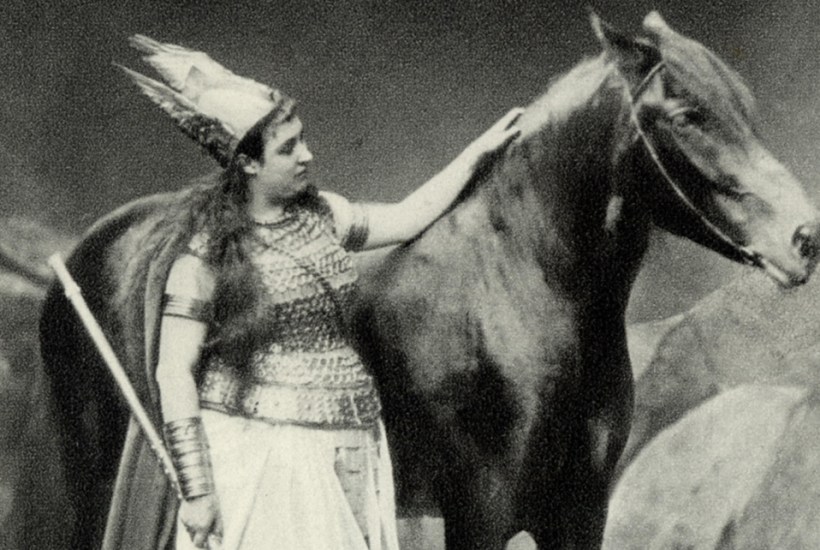
As I say, I was thinking of cancelling my direct debit. But then Apple Music announced that, to mark the 150th anniversary of the première of Wagner’s Ring Cycle, it has created a Listening Guide that ‘accompanies listeners through all 15-plus hours of Wagner’s drama via expert text-based commentary synchronised in real time to Sir Georg Solti’s legendary Decca Classics recording’. That’s 45,000 words of ‘moment-by-moment insights into the music, mythology, characters and ideas’.
Apparently there are already 200 synchronised guides. That was news to me. To be fair, it’s not the sort of thing you just stumble across. Intuitive it ain’t. Go to the Apple Classical homepage, choose ‘search’, and up pops a page of icons. The Listening Guide section displays the albums that have received the treatment; when you start playing a track, click the tiny treble clef at the bottom and, at last, you’re in.
As the music moves, so do the highlighted words. For example, in the first few seconds of a famous piano concerto: ‘Over a gentle murmuring accompaniment, the solo piano plays a simple, very singable theme in both hands…’ Run the text without the music and there’s a neat challenge for music buffs.
Anyway, you can understand why Wagner’s Ring would be perfect for a synchronised commentary – and also why it took a whole year to assemble. There are dozens of leitmotifs in the cycle; by the time we reach Götterdämmerung they’re in every bar, though they’re so beautiful that we scarcely notice. Alas, the score doesn’t name them, so Wagnerian trainspotters are always squabbling over whether one group of notes represents a curse or the renunciation of love, or at what point the Ring motif turns into Valhalla, and so on.
There are several rival lists out there, some running to nearly 200 entries and all guaranteed to bore the average listener to tears. On the other hand you can’t totally ignore the leitmotifs because they drive the story forward, often revealing things that you won’t find in the libretto. But blink and you’ve missed it – and, let’s face it, it’s easy to blink during what Rossini called Wagner’s mauvais quart d’heures.
Listening Guide to the rescue! The commentary kept me alert during the Norns’ moanathon in the Prologue to Götterdämmerung, after which comes my favourite moment in the whole cycle, beginning with Brünnhilde’s post-coital cry of ‘O! heilige Götter!’ Here’s Apple’s description: ‘The descending Siegfried’s Missions motif and Brünnhilde’s new Love motif are rapturously combined… The salutes become a duet at last: they greet each other, culminating in a top C for Brünnhilde.’ That’s precisely the right level of detail, and my iPad served it up without prompting, allowing me to forget the fatuous libretto. Needless to say Birgit Nilsson hits that C like a laser and Solti whips up the Vienna Phil into a frenzy as it spurts out ‘an orgiastic treatment of Siegfried’s harmonised Horn Call’. Ooh, missus!
To cut a long story short, Apple’s Classical app is my new favourite toy. I can’t wait to use the simultaneous commentary on the Goldberg Variations: I’m embarrassed to admit that, after decades of listening, I routinely mix up canonic and non-canonic variations. Likewise, I still need extra tuition to show me where Mahler begins his development sections.
But, see above, Apple still subscribes to bien-pensant fantasies. Will it waste its new superpower? I wonder if some hard-up music critic has been dragooned into writing a simultaneous commentary for, say, a symphony by Louise Farrenc (1804-75). Imagine if, instead of the prescribed gushing, the text told the truth: ‘Here the composer switches on the autopilot as she glides towards the home key and a derivative coda…’
On second thoughts, let’s not go there. I’ve just remembered which company manufactured, and can presumably peer inside, the computer on which I’m typing these words. So… guide my listening, Apple!
Got something to add? Join the discussion and comment below.
You might disagree with half of it, but you’ll enjoy reading all of it. Try your first month for free, then just $2 a week for the remainder of your first year.