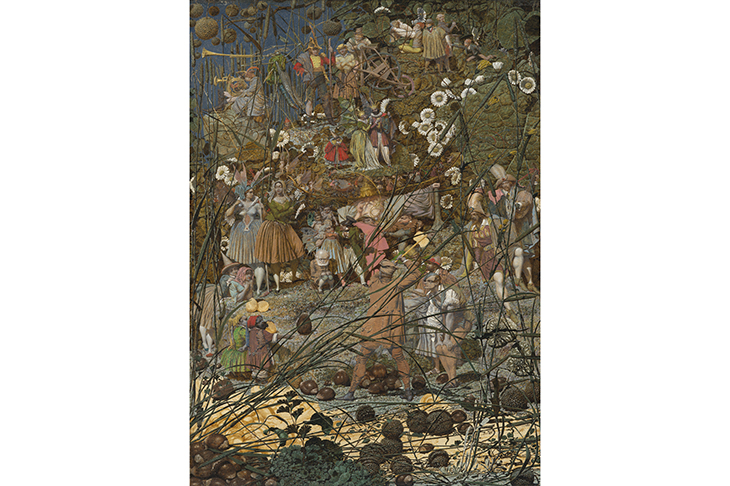
No one paints fairyland like Richard Dadd (1817-86). In ‘The Fairy Feller’s Master-Stroke’, 1855-64, he reveals a teeming congregation of tiny folk, summoned by a dragonfly trumpeter, marshalled by a pompous chamberlain no bigger than a daisy, all gathered in the presence of Merlin (dead centre) to witness a macho fairy break a hazelnut with an axe. The shell will serve, of course, as Queen Mab’s chariot.
And yet the scene isn’t cute. By placing the shiny bald pate of a frightened gnome a jot too close to the swing of the axe, the artist suggests the fairy feller might break that nut instead. Dadd is like a Victorian Hieronymus Bosch.
The fabled painting was donated to the Tate by Siegfried Sassoon in 1963 in memory of his friend Julian Dadd, the painter’s great-nephew, and his two brothers, all killed in the Great War. It also went on to inspire a song by Freddie Mercury.
For 42 years, Bethlem and Broadmoor were Dadd’s prison, home and studio
I eagerly signed up for the press preview for Dadd’s forthcoming Royal Academy show, then looked twice at the address. It was the Bethlem Royal Hospital in East Croydon, a working psychiatric hospital, the modern incarnation of Bedlam, which relocated to suburban south London in the 1930s. I discovered it to be a spacious, welcoming campus. Alongside secure areas, there’s a café, a gallery and the Museum of the Mind, which holds the Dadd archive.
Dadd murdered his father during a psychotic episode in 1843, and was committed to permanent custody without trial. For 42 years, Bethlem and Broadmoor were his prison, home and studio, and the wardens his substitute family, who often cherished his work. The compassion with which he was treated gives one hope.
At Bethlem Hospital I met the infinitely patient, clever Nicholas Tromans, a working NHS probation officer, Victorian art scholar and Dadd specialist, author of The Artist and the Asylum (2012). There could scarcely be a better qualified person to curate this landmark survey, which engages frankly with the psychiatric background.
‘Dadd used to be considered an outsider artist, but he was the opposite,’ says Tromans. His father was a gilder of frames for artists based on Suffolk Street, off Pall Mall, and David Roberts, the painter of grand Egyptian panoramas, was a family friend. Dadd became a prize-winning student at the Royal Academy, with the best record of attendance. His friendship group, ‘The Clique’, included Augustus Egg and William Powell Frith. Dadd made high-flown paintings of scenes from Shakespeare: a goggle-eyed Hamlet who can see his father’s ghost; Ariel’s mob footing it featly in ‘Come Unto These Yellow Sands’ (1842). They were praised in the press as both sublime and silly; Dadd was already a brilliant but, as Tromans puts it, ‘unstable compound’.
Hereditary schizophrenia is often brought on in the late teens and early twenties by a period of stress. Dadd signed up to work as the official artist on a thrilling but very intense journey, a Grand Tour that extended into the Holy Land, Egypt and Syria, led by Sir Thomas Phillips, lawyer and former mayor of Newport. There was little time for Dadd to record the endlessly stimulating scenery. ‘All seemed to slip away from me as if unreal,’ he wrote to Roberts, ‘and yet I do not think that I am much to be blamed, for a body can’t very well sketch riding on horseback.’
He drew many beautiful, jumbled impressions, often unsure where he was. At first his companions thought he had sunstroke. In the Vatican, he told them he had seen the Devil inspecting the pictures, in the form of an old lady wearing lavender silk. His later painting, based on memories of the trip, ‘The Artist’s Halt in the Desert’ (c.1845), shows clouds above the travellers drifting into the form of a bearded magus. Dadd alienated Sir Thomas by praising paganism over Christianity. On return to London in 1843 he was noticeably mentally unwell, but working hard on the paintings he owed Sir Thomas, with results Frith described as ‘sluggish’.
That summer he watched the stars for a sign, and then committed his terrible crime, stabbing his father in a premeditated attack while they walked side by side in Cobham Park in Kent. Asylum notes from 1877 describe how Dadd then posed ‘(with upstretched arm), thus apostrophised the starry bodies, “Go,” said he, “and tell the great god Osiris that I have done the deed which is to set him free.”’
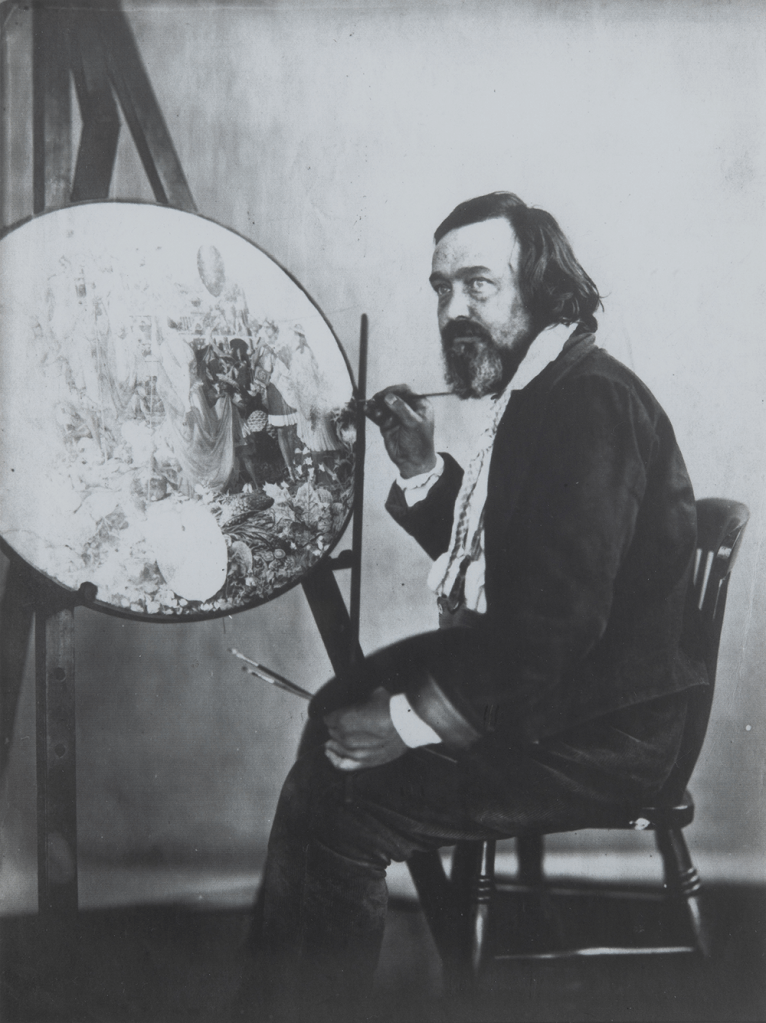 ‘Portrait of Richard Dadd’, c.1857, by Henry Hering. Bethlem Museum of the Mind. Alex Fox (Roy Fox Fine Art Photography)
Apprehended on the run in France after nearly stabbing a passenger on a train, he was extradited home. In the criminal wing of Bethlem – a building that is now the Imperial War Museum – he was allowed to paint using materials his family sent him. No notes were kept on him for his first ten years of incarceration. ‘Then Bethlem was put in special measures,’ notes Tromans, ‘and a new resident superintendent physician arrived, Dr William Charles Hood.’ Hood was an active reformer, dividing those who had committed crimes prior to becoming unwell from those whose crimes were a result of illness, such as Dadd. Hood granted Dadd access to books and periodicals so he could keep up to date on art, decorated the asylum’s walls with prints and sculptures, and reignited Dadd’s interest in Shakespeare. Tromans thinks Hood is depicted in Dadd’s peaceful, airy ‘Portrait of a Young Man’ (1853).
‘Hood wanted him to be a success,’ he says. ‘He allowed journalists to come to see Dadd at work, he encouraged art shops to donate to him when his family stopped sending materials…’ (Two of his siblings were also hospitalised with mental illness.) ‘…and when Dadd was working on his great painting of Oberon and Titania, “Contradiction” (1854-8), Hood had that memorialised by Henry Hering [see below], the top portrait photographer of the day.’ Dadd was prevented by law from profiting from his work, which was not allowed out of the hospital. But it was surely inappropriate that Hood, Haydon and other physicians close to Dadd personally owned a great many of his works, and their estates eventually swelled with the proceeds.
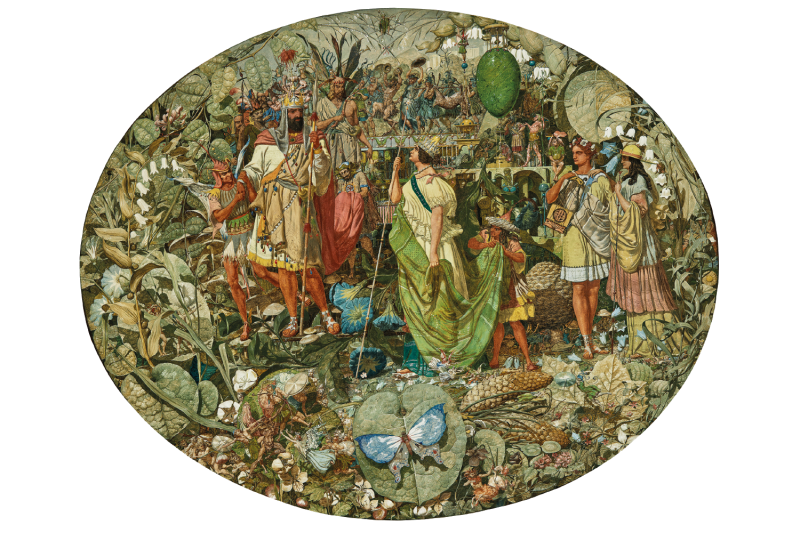 ‘Contradiction: Oberon and Titania’, 1854-58, by Richard Dadd. Photo © David Parmiter
Dadd’s case notes, written in a Victorian hand, explain that he was good company but suffered from bulimia and made impulsive aggressive attacks, for which he would later apologise. His sensation of passivity – he felt he was merely the ‘cat’s paw’ working at the behest of spirits – is a known symptom of schizophrenia. So is the jumbled thinking in his rambling poem ‘Feller’s Master Stroke’ (1865). And yet it does show acceptance:
Dadd became a prize-winning student at the Royal Academy, with the best record of attendance
And they close their eyes, that gate –
By which reminders enter.
And in a paradise of fools contented live.
The notes exhibit a watch-and-wait approach. ‘No change.’ ‘No change.’ ‘No change.’ Food, rest and occasional opiates were the only remedies of the time. An essay in the exhibition’s catalogue by Professor Richard Howard explains that while Dadd was spared the ineffectual therapies such as insulin coma or frontal leucotomy of the early 20th century, the breakthrough discovery in 1952 of chlorpromazine would have meant that if treated today ‘it would be reasonable to anticipate that he would be out of hospital and living in unlocked supervised accommodation within five to ten years’.
In the Bethlem studio and gallery, I saw stunning work by artists who are current or former health-service users, such as Daniel Regan. These artists are supported and their work celebrated, and sold on their behalf. The long road to honouring their output probably started with Dadd.
Clearly, when he was in prison, Dadd’s imaginative freedom replaced physical freedom, and the lack of time that was so acute during that fateful, rushed Grand Tour was replaced by acres, oodles, vast yards of uninterrupted time, with a single painting sometimes taking eight years to complete. His work is often beautiful, but the menace of weaponry and tortured thinking is horribly present. ‘He’s funny, he has a sense of wit, he undermines himself a lot,’ says Tromans. ‘It’s why I’ve kept going with him.’ Tromans feels Dadd lacked the ability to relate to another person. I closed by asking if he felt Dadd was remorseful, but I was unprepared for the stark answer: ‘No.’
Got something to add? Join the discussion and comment below.
You might disagree with half of it, but you’ll enjoy reading all of it. Try your first month for free, then just $2 a week for the remainder of your first year.