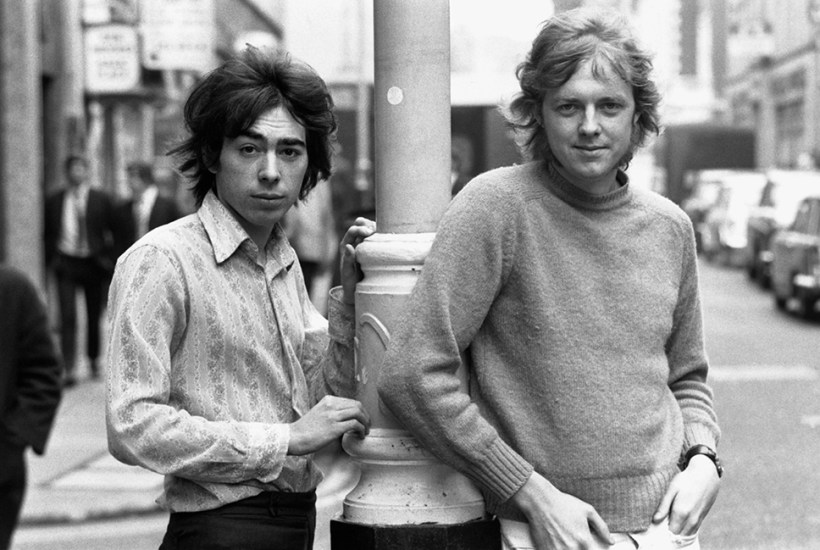
Jesus Christ Superstar is returning to the West End at the Palladium, the theatre owned by its composer. It probably wasn’t too difficult for the show to obtain the booking, but I’m glad to say that the work has continued to be performed all around the world in myriad versions, in many languages, even in venues Andrew does not own, since he and I wrote it in 1969-70. It was our first real success and, like many artistic endeavours, was initially rejected out of hand by almost everyone of any importance in the theatre world. Christianity is 2.5 per cent older now than it was when we finished writing it, and almost 5 per cent older than it was when I first became intrigued by the roles mere mortals played in the Jesus story, courtesy of Eagle, the revolutionary postwar comic for boys. Christianity seems to be hanging in there although Eagle, sad to say, is no more.
Because of the lack of West End enthusiasm, we accepted what we (very) briefly thought of as better than nothing – a deal with MCA-UK, then the new London branch of the giant US entertainment corporation. A 45 r.p.m. vinyl single of the title song ‘Superstar’, sung by Murray Head (who had let me sing a song or two at a May ball with his excellent band, the Blue Monks) was released and promptly flopped in our home country. This was annoying because it almost certainly meant MCA would not follow through with the album of the entire show.
However American radio began playing it and the single lurched up the Hot 100. Then it took off in Holland, Brazil, Australia – almost everywhere but home. MCA gave us the go-ahead to record the entire work, which occupied us for most of 1970. I recall it being a very hot summer, certainly in the magnificent Olympic studio in Barnes. We roped in a fine selection of contemporary rock musicians and singers, many pals of Murray, some established names such as Ian Gillan of Deep Purple, the members of Joe Cocker’s Grease Band, Mike d’Abo, late of Manfred Mann and some wonderful unknowns such as Yvonne Elliman. The album, frankly, was pretty good, and despite virtually nil interest in the UK it shot to No. 1 in America. Suddenly everyone there wanted to put on the show. Robert Stigwood got the nod and, as a huge fan of his major act, the Bee Gees, I was thrilled. The first professional performance of anything Andrew and I had written opened at the Mark Hellinger Theatre on Broadway in October 1971. Our previous effort, Joseph and the Amazing Technicolor Dreamcoat, had at that point only been seen by reluctant parents at school concerts.
The rest is history and, like many success stories, not wildly interesting. But 57 years after I was inspired to change its name by an advert in Melody Maker, which stated that Tom Jones was the world’s No. 1 Superstar (Jesus Christ Superstar was a better title than our original plain Jesus Christ), I remain grateful and bewildered by the musical’s continued success. Of course it has great tunes and it established rock in musical theatre, which now dominates. Whether or not we should be proud of that I’m not sure – actually, I am…
Hair was the show that first brought rock to Broadway and has one of the greatest scores of any musical written in my lifetime. But, disgracefully, it hasn’t remained a regular Broadway or West End staple, possibly because it doesn’t have a strong story, although many witty mini-tales of the hippy-dippy culture are celebrated superbly. Story is King. Whenever I am asked to waffle at schools or to ambitious young writers about musicals this is the most important advice I can give: choose a great story – it’s even more important than the music or lyrics (annoyingly). It doesn’t have to be a well-known story. We were told that Superstar wouldn’t work because everybody already knew the story, and when working on Evita I was told it wouldn’t work because nobody knew the story. But they were both great tales which inspired wonderful music and the odd line in the Oxford Dictionary of Quotations.
On another theatrical matter, I am getting more and more incensed about the lack of a West End theatre named after Lionel Bart. Oliver! returned recently to Shaftesbury Avenue and was a huge success. Blitz and Fings Ain’t Wot They Used T’ Be are two other Bart shows of genius. Plus he wrote a string of great pop standards for the likes of Cliff Richard, Tommy Steele, Shirley Bassey, Matt Monro, Anthony Newley, Mark Wynter and Adam Faith. Now who do I know who owns a theatre?
Got something to add? Join the discussion and comment below.
You might disagree with half of it, but you’ll enjoy reading all of it. Try your first month for free, then just $2 a week for the remainder of your first year.