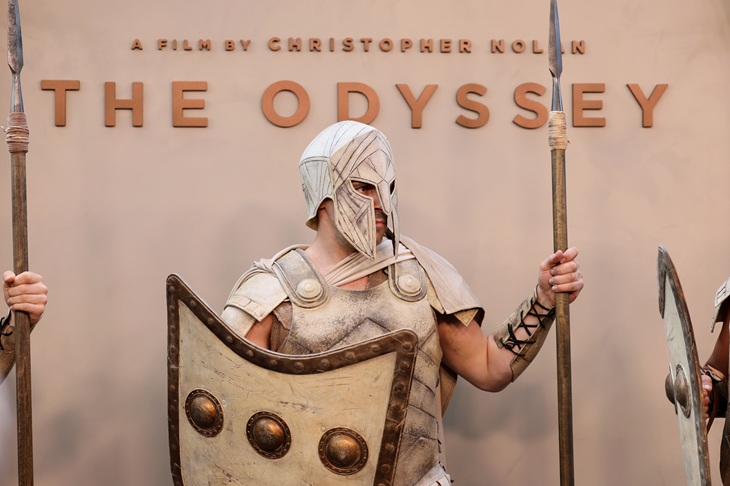
The temptation to review The Odyssey is strong. Stronger still is the temptation to wail about the casting, the incorporation of rap, of modern themes overpopulating the film: what amounts to provocation.
But this is to fall into an obvious trap.
When your history is in the hands of your enemies, nothing pleases them more than to cast you as the iconoclast and themselves as the victim. Desecration from a position of power invites combat on uneven ground, on terrain of the opponent’s choosing, a baited ambush that invites moral inversion.
It is better to accept what Hollywood is – without pretending it is good – and look at what it says, in spite of itself.
A story about ancient myths will collect modern myths in the retelling. The most obvious of these is post-Enlightenment universalism, that everywhere and for all time people are the same. Thus, cast anybody in any role: people are but clay. It serves to remind that the canon is nobody’s in particular. This was among the nobler intentions of our deceased outward-looking civilisational ethic – unshakeable confidence that the telling of our stories spoke to total truth – that led to disastrous consequences. It followed that our homes, and in fact anything else, is no longer anybody’s by right.
The Odyssey has survived reinterpretation before. A muddling of Greek xenia and Christian morality is excusable because this is what Western thinkers have been doing for two thousand years. St Basil the Great implored us to be like the bee, taking the honey; the cry that ‘great Pan is dead’ that rang out in the reign of Tiberius was interpreted as the implosion of the old pagan world, that would become the Christian world. It is impossible for us, even while we might regard ourselves as post-Christian, to properly inhabit the ferocity of the pre-Christian world, where Odysseus sacked the Cicones on his way home and carried off their women as lawful prize.
Yet The Odyssey, by virtue of its source material colliding with modern sensibilities, accidentally reveals Poseidon’s gale, blowing our own civilisational ship from one sea into another. It is difficult not to view Odysseus’s trials with envy. We wonder what men we might become in the face of such things. Many today live and die with their courage untested. Nicolás Gómez Dávila said that the tragedy of modern man is not that he is mediocre, but that he imagines he can be anything but mediocre. Layers of dependency deny us Achilles’s choice as offered by Thetis: there is no glory to be found in the monochromatic modern world.
The divine is gone, a mere hallucination, explained away as Jung’s archetypes butting against the conscious mind, or simple schizoaffective disorder. But the monsters remain.
Therapy is one answer because the dominant vocabulary of journeying today is therapeutic, and an inward one. This is not the inward journey of classical thinking, but largely a self-serving one. It is less adventure and more navel-gazing. Seven years with Calypso led Odysseus to forget his duty, to dissolve himself into the chthonic feminine; to eat opiates to restore his ruined mood, because man today above all else wants to feel fine even while his home is on fire. Odysseus must eventually return to the Penelope who waits from the Calypso who keeps. If it is uncomfortable, it is because the old readings of man are still accurate: that the heart is deceitful above all things, that virtue and aristeia are painful, are overcoming, not reassurance and patting ourselves on the heads. Classical introspection exists in order to orient action; modern introspection serves as an end in itself.
Most modern thinking is about evading things or acquiring things. The Odyssey is concerned not with fulfilment, but return.
What is remarkable is that Hollywood dared tell this story at all.
An age that says everywhere and nowhere is home makes a film about homesickness, about going home, home as the particular; home only dimly remembered. It is a story about a man who must disguise his intentions and truest self, amidst his own inheritance; who is reduced to beggary in his own home, a home changed out of recognition. An age that welcomes strangers repeats a story about hospitality gone badly wrong, to everybody’s detriment. Fidelity to the old world is represented by a man with no eyes – who has gone blind – an impotent youth without the means to restore his home, and a woman who, while nominally in command, can exert no muscular power and is harassed by illegitimate squatters. She waits for the masculinity required to restore things. She is as lonely – at home but not at home, the mirage of power no comfort – as Odysseus, who is far away and uncertain. The virtues suggested are not tolerance, nor self-effacing public humiliation rituals, nor an inward therapeutic journey calming storms we would rather forget, nor gender myopia, nor egalitarianism. The casting only makes this more apparent.
Many suitors are outsiders, bound by laws of hospitality, who eat the feasts they never toiled to gather, drink the wine they never trod. But many are also insiders, scions of Ithaca’s noble houses, whose de facto rule is illegitimate. Today’s world imagines legitimacy as expertise, procedure, institutional authority: justifications as amorphous and unknowable and opaque as the wine-dark sea. These would-be suitors are like the Britons after Rome left, who cannibalised the old stone walls to furnish their own paltry dwellings, to make their own ersatz glory from the departed genuine article. Their ethic is entirely acquisitive and consumptive; not once is the stewardship of Ithaca considered, its defence. Ithaca is mere grab-bag, the satiation of appetite at another’s expense; plutocracy. In the end, those suitors drown in their own blood, when home is properly remembered.
The film is about the anxiety at the end of an age. It was not the sacking of Troy but the men who lost their way afterward that doomed it.
So, it is with today. To remember who we are; that is the challenge thrown down by films like this, made by those who would prefer we eat lotuses forever and let the years lay us waste. Ungrateful suitors who overstay their welcome should worry.