Telling stories
Sir: As a filmmaker by training and a marketer by profession, I couldn’t agree more with your leading article (‘Northern soul’, 27 June) on the absence of narrative in our politics. The appeal of figures such as Burnham and Nigel Farage lies in the storyworld they build around themselves – be it via pints shared down the pub, off-the-cuff honesty, or a Monty Python line landing in the Commons. But the PM who stays the course, as any brand-builder learns the hard way, must know two things: their own story, well enough to tell it plainly; and the people they speak to, well enough for them to make it their own. Aim a dull narrative at everyone and you reach no one; tell a story worth sharing and both left and right will see themselves in it.
Jon Stanford
Bullfinch Digital, Shrewsbury, Shropshire
Starmer’s musicality
Sir: You unfairly attack Sir Keir Starmer for allegedly lacking a hinterland and his inability to name a favourite book. Apart from football, his hinterland is music and he has had no difficulty in naming favourite composers, in particular Beethoven for his symphonies and ‘Emperor’ piano concerto. His musical taste was nurtured by his father and by playing violin, piano and flute in his youth (he attended the Guildhall School of Music as a scholar). Incidentally, the more widely read one is, the more difficult it can be instantly to name favourites.
David Woodhead
Leatherhead, Surrey
Multivarious modernism
Sir: Calvin Po attended a conference about traditional architecture named in honour of James Stevens Curl (Arts, 27 June). When I reviewed Curl’s last book on these pages some years ago, I found it notably ignorant. He perpetuated a misunderstanding that undermines all serious attempts to get better building design in this country. This is that ‘modernism’ is a monolithic, monocausal entity. In fact, it was – and remains – very various, as anyone familiar with the work of Carlo Scarpa, Louis Kahn and even our own James Stirling knows. As Gustav Mahler observed, tradition is not about worshipping the ashes, but of tending the flame.
Stephen Bayley
London SW8
China crisis
Sir: Otto Saumarez Smith rightly refers to the cross-global give-and-take of china manufacture (Arts, 27 June). For years, Chinese and Staffordshire manufacture operated in separate universes, but economic changes in the 1990s changed the model. Successful English companies saw the Potteries as a centre for design and brand management, and the Far East as their supplier. The secret was to create wares that projected Englishness to consumers across the globe. The Moonlight Rose pattern, launched in 1987 and made in Doulton’s Royal Albert factories, was uniquely English in taste and chosen for exhibition by the V&A. It became an international bestseller but rising UK manufacturing costs required high-quality overseas manufacture. Royal Doulton saw the need for change but its initiatives were blocked by shareholders. Management reverted to being little Englanders and the company imploded.
Stuart Lyons
CEO Royal Doulton group, 1985-97
London SW10
Knickerless monastic
Sir: Charles Moore reminds us of Monsignor Gilbey’s coolness in making his way to his club, wearing his soutane and a saturno, as the sun bore down (Notes, 27 June). Two summers ago, I attended High Mass at Buckfast Abbey in Devon. The weather was broiling. Before Mass, I was introduced to a visiting abbot of a community who had educated me many years ago. Wearing my linen jacket, I sympathised with the abbot robed in his heavily embroidered vestments, mitre and all, asking how he remained cool. Winking unabashedly at me, he answered: ‘It’s really no problem, I go commando.’ Gloria in excelsis Deo.
Nick Crean
Stanton St Bernard, Wilts
Saddle up
Sir: Melissa Kite (‘Herd mentality’, 27 June) rightly expresses concern over the proposed reduction in the number of Dartmoor ponies grazing on the moor. As far as the law goes, ponies and horses are not classed as agricultural animals, though Natural England (as a government agency) can no doubt make any decision it likes. As Melissa suggests, selling the ponies for meat is one practical solution, though we are culturally averse to the idea. The other would be to encourage more riding for children. Where are local pony clubs in this? Native breeds make ideal mounts. City riding schools which recognise the many benefits of riding could play some part. All need not be lost.
Marian Waters
Pebworth
A drop and standards
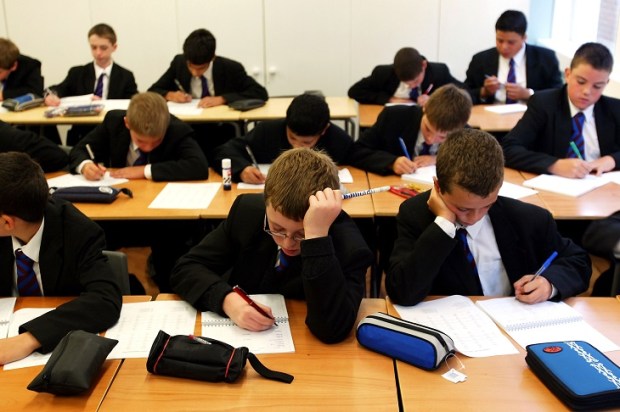
Sir: Richard Madeley regrets the demise of drinking among those working in the media (Diary, 27 June). Workplace boozing was not confined to journalism, though. In 1983, I began to teach at one of our leading independent schools and learnt that its most important building was the Masters’ Common Room, at the heart of which was the bar – a smoky and irreverent enclave where pressing issues were discussed. It was here that some of the most distinguished masters lurked, sipping Scotch, playing bridge and chain-smoking, while pondering the vicissitudes of life.
Far from being a problem, this free-booting culture seemed to enhance pupils’ prospects. Each year, the school’s A-level results were among the best in the land, with scores of boys going to Oxbridge. In education, such bacchanalian practices are long extinct. But as to whether the brightest pupils are best served by teachers with no access to beer, wine or spirits at break and lunchtime remains a matter of debate.
Richard Kelly
Nant Mawr, Flintshire
Dental aberration
Sir: Charles Moore’s boyhood fears of dentists (Notes, 20 June) reminded me of an amusing run-in I had with a dentist. At the time, I contributed a roundup of local hockey matches for BBC Radio Sussex’s Saturday sports programmes. One week there had been a surprise result for which the losing captain blamed the umpire’s bad decisions, and I made a brief reference to this. Two days later, as my dentist was about to start drilling my tooth, he revealed he was that same umpire. Fortunately I wasn’t made to suffer, but I’ve never criticised an umpire or referee in public again.
David Bennett
Hove, Sussex
The open road
Sir: From rural Stirlingshire, I can confirm that Charles Moore’s analysis of the roads ‘not’ closed ratio is spot on (Notes, 27 June). In fact one closure was so efficient that the road had already reopened before the signposted time of the closure. As for ‘CATS EYES REMOVED’ signs, the upside is that the field mice are delighted.
W. McCall
Stirlingshire
Got something to add? Join the discussion and comment below.
You might disagree with half of it, but you’ll enjoy reading all of it. Try your first month for free, then just $2 a week for the remainder of your first year.