It’s a noble story of one man struggling against monstrous odds, valiantly captaining his crew while trying to avoid being skewered and striving to reclaim his crown. Welcome to the chronicles of Christopher Nolan and his hubristic film adaptation of the Odyssey.
Will Nolan’s Odyssey make us feel – as Keats did when reading George Chapman’s translation of Homer – like some watcher of the skies when a new planet swims into our ken? Or will it be a thundering, 172-minute disappointment? Being a cinematic endeavour, the film should be judged more on its visuals than its script. And on that front, Nolan is pitting himself against a 2,700-year history of artworks depicting Homer’s epic.
Being a cinematic endeavour, the film should be judged more on its visuals than its script
The oldest extant depiction can be found on the neck of the Eleusis Amphora, painted around 650 BC, showing Odysseus and his men blinding the cyclops Polyphemus. Like other early depictions of Odysseus’s ten-year homeward journey it focuses on an action-packed set piece; elsewhere we get his travails with Scylla, Charybdis, the Sirens and Circe. Dramatic spectacles like these were ideal for vase painting, where forms were blocked out in silhouette and the inner details marked with incisions rather than the fluid line of a brush. Within these constraints, simplicity was paramount.
What got left out in these images were all the many nuances of psychology and motivation that make up the Odyssey. As anyone who has read it will know, the work is a copious and complex poem, stuffed with descriptions of things that can never be seen. How do you visually represent these non-visual subtleties? Polygnotus, one of the world’s first great painters, offered a solution. In his mural of Odysseus’s journey to the underworld at Delphi, he insinuated characters’ inner personalities in sophisticated choreographies of gesture, facial expression and pose. The painting marked a turning point in the history of figurative art because it showed artists how to unveil an otherwise invisible quality.
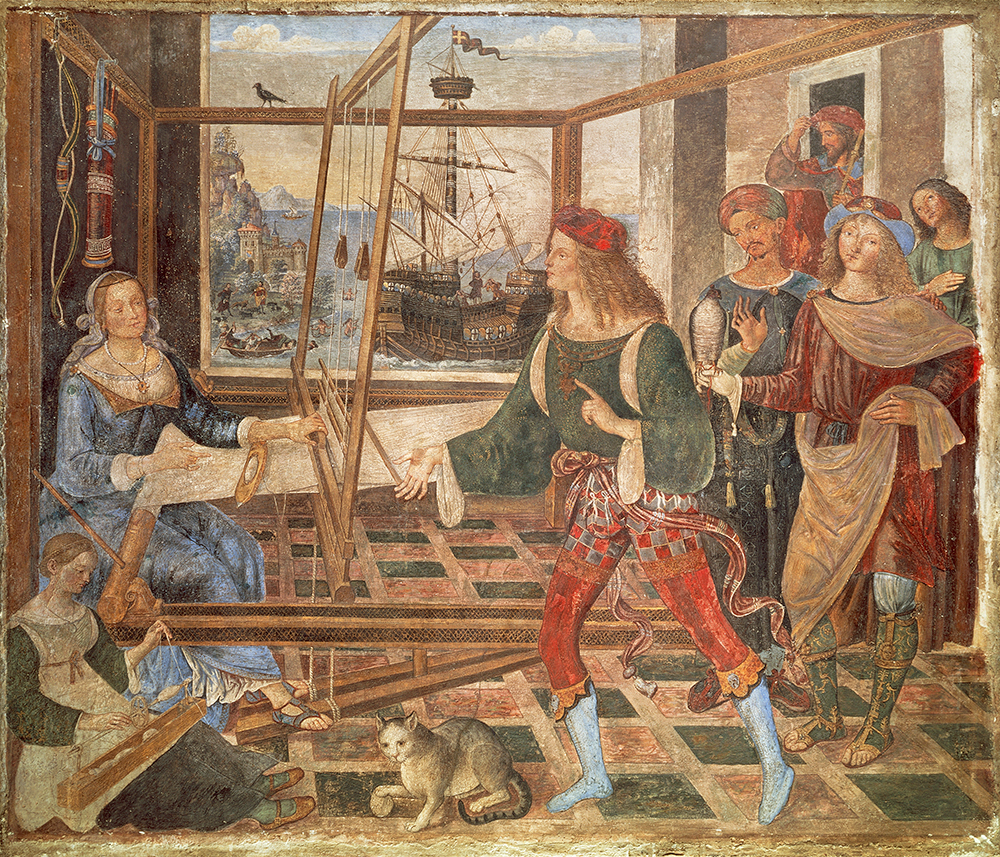 ‘Penelope with the Suitors’, c,1509, by Pinturicchio. [Image: DeAgostini/Getty Images]
But other strategies were available. Watch how nature becomes the leading character in the Casa di via Graziosa fresco cycle that now hangs in the Vatican Museums, painted in the first century BC. Yet again we encounter a dramatic centrepiece, where a team of gangly man-eating giants, the Laestrygonians, pound Odysseus’s ships to smithereens. But here the landscape dominates the action. Nature is the star, the force that human affairs must bow down to, echoing divine will.
Apollonio di Giovanni’s ‘The Adventures of Ulysses’ (1435-45) was originally made to decorate the side of a marriage chest and, rather than isolate a single telling episode, we get the whole story in beautiful and continuous narrative flow. Here we find all the principal characters decked out in Renaissance outfits, Odysseus in a magnificent gold suit. Then in the lower right-hand corner we see Nausicaa, the young seductress who discovers a shipwrecked Odysseus in Book VI, and offers him hospitality. It converts the poem into a tale of escape from sexual temptation towards monogamous virtue.
In Pintoricchio’s ‘Penelope with the Suitors’ (c.1509) several episodes are cunningly compressed into a single scene. It offers the viewer a puzzle. We are in Penelope’s room in Ithaca, where she is constructing her tapestry. The suitors who seek to take her husband’s throne have been promised that she’ll marry one of them once her weaving is complete. Every night, however, she unpicks her day’s work. Pintoricchio has arranged the tableau so that the loom itself frames a view not only of Odysseus’s ship, but also of his earlier misadventures with the Sirens and Circe. And in the foreground, the culmination of the Odyssey: our hero returned home in disguise to reclaim his throne and his wife. But which of the visitors is our Odysseus? Pintoricchio has hidden him away, secreted him among the suitors, stumbling through the doorway, holding a traveller’s staff.
J.M.W. Turner’s ‘Ulysses deriding Polyphemus’ (1829) offers a wide shot of the action. Having blinded Polyphemus and led an audacious breakout from his cave, Odysseus races to his ship and taunts the cyclops as he sails to freedom. Yet none of this stirs Turner as much as the gauzy effects of light patchworking the Sicilian shoreline in ripples of gold and lemon. But look closer and you will see the mythic creatures peppering the scene. A recumbent Polyphemus lolls on the mountaintop above the ship, phosphorescent sea-nymphs parade in front of the ship’s bow, and Apollo’s horses rear around the sun. Turner’s vision of the Odyssey is every bit the romantic fantasy. Forget plot details and moral messages, the painter evokes a transcendent journey into the unknown through a manipulation of composition, colour and light.
For Victorian painters such as John William Waterhouse, the Odyssey was probed for its tales of conflict between the sexes, where a noble hero is forced to contend with femmes fatales. His ‘Ulysses and the Sirens’ (1891) is constructed every bit like a still from a movie, camera slightly elevated and close to the action. Unlike previous versions of the story stretching back to antiquity, the terror of the high seas and the menace of homicidal monsters are less of a threat than feminine seduction.
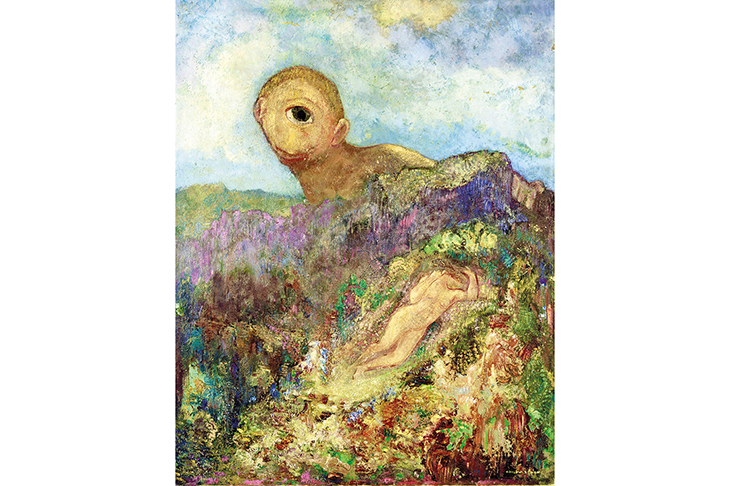
Even more of an erotic charge pours forth from Odilon Redon’s ‘The Cyclops’ (1914), Polyphemus’s phallic head and shoulders shown peeping voyeuristically over a clifftop at the supine Nereid Galatea. We are almost tempted to pity Odysseus’s tormentor, cursed to live alone with his ugliness and animalistic instincts. He’s not a predator in Redon’s imagination but a victim of unrequited lust: his oversized eye fuelling his sexual desire, but his ungainliness making its realisation an impossibility.
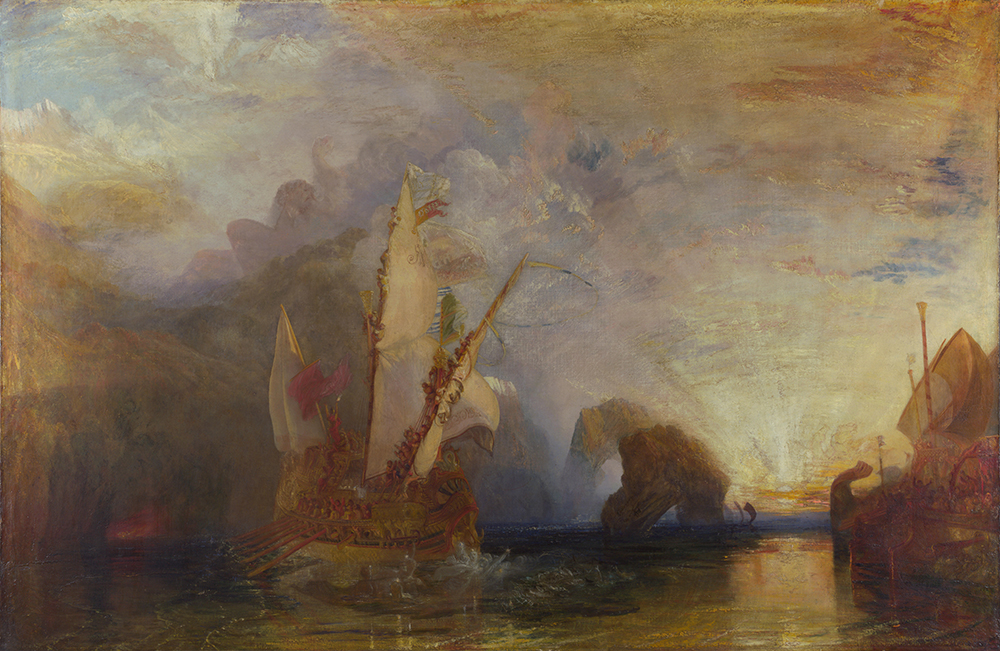 ‘Ulysses deriding Polyphemus’, 1829, by J.M.W. Turner. [Image: Fine Art Images/Heritage Images/Getty Images]
You can establish something of Redon’s intent from his 1878 statement about Gustave Moreau’s ‘Phaéton’: ‘I defy you, if you have entered for one instant the cold vaults of the academic temple, to find there a mind that rejuvenates antiquity in this way, with such an entire liberty.’ Redon’s liberation from antiquity’s vault pilots us through a dreamscape in which the imagination rides triumphant over accuracy.
Which brings us back to Christopher Nolan’s film. I’ve already bought my overpriced ticket and joined the throng of sceptics, half-anticipating a failure – but also hoping that the Muse might have decided to sing through Nolan and inspire him to live up to this 2,700-year tradition.
Got something to add? Join the discussion and comment below.
You might disagree with half of it, but you’ll enjoy reading all of it. Try your first month for free, then just $2 a week for the remainder of your first year.