A decade ago, I planted 12 acres of trees in a field that had proved unsuitable for productive grazing. The trees themselves are doing well but the most remarkable change has been the increase in birds, invertebrates and flora. Each year brings new species, new levels of abundance. It has been very satisfying and strangely quick. We’re encouraged to think that the planet’s natural processes work if not always at a geological pace, at least not in the instant reward timeframe that characterises our own brief lives.
In Nature’s Echo, the leading ecologist Thomas Crowther takes this capacity for nature’s rapid recovery as one reason why we should temper pessimism about environmental catastrophe. He identifies the pattern that more than simple cause and effect helps define the dynamics of change: feedback loops. They’re everywhere. They were there after the Big Bang when the first coalescing of matter took place and created density, and density increased gravity, and gravity increased density, until massive stars were spinning around the void. Once life appeared on Earth, ‘the feedback loops that followed gave rise to the most dazzling array of molecular complexity that our universe – as far as we know – has ever seen’. Natural selection is another feedback loop, with certain traits helping survival, which then leads to more of those same traits.
As well as informing an understanding of natural systems, feedback loops can be applied to human behaviour. Following a near-fatal pontine stroke in his late twenties, Crowther suffered two years of depression. He experienced it as a cycle of self-fulfilling negative thoughts looping through his head. He broke the cycle, he explains, by the realisation that his psychological state and the state of the planet were analogous – each damaged by the same culture of separation from nature, the legacy of Cartesian dualism.
Since then, bolstered by some Buddhist and Taoist tenets, his ecological convictions have grown stronger and his career has flourished. As well as holding a number of international academic posts, Crowther set up his own 60-scientist lab in Zurich, co-chairs the advisory board for the UN Decade on Economy Restoration, is president of a worldwide network of biodiversity researchers, the founder of Restor.eco (a forum for tens of thousands of nature regeneration projects) and in 2021 was named by the World Economic Forum as a ‘young global leader’. He is still just shy of 40.
Should we share his optimism? He does not ignore the doom: atmospheric warming, soil erosion, habitat destruction, species collapse – each of these afflictions is made worse by its own feedback loop. Crowther has witnessed in the global south the vicious cycle of poverty and environmental degradation. He speaks for his contemporaries, those brought up with the background threat of planetary catastrophe, a generation whose attitude to it is either breezy denial or deep-seated anxiety about a future that looks like a cross between Mad Max and The Road.
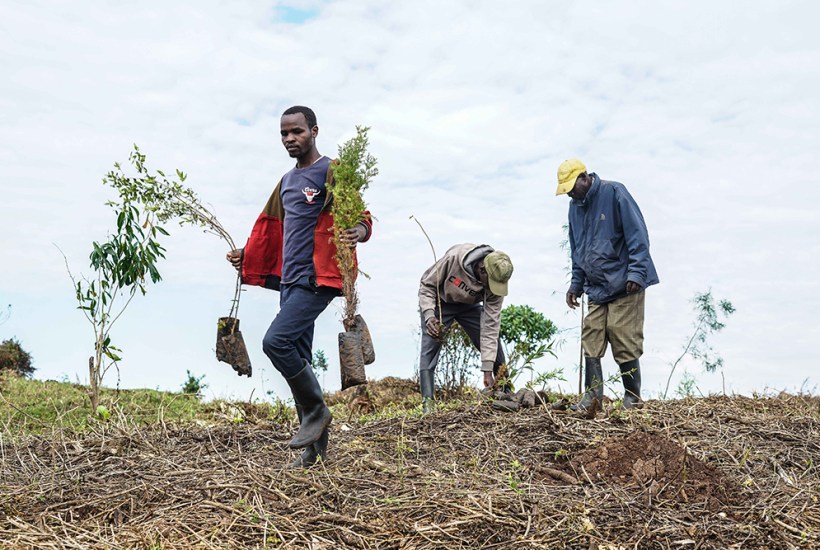
But Crowther’s work has brought him into contact with many positive initiatives. Most of these do not have the news-grabbing glamour of global trends but have impact at a local level. In northern Kenya, communities have restored their land and livelihoods by accessing lost water sources. In Rajasthan, degraded soil and drying wells recently drove some 15 million people from their villages; their flight has now been reversed by place-specific ecological management. In Niger, tree-planting in croplands has improved the lives of almost a million, while the same scheme has helped countless others in a further 24 countries. Examples of regenerative projects in the Andes, south-east Asia and the Caribbean all emphasise a simple truth – restoring land and soil increases income.
Other successes include Africa’s Great Green Wall project, which has so far benefitted 11 million; China’s vast Loess Plateau soil stabilisation strategy; and Costa Rica’s reforestation, which has doubled the country’s tree cover and helped generate economic growth. Crowther reports: ‘A revolution is emerging as the positive feedback loops between ecosystems and rural livelihoods continue to snowball.’
Such projects make use of forces intrinsic to the natural world, such as those of soil microbial communities whose extraordinary restorative potential is only now being understood. But Crowther’s principal point is more human: to harness the power of positive thinking. Adopting optimism as a strategy can have a self-fulfilling effect. Standing in the path of the juggernaut of habitat loss, climate change and political obduracy and calling for positive thinking might look naive, but it’s not entirely foolish.
As a working scientist, Crowther offers insights that are wide-ranging and compelling. What emerges most strongly, though, is the basic truth of ecology. Nature’s Echo identifies a shift in perspective that is spreading out from the work of specialists and laboratories, an idea that is gathering pace, thanks to its own internal feedback loop: the natural world can no longer be seen for its parts, the sum of separate elements and species, but as a system of infinitely complex interactions. And in that there lies a certain wild beauty.
Got something to add? Join the discussion and comment below.
You might disagree with half of it, but you’ll enjoy reading all of it. Try your first month for free, then just $2 a week for the remainder of your first year.