Following voter revolts in the UK, France, Germany, Italy, and other European countries, Australians are now punishing the parties that have been the mainstay of the nation’s post-second world war politics.
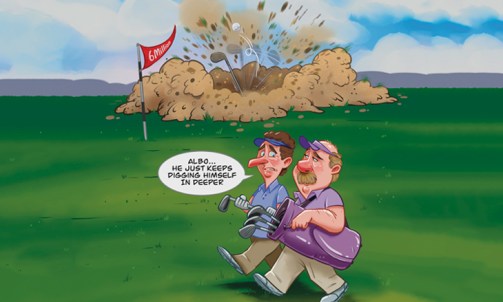
The rise of One Nation is the electorate-inflicting visceral punishment on both the Coalition and Labor as their decades of damaging economic policies bear down on ordinary Australians.
Elections and polls
In the South Australian election in March, One Nation won four lower-house seats, and scored 22 per cent of the vote.
Federally, this indicates that One Nation could win at least four House of Representative seats, including the only two South Australian seats that the Liberals still hold – the Murray Riverland seat of Barker, stretching from the Victorian border down to Lake Alexandrina, and the largely rural seat of Grey, which encompasses 92 per cent of the state. One Nation could also win two Senate seats.
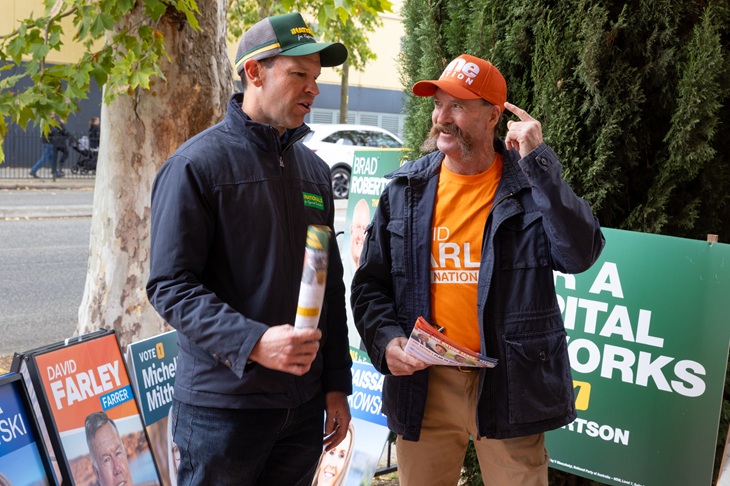
Then in May, One Nation won the by-election for the federal seat of Farrer after the retirement of former Liberal Leader Sussan Ley. The Liberals and Nationals had held Farrer since its creation in 1949.
One Nation’s David Farley romped it home with 39.5 per cent of the primary vote, and 57.5 per cent of the two-party preferred. Farrer stretches from Albury along the Murray River irrigation region to the SA border, and encompasses the NSW state seat of Murray, which is held by independent, pro-farmer Helen Dalton.
Polling tells a wider story.
In early May, Redbridge polling of 6,015 voters just before the Federal Budget (see table, top right) found that 62 seats would have changed hands if an election had been held at that time.
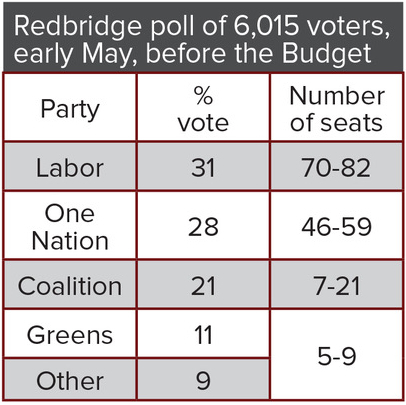
One Nation would have become the official Opposition. The Coalition, particularly the Nationals/LNP, would have suffered humiliating losses. Even Coalition Leader Angus Taylor and Andrew Hastie would have lost their seats.
Then, post-Budget, came a fresh poll from AFR/Redbridge/Accent at the start of June. One Nation’s vote had again increased, to 31 per cent, leading over Labor at 28 per cent and the Coalition at 20 per cent.
On a two-party-preferred basis, Labor’s lead over One Nation narrowed from 55-45 per cent in the previous poll to 51-49 per cent.
Kos Samaras, a Redbridge Group director, said that the two-party system that Australians grew up with was ‘gone’. ‘The real contest, unless something changes by 2028, now runs between Labor and One Nation, and the Coalition is a spectator in the stands … eating doughnuts.’
Behind the revolt
First, the rural sector. As I point out in my new book, Caught in the Current (Wilkinson Publishing), Australia’s volume of farm product increased substantially from 1975 to 2002, but since has literally flatlined.
Under the devastating impact of National Competition Policy (NCP), farmers lost their bargaining power with the duopoly supermarkets and corrupt world markets. NCP forced the abolition of the single selling desks for wheat, barley and sugar cane, and terminated state-based dairy marketing arrangements.
Then came the disastrous Water Act 2007 and Murray-Darling Basin Plan that took an area almost twice the size of the ACT out of irrigation farming. Land under irrigation is 42 times as productive per hectare as the average Australian farm.
Free trade policies have led to rising agricultural imports, with Australia set to become a net importer of food and fibre by 2037.
The Coalition drove these policies. Now they are suffering the backlash.
Yet, I believe that data derived from Caught in the Current could show that, had disastrous rural policies not stagnated production, today farm output might be $149 billion, not the $100 billion that it is.
Second, under purist free trade policies, Australian manufacturing shrivelled to 5.1 per cent of the economy, the smallest of any developed nation. Australia’s manufacturing should be at least 10 per cent of the economy, then it would be worth $280 billion, not $142 billion, to the nation’s $2.8 trillion economy.
Third, Australia imports more than 90 per cent of liquid fuels. The $51 billion that this sends offshore annually could be circulating in Australia, if this country produced its own petrol, diesel, and aviation fuel.
These three sectors could be pumping an extra $242 billion into the economy, generating $80 billion more in tax revenue.
Tony Barry, a Redbridge director, notes: ‘With almost two-thirds of the electorate now saying Australia is heading in the wrong direction … a growing cohort of voters [believe] that the answer lies outside established norms and major parties.’
Whether is capable of One Nation developing a policy agenda to solve the nation’s deep structural problems remains to be seen.
By Patrick J. Byrne, immediate past national president of the National Civic Council.