Last week was about scrutiny, with Barnaby Joyce declining, as One Nation’s Treasury spokesman, to commit to costing One Nation’s policies before an election. This week we return to things more fundamental – constitutions, institutions and responsible government – and wander briefly back to Barnaby, but with a new insight.
Conservatives believe institutions should matter more than personalities. Conservatives distrust the concentration of power. We believe institutions exist not simply to organise authority but to restrain it, diffuse it and, ultimately, outlast the individuals who occupy positions within them. That is one of the great achievements of the Westminster tradition. It assumes no politician is infallible. It is not surprising, therefore, that the constitutions of Westminster’s traditional parties seek to reflect these enduring principles of governance.
This leads inevitably to the question: what does One Nation’s constitution look like?
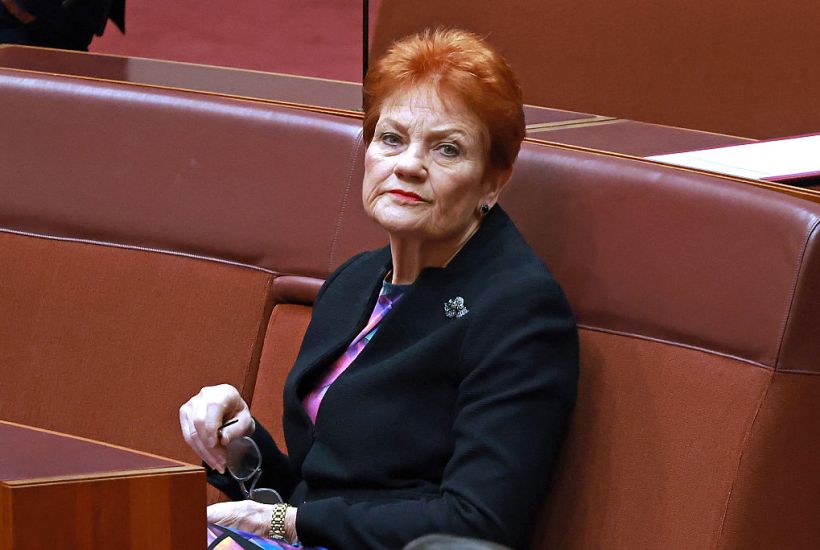
It has been widely reported that, in addition to being the parliamentary leader of One Nation, Pauline Hanson is also its president and administrator, exercising extraordinary authority over the organisation itself. I wanted to know whether that is what the party’s constitution actually says. It does.
The One Nation constitution, available on the Asic website, establishes a highly centralised structure, with extensive authority vested in a minimum three-member executive. Branches, candidates and administration are all subject to central control. In essence, all organisational power lies with Pauline Hanson, who is personally named in the constitution as president and alone has the power to appoint her successor.
It is a remarkable constitutional design for a party that aspires to government. It is a hugely different model from the Westminster tradition, where authority within political parties is generally dispersed through state organisations, elected executives and separate parliamentary processes. Whether the major parties’ expressed diffusion of power is perfect or fit for purpose is another question. But for both, their constitutions at least reflect a conservative instinct that power should rarely reside in one place or with one person.
What stopped me in my tracks, however, was not the concentration of power, but something even more revealing. There is the constitutional entrenchment of 38 separately numbered constitutional commitments – a mix of philosophical commitments, ideological propositions and policy prescriptions. Some are very good. Some are very bad. A couple are outdated. Let’s leave the substance of those for another day.
These commitments are not published on a website as an election platform, nor contained in a policy handbook. They are embedded in the One Nation constitution itself. Of course, constitutions can be amended. Nor are the 38 constitutional commitments expressed to be a complete code of One Nation’s current policies. They plainly are not. Since the document was last amended in 2021, the party has announced additional policies, including recently copying Coalition tax policies. That is not the point.
Constitutions exist to entrench. They identify the matters their authors regard as sufficiently fundamental to place beyond the ordinary ebb and flow of political debate. Political scientists have long observed that functioning institutions do not merely mirror political culture. Over time, they create it. If that is true of nations, it is also true of political parties.
Which brings me back to Barnaby Joyce.
The office of treasurer – and by extension opposition treasury spokesman – is not merely another portfolio. Within the Westminster tradition it is one of the great constitutional offices of government. Since the famous nineteenth-century Chancellors of the Exchequer, Treasury has been the institution that determines which ambitions can responsibly be pursued. Every serious government, or government in waiting, begins with the budget because every political promise ultimately competes with others for resources. That is why the treasurer has traditionally stood second only to the prime minister. He asks: Can we afford it? What must wait? Which objectives survive contact with economic reality? Treasurers are, in effect, the institutional embodiment of saying ‘no’ to enthusiasm – sometimes even the prime minister’s.
Having read One Nation’s constitution, it is fair to say there is likely an institutional reason sitting beneath Barnaby Joyce’s refusal to commit to costing the party’s policies. None of us knows to what extent Barnaby has more influence than the constitution formally permits. He surely would.
But if the governing rules and culture of an organisation are ones in which a substantial body of philosophy and policy has already been constitutionally entrenched, the space left for a treasury spokesman to perform his traditional role as custodian of the nation’s finances is hugely compromised.
The difficulty is not only that the cost of the One Nation policies will prove exorbitant. It is also that reality changes. Wars occur. Economies change. Financial crises emerge. Westminster has endured because it evolved to accommodate unforeseen realities.
Supporters of One Nation will say that constitutional entrenchment of this kind reflects conviction, consistency and an unwillingness to bend with every passing political fashion. But there is another side to the ledger. The same constitutional design reveals a dangerous concentration of power and a philosophy of government that sits uneasily with responsible government itself.
One Nation’s constitution provides a blinding insight into the party’s philosophy of government. It reveals a constitutional instinct that sits uneasily with one of the oldest, wisest and most enduring innovations of Westminster government: institutions should endure, principles should guide, but policy must remain capable of yielding to reality, including cost. That is how governments preserve their convictions without becoming prisoners of them. A long-standing practitioner of Westminster government, particularly one who has practised politics with enormous freedom and latitude, would, I suspect, find inhabiting such an institution very uncomfortable.
There will be readers shouting by now that flexibility has been the Liberal party’s problem. Too much compromise. Too much surrender to the bureaucratic state and fashionable orthodoxies. There has undoubtedly been some of that. But that reflects the times, and failures of leadership and political judgment within the institution, not a defect in the institution itself.
The answer is not to abandon the institutional virtues that have evolved and served Westminster government for centuries. It is to elect leaders with the judgment and conviction to use those institutions properly and faithfully execute the promises they make to the Australian people.
That, ultimately, is why institutions matter, and matter profoundly. They cannot substitute for leadership. But they can ensure that no person, however strong, is ever larger than the institution itself.
Got something to add? Join the discussion and comment below.
Louise Clegg is a former lawyer, now writer. She is married to the opposition leader.
You might disagree with half of it, but you’ll enjoy reading all of it. Try your first month for free, then just $2 a week for the remainder of your first year.