If you live or work in Bristol, it’s impossible to escape the Victorian engineer Isambard Kingdom Brunel’s shadow – but that won’t stop some people from trying. The heritage site which looks after his early masterpiece, the steamship SS Great Britain, is to change its name from the splendid and (you would have thought) uncontroversial ‘Brunel’s SS Great Britain’ to the rather more dreary ‘Bristol Dockyards’.
This is a move that smacks of managerial timidity, scrubbing the name of a great individual and his achievement in favour of something numbingly bland and sterile
Brunel is Bristol’s most famous and celebrated son. When the BBC ran a national poll to find the public’s greatest Britons in 2002, Brunel came in second place behind Winston Churchill, seeing off competition from the likes of William Shakespeare, Elizabeth I and Isaac Newton. It was an honour well deserved.
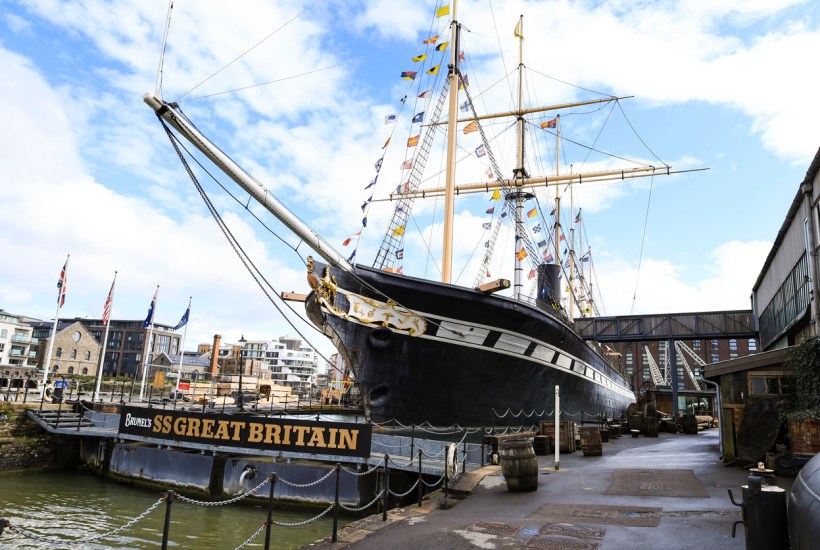
Towering over the Avon Gorge to the west of the city is his mighty suspension bridge, over which another Bristol-based engineering marvel of the twentieth century, Concorde, famously made her final flight in 2003. Resting in clear sight of that bridge, permanently dry-docked in Bristol’s harbour, lies the SS Great Britain, one of Brunel’s earlier marvels.
SS Great Britain was launched in 1843 by Prince Albert, who had travelled to the city by the cutting-edge means of the railway. His journey from London had taken only about three hours, considered at the time to be eye-wateringly fast. The line connecting London and Bristol had opened just two years before, another feat of Brunel’s ambition and skill. Whether it came to bridges, railways, or boats, Brunel’s skill made the seemingly impossible, possible.
It’s hard not to be impressed by the SS Great Britain. The first thing to note is her enormity: at 98 meters long and with a 3400-ton displacement, she was by some lick the biggest and grandest vessel of her day. But with Brunel, size combined with ingenuity. The first ship in the world to combine an iron hull with a screw propeller, SS Great Britain was designed as a luxury transatlantic ocean liner, ferrying the great and the good back and forth to New York with the highest-possible speed and comfort, a whole seven decades before Titanic.
Run aground in Ireland in 1846, she was sold off cheaply to new owners, who doubled her capacity and used her to shuttle hopeful prospectors to the southern hemisphere during the Australian Gold Rush. Her later history is less illustrious. Towards the end of the century, she was converted once again, this time into a coal transport ship. Following an onboard fire, she spent about 50 years as a giant floating coal scuttle in the Falkland Islands before her final abandonment in 1937.
Fortunately, that was not the end of her story, and SS Great Britain was rescued from her bleak graveyard in 1970. She was returned to her home city of Bristol, and refurbished to serve in perpetuity as a museum, visitor attraction and educational site. When she floated back home under Brunel’s suspension bridge in July 1970, she was welcomed by crowds of joyous Bristolians in scenes which mirrored her triumphant launch 127 years before. Here she remains today, visited by more than 150,000 awe-struck people every year.
According to reports, the name change is designed to make the site ‘cooler’ (because we all know that names chosen by committee are cool) and more inclusive. The chief executive of the SS Great Britain Trust, Andrew Edwards, accepts that some people resistant to change will label it ‘woke’. I wouldn’t give it that much credit. Wokeness would at least attempt to capture some of the energy and radicalism of the protestors who tore down the Edward Colston statue in 2020. This, however, is a move that smacks more of managerial timidity, scrubbing the name of a great individual and his achievement in favour of something numbingly bland and sterile.
The real reason for the change is likely to do with a perceived need to avoid controversy. Many people in Bristol wrongly believe that SS Great Britain is in some way connected to the slave trade. While she certainly had an extremely eventful imperial history, including service as a troop carrier during the Crimean War and the Indian Mutiny in the 1850s, nowhere in her story is there any sort of entanglement with the history of slavery. She was, after all, launched 36 years after the 1807 abolition of the slave trade and ten years after the 1833 abolition of slavery in the British Empire.
Nonetheless, the simple facts of being a ship in Bristol are damning enough. Putting two and two together to make five, myths about SS Great Britain and her assumed relationship to the slave trade are common. As Edwards noted, many people in the city believe that the ‘SS’ in her name stands for ‘slave ship’ rather than ‘steam ship’. Sadly, though, this decision will only serve to obscure the real history of the vessel and her creator. It will be wrongly and widely assumed, on the logic of there being no smoke without fire, that there must be something untoward about the names Brunel and SS Great Britain.
There isn’t anything embarrassing about either of those names, of course. Both the man and his glorious ship deserve to be known and celebrated, in Bristol, Britain, and beyond. When people are wrong, they should kindly but firmly be put right. Apparently, the site will continue to be described as the ‘home of the SS Great Britain’, a simple statement of fact. But it would be good to see a bit less sheepishness and a bit more plain talking. It’s a shame to see Britain’s greatest engineer, and one of his crowning achievements, newly buried, not under Falklands sludge this time, but beneath an even thicker layer of play-it-safe managerialese.