God, King, and Country is an interesting concept. As a political scientist, my method tends to be what is known as historical institutionalism. What I look at are legacies and how they inform policy choices in the present, but also continuity, disruption, and often serendipity.
In terms of serendipity, it’s interesting that Lord Kitchener was invited to Australia by Alfred Deakin to report on the Australian land defence force, the Australian Army. At the time there was controversy that it should have been Lord Fisher looking at the Navy, which made more strategic sense. But Kitchener arrived in 1909 and stayed until 1910. He travelled throughout Australia – Seymour, Darwin, Townsville, and elsewhere – and arrived to great fanfare. The country people loved the fact that this war hero, the Kitchener of Khartoum, was visiting Australia. Kitchener, of course, became the face of the first world war recruitment campaign.
It was interesting that Uncle Sam is a fictitious character, whereas Kitchener was the real, living hero. He was often criticised for sending many young men from British country towns to their deaths. Anyway, the long story short. Kitchener advised the formation of the Royal Military College, Duntroon. Duntroon was established along the lines of Sandhurst in the UK. It was quite natural that British identity would form part of the early institutions of the Australian Army and the military more generally.
Kitchener said Australians were soldiers naturally.
I probably won’t come up with any fantastic theoretical contributions today, but one thing strikes me personally. I am one of four generations of my family who have served in the Australian Army – my great-grandfather, my grandfather, myself, and my son. The Australian Army has been part of our family history for a very long time, and it feels entirely natural. As a teenager I had the Union Jack and the Australian flag hanging in my bedroom, and I took them with me to Duntroon in 1992 and 1993. I don’t know why I did that. It’s just what I did. There is something very natural about that British identity in the Australian Defence Force.
When it comes to God, my first experience in the military was the laying up of the colours for the 51st Battalion, the Far North Queensland Regiment. In a church. It was a church parade. I’ll never forget at Duntroon the trooping of the colours on the Queen’s Birthday and the call, ‘Three cheers for Her Most Gracious Majesty. Hip, hip-hip, huzzah!’ I tell you what – if you’re not a monarchist after shouting ‘huzzah’, what’s wrong with you?
Then there is country. My first unit, the 51st Battalion, carried the sentiment Ducit Amor Patriae – excuse my Latin, but it essentially means love of country leads me. God, King, and Country are embedded in the symbolism, the practices, and the institutions of the Australian Defence Force.
This is very personal for me. What I’ll be arguing is that Menzies is part of that continuity. I dare say that without Queen Elizabeth II reigning for so long, we would not have had the same degree of continuity. I don’t know that King Charles would have carried the same appeal had he been the monarch we relied upon as the representative of the Crown for Australia. There was deep affection for Queen Elizabeth II, shared by Sir Robert Menzies – famously ‘British to the bootstraps’ – and reflected in the well-known story of the Queen walking past him in Old Parliament House. A lot of that feels natural, almost serendipitous.
The enduring importance of God, King, and Country in the ADF lies in the sense of purpose that most others do not have. When you are commissioned as an officer, you receive your commission from the Queen – in my case – which says you are to follow the orders given to you. If that means sending your soldiers to their deaths, and possibly yourself, then that is your job. That is a very powerful thing, and it is shared by warrant officers and other ranks as well.
Menzies played an important role in perpetuating that ideal. The modern expression of it really begins with the Korean War, which I’ll come to shortly. But let me start at the end.
Under the Morrison government – and reaffirmed in recent years—the Australian Defence Veterans’ Covenant was introduced. My generation of soldiers was very disillusioned with the RSL and the Department of Veterans’ Affairs. Only in recent years have many of us started coming back to the fold. I think we reached an age where we realised how important it was and wanted it back in our lives.
I wasn’t even aware the Covenant existed until my hearing began to fail. As an artillery officer I discovered I was already pre-registered for hearing aids, which was welcome. Suddenly I needed an RSL advocate, so I dug out my old 1999 badge and rejoined. The Covenant introduced something of an American-style ‘thank you for your service’. The oath states, ‘For what they have done, this we will do.’ One of the most significant aspects is that all mental health treatment is now covered for every soldier, sailor, and airman who has served.
Things have changed significantly, as they did after the first world war and again after the Second. Yet the Covenant sits quite comfortably alongside British military customs. Clement Attlee’s idea of the New Jerusalem was similar in spirit – the general ideal of looking after veterans – though perhaps with more of a socialist bent than Sir Robert would have liked.
In the regular army I served with the Royal Regiment of Australian Artillery. The title ‘Royal’ was granted by Queen Elizabeth II to the Australian Artillery in 1962, during Menzies’ time and during her reign. I’ll never forget, as a young subaltern, being told that the newest member of the regiment had to say grace at a dining-in night. These were formal occasions where you were not permitted to leave the table until the loyal toast had been drunk – quite excruciating in the ’90s, I can only imagine what they were like earlier.
The grace was simple, ‘For what we are about to receive, thank God.’ When I was first told to say it, it took me straight back to Duntroon, where I once asked the regimental drill sergeant major for advice on a parade and received a classic ‘bum steer’, resulting in two weeks of extra drills. It was that sort of culture – rather like an apprentice being sent to find a couple of skyhooks. But the grace was correct and very straightforward.
Back then the loyal toast for the Royal Regiment of Australian Artillery was, ‘The Queen, our Captain General.’ King Charles is now the Captain General. These are direct, frequent affirmations of the Crown and the Christian tradition. That tradition continues in the RSL. The League has its roots in the first world war. Like the Gallipoli Memorial Club in Sydney, which still exists, early RSL branches sometimes tried to restrict membership to those who had served at Gallipoli, but that could not last. The RSL adapted, as institutions must. Even today, RSL meetings usually display both the Union Jack and the Australian flag, and we always recite the Ode. It is almost archaic, yet very moving.
I mentioned the Korean War. My grandfather, whom I knew well, served in the second world war and then with the 67th Battalion in the British Commonwealth Occupation Force in Japan, including Hiroshima. Australia’s participation in the BCOF was entirely natural. The 67th Battalion became the 3rd Battalion, Royal Australian Regiment. The ‘Royal’ prefix was important. We began serving alongside Americans as the Royal Australian Regiment during the Korean War. The 67th Battalion was formed from volunteers from the 3rd, 6th, and 11th Divisions to deploy as part of the BCOF.
Anyone who has served with an infantry battalion, or as a forward observer in artillery – as I did with Bravo Company, 6 RAR in Brisbane – knows how strongly those soldiers feel part of the Royal Australian Regiment. They are extremely proud of it. The Royal Australian Navy and Royal Australian Air Force have their own proud traditions. What we see overall is the continuation of the British Army regimental system in Australia.
In my day we were still called SO3 – Staff Officer Grade Three, a captain’s rank – followed by our functional title (Operations, Fire Support, or whatever it was). Those titles have since moved toward American usage for interoperability, though the British have done something similar. Honours and awards are still approved by the Sovereign, and the Crown remains the symbolic legal source of military authority in Australia.
The RSL was long focused on the idea of imperial service, and that emphasis continued through the inter-war and post-war periods. After he retired, my grandfather lived in an RSL home called War Haven in Cairns – an entire village of veterans. You can imagine the shenanigans. But there was also a profound sense of loyalty, belonging, and camaraderie.
Service in the two world wars was largely seen as service to the Empire. Even when Curtin brought the 7th Division home, it showed a necessary turn toward the Americans. That did not erase the deep Britishness inculcated in the Australian Defence Force. Returned soldiers received enhanced social status. Old property maps of Australia still show the impact of soldier settlement schemes, especially in country towns. Military service was a badge of superior citizenship, rooted in the ideal of British imperial loyalty.
Menzies described himself as ‘British to the bootstraps’. It has become almost a cliché, yet he genuinely sought to preserve a cultural, even puritan, inflection of British character in Australia. It is unfair when the left admonishes him for this, because he also had warm connections with the United States and lectured there. Through his demeanour, however, he reinvigorated monarchist and imperial sentiment in the 1950s and ’60s. The granting of royal titles to our military units, many of which remain unchanged, created a favourable climate for the RSL’s British-oriented veterans’ culture – one that still exists today.
The Royal Australian Regiment grew out of the British Commonwealth Occupation Force. This was not all Menzies’ doing. It occurred under the Chifley government. In earlier work I have written about communications and about Menzies and nuclear policy. He was not always the instigator, but he was a powerful perpetuator of these ideas. The Royal Australian Regiment became Australia’s first permanent infantry regiment, modelled on British lines.
Kitchener had recommended a form of compulsory military training, which existed from 1911 until around 1922. Menzies later reintroduced national service. During these foundational periods, a great many able-bodied young Australian men experienced that tradition. The inculcation of British military history and culture through the Australian military has been perpetuated though such schemes.
If you come to Gunning, my village in the Southern Tablelands of New South Wales – population roughly a thousand – we routinely see more than three hundred people at the Anzac Day service. Particularly in regional Australia, the culture and sense of identity remain strong.
The Royal Australian Regiment’s motto, worn on the hat badge, is ‘Duty First’. If you were not doing your job, your mates would soon remind you to ‘read your hat badge’. These symbols are constantly reinforced. They are not mere decoration. They function as living institutions. That is something you do not find in the same way elsewhere.
In the Commonwealth context, Australia retained the Crown while republics were admitted to the Commonwealth of Nations. The ADF continued to operate within the broader Commonwealth military culture – ABCA (American, British, Canadian, and Australian), later expanded with New Zealand – through regimental exchanges and close cooperation.
At Duntroon, my guidance officer was a British infantry officer of the Northumberland Fusiliers. My surname traces to Northumberland. Our artillery regimental officers’ basic course was run by a regimental sergeant major from the Royal Horse Artillery. These exchanges between Australia and the British military continue and remain important. The integration is remarkably seamless. The main cultural difference is that Australians tend to bag each other more than the Brits or Kiwis do, but apart from minor drill variations, it feels entirely natural to serve together.
British identity in the defence force stands in contrast to civilian Australia, where it is now largely symbolic and declining. We still see coats of arms on regional courthouses and prisons, but they are not lived traditions. In the ADF these traditions are institutional, daily, and operational. In many ways the Australian Defence Force is the last redoubt of God, King, and Country.
The difference persists because tradition and esprit de corps require continuity. You cannot simply recreate a history. Anyone who has marched in column to a pipes and drums band, or to a military band playing the same tunes the British marched to in the Seven Years’ War in the 1750s, knows the adrenaline that rises. These are tried and tested ways of motivating troops, and the same music continues today. The regimental system is inherently conservative precisely because tradition matters.
Interoperability with the UK and Commonwealth partners now extends to the Americans as well. There is also a constitutional reality. The King, symbolically and constitutionally, through the Governor-General, remains Commander-in-Chief of the Australian Defence Force. Veterans’ organisations continue to reinforce that Britishness.
To conclude, the ADF remains one of the most British institutions in contemporary Australia. Loyalty to King and Country – and implicitly to God – is not a mere ceremony but a living tradition.
I’ll never forget an early lecture at Duntroon on comparative religion. The lecturer asked, ‘Hands up – who doesn’t believe in God?’ A few hands went up. He said, ‘When we were caught in an ambush by the Japanese in New Guinea, everybody prayed’. Implicitly, God is part of that process. As the Americans say, there are no atheists in foxholes.
This identity was consciously preserved through the Menzies era and continues to shape the profession of arms in Australia. Menzies was a big supporter of the RSL. In the military, more than anywhere else in Australian society, this British identity endures.
Just to finish, the black-and-white photographs across the top of montage below shows my great-grandfather – before he went overseas, during his preparation, and then in the second world war, because he went back for another six years. You can see the impact. Featured are my grandfather, myself, and my son. It is very difficult to separate the personal from this idea of British identity, because to me it is simply natural.
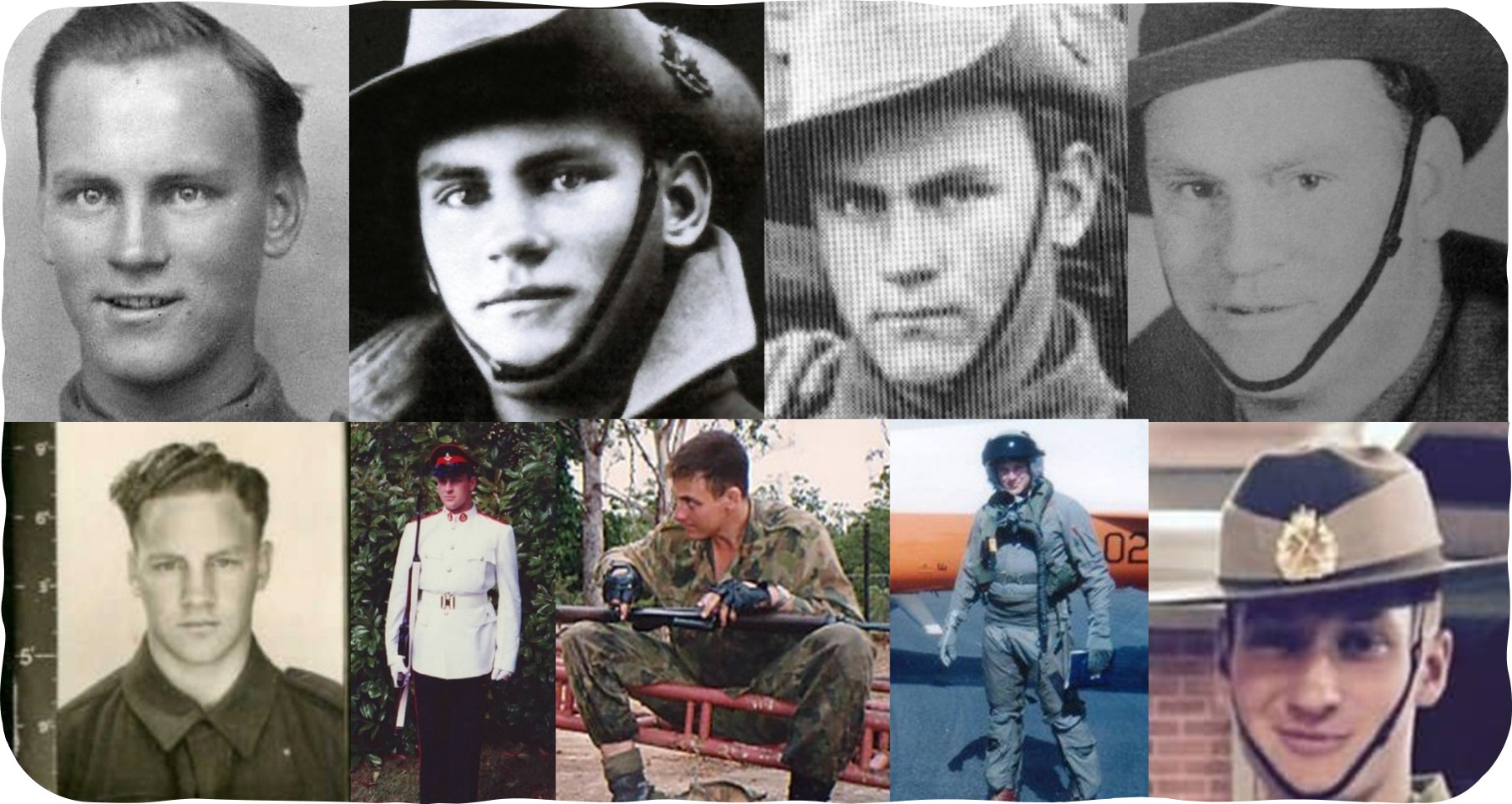
The Percy Warriors