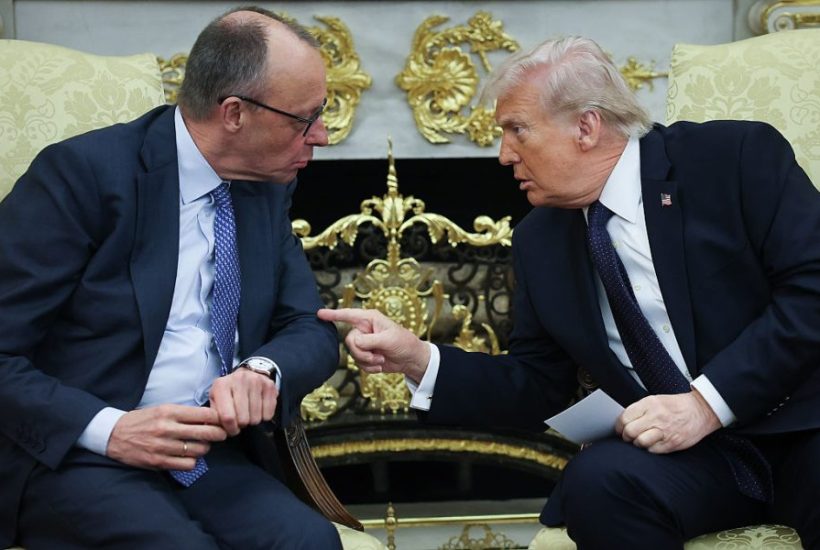
It has been a choppy 12 months for transatlantic relations since Friedrich Merz was sworn in as chancellor of Germany a year ago today. Fittingly, he is marking one year in office by dealing with the fallout of a spat with Donald Trump which has resulted in very real consequences for German – and potentially European – defence.
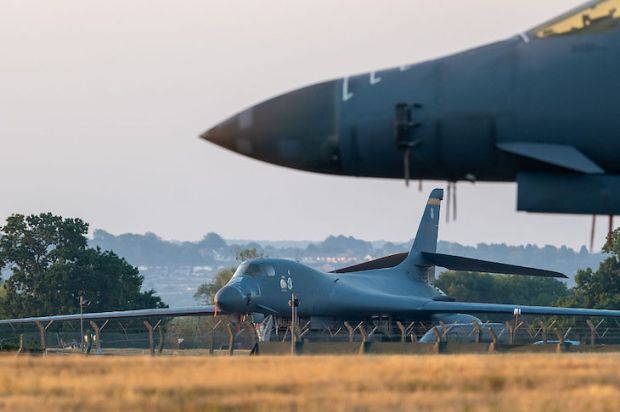
On Friday, the Pentagon announced that 5,000 American troops would be withdrawn from German soil over the coming six to 12 months. Additionally, contrary to an agreement struck between Merz’s predecessor Olaf Scholz and Joe Biden, no new intermediate-range missiles would be stationed in Germany in the immediate future.
Germany currently hosts nearly 40,000 active US soldiers on its territory – roughly two-fifths of the total American presence in Europe. Most are based around the city of Ramstein in Rhineland-Palatinate, home to the largest US military base outside the US. The American army also runs a military hospital in Landstuhl (America’s largest on foreign soil) as well as maintaining a presence in bases near Stuttgart, Wiesbaden and the Bavarian town of Grafenwöhr, among others. They have formed a key part of the continent’s security architecture since the end of the second world war, providing a bulwark against the Soviet Union throughout the Cold War.
German officials have long anticipated that something like this could happen
The White House hasn’t clarified yet which troops specifically will be pulled out – although the German government and Nato officials are reportedly currently demanding answers to this. While unlikely to weaken Germany too drastically, the country is still expected to feel the loss of these troops – which will bring the American presence in the country back down to roughly pre-2022 levels. That this sends a message of western discord to Vladimir Putin goes without saying.
There will, additionally, be a substantial economic knock-on effect where American troops are withdrawn: having been based across the country for more than 80 years, their presence has fed into local economies. Still, German defence minister Boris Pistorius sought to downplay the significance of the announcement over the weekend, saying, ‘It was anticipated that the US might withdraw troops from Europe, including Germany.’
Pistorius is correct. Going right back to Trump’s first administration, German officials have long anticipated that something like this could happen. At the end of his first term in office in July 2020, Trump announced his intention to withdraw 12,000 troops from Germany because the country was not ‘paying their bills’ on defence. Only his loss to Joe Biden at that year’s presidential election prevented him from carrying out the withdrawal; Biden reversed the order. More recently, the White House’s National Security Strategy, published in December, stated that the US would reassess European troop deployments and readjust its ‘global military presence’.
More concerning for Germany’s security is the Pentagon’s decision to also cancel the stationing of US intermediate-range missiles on its territory. Back in 2024, Scholz and Biden struck a deal that Typhon missile launchers capable of firing Tomahawk cruise missiles would be stationed in Germany by this year. This was a response to the intermediate-range missiles Moscow had transferred to its exclave on the Baltic sea, Kaliningrad, which are capable of reaching deep into Germany and large parts of Europe. It had also been agreed that America would station Dark Eagle hypersonic missiles on German soil, whose range of 2,175 miles would make them capable of striking Moscow.
These American missiles were intended to bridge the gap in Europe’s capability while Germany developed European-grown alternatives with allies including Britain, France, Italy, Poland and Sweden. This grouping has been collaborating on the so-called ‘European Long-Range Strike Approach’ (ELSA) project, with the aim of developing combat drones and a more than 620-mile range weapon capable of eliminating strategic Russian targets. Two years on, ELSA has barely got going. Trump cancelling the delivery of Typhons and Tomahawks leaves Germany – and Europe – vulnerable.
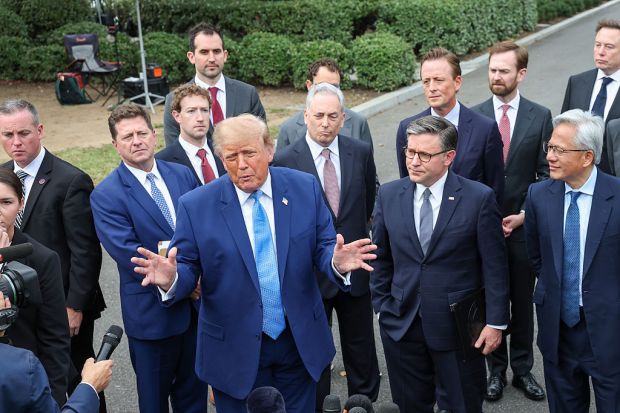
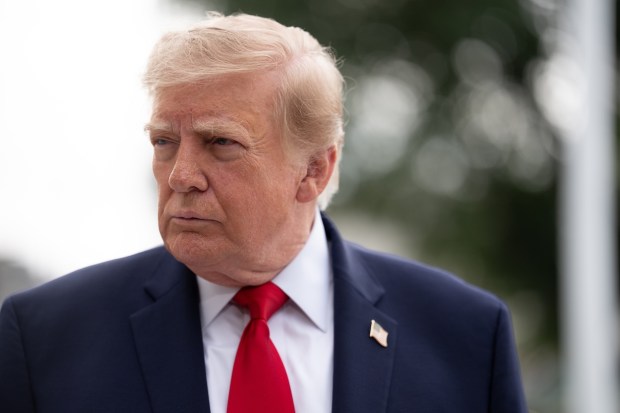
Although Trump has threatened to reduce troop numbers in Germany for some time, it appears that his decision to announce this now is also intended to punish Merz following a public dispute between the two leaders over the past few weeks. Since Trump’s attack on Iran at the end of February, Merz has grown increasingly critical of the war in public.
Germany has allowed the US to use its military bases and given permission for overflights through its airspace, but in typical form Merz was unable to hold back speaking rashly. On a visit to a school early last week, he said: ‘The Iranians are clearly stronger than expected and the Americans clearly have no truly convincing strategy in the negotiations either.’ The ‘entire nation’ of America was, he added, ‘being humiliated by the Iranian leadership.’
Merz’s domestic critics have, unsurprisingly, seized on the opportunity to lambast him for it. But, viewed through the lens of the Iran war, where the US reportedly fired more than 850 Tomahawks in its first four weeks, the cancellation of plans to send missiles to Germany may be as much because America is reluctant to divert crucial resources away from the Middle East.
Intriguingly, the Pentagon’s announcement appears to have polarised German society. According to one YouGov poll, 37 per cent of Germans oppose the decision to withdraw US troops, while 34 per cent are in favour. A further 29 per cent couldn’t decide. The far-right AfD and far-left BSW and Die Linke parties had all campaigned against the expected arrival of Tomahawk missiles in Germany. They have also repeatedly pushed anti-Ukraine, anti-Nato and pro-Russia stances since the invasion of Ukraine four years ago. The YouGov poll reveals that supporters of those parties overwhelmingly support Trump’s decision.
On Sunday, Trump threatened to cut troop numbers in Germany by ‘a lot further than 5,000’. Whether or not he is able to will rest largely on how cooperative the US Congress is. But with no Tomahawk missiles coming to Germany, Europe has been served another reminder of how unreliable an ally America has become – and how the defence of the continent against Russia has fallen down Trump’s list of priorities.