On Donald Trump’s sojourn to China – the first visit by a US president in almost a decade – North Korea was hardly at the top of the agenda. Trump and Xi Jinping had bigger fish to fry, be that China’s desire to secure rhetorical US concessions on Taiwan, Trump’s wishes for greater Chinese investment in US manufacturing or whether Beijing can compel Iran to ease the effects of the Iran War.
But US-China relations are not just a two-player game. Only last weekend, history was made as North Korean soldiers participated in Moscow’s Victory Day parade for the first time. A day beforehand, Kim Jong-un had pledged to Vladimir Putin that North Korea would ‘give top priority’ to its relations with Russia. With China as one of the key enablers of the Ukraine war, as well as being North Korea’s principal economic benefactor, the North Korea question cannot go away.
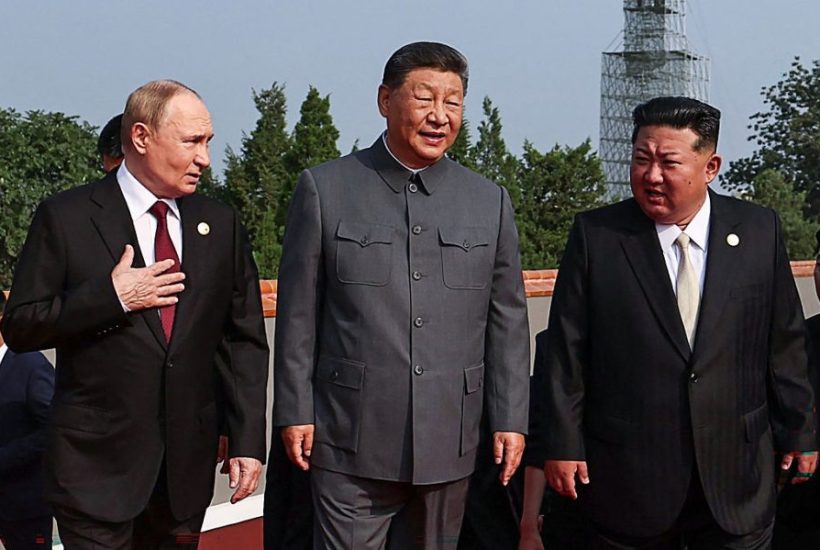
Putin’s Victory Day parade in Moscow paled in comparison to that of his Chinese and North Korean counterparts. Intercontinental ballistic missiles and tanks were nowhere to be seen. While at China’s Victory Day parade in September last year, Kim flanked Putin and Xi, in Moscow, the North Korean leader chose to stay at home. Yet, the striking sight of over 120 North Korean naval, ground, and infantry troops on parade, paying homage to their fellow men fighting in the Kremlin’s war, demonstrated that the Russia-North Korea relationship looks here to stay.
Washington and the West would do well to split Beijing and Pyongyang from Moscow
While Kim was praising North Korean soldiers fighting for Russia – of whom over 2,000 have been killed and over 3,000 wounded – as ‘living bombs’, Russia’s Defence Minister, Andrei Belousov, announced that the Kremlin would sign a security cooperation agreement with the hermit kingdom lasting until 2031. Washington and the West must prepare for this ‘invincible alliance’ to stay, even if any end of the Ukraine war means that Putin no longer requires North Korean artillery or manpower.
Nevertheless, for all Kim’s rhetoric that Pyongyang will put all its eggs in Moscow’s basket, North Korea will not want to alienate China, its decades-long anti-Western economic backer. After all, when the ongoing Iran war led the US to redeploy parts of its Terminal High Altitude Aerial Defence System (THAAD) batteries – which Beijing and Pyongyang detest with a passion –from South Korea to the Middle East, there were no clearer victors than Kim and Xi. One of the US’s ambitious goals for last week’s summit between Trump and Xi was to see whether China can compel Iran back to the negotiating table. The economic and energy implications of the closed Strait of Hormuz are worsening by the day – for the West but also for China.
Xi may assert that the United States and China should be ‘partners not rivals’, but Beijing has no intention of abating its aggressive economic coercion towards the West and its allies. Just how any cooperative Sino-US partnership can emerge remains to be seen. While Washington and the West would do well to split Beijing and Pyongyang from Moscow, doing so is an arduous task. Russia’s economy remains dependent on that of the middle kingdom, and for all China’s claims that it does not support Russia’s war, the facts tell a different story: Chinese dual-use technologies continue to head in Moscow’s direction.
There is no clearer indication of China’s priorities than its assistance to North Korea in facilitating its sanctions evasion. For China, maintaining the status quo on the Korean Peninsula is a far higher preference than urging North Korea to abandon its nuclear weapons and delivery systems, the quality and quantity of which only continue to improve. China, too, continues to advance its own nuclear arsenal.
Ultimately, however, as the Chinese Foreign Ministry stressed after yesterday’s Trump-Xi meeting, Taiwan is China’s most important priority. In Beijing’s eyes, ‘Taiwan independence and cross-strait peace are as irreconcilable as fire and water’.
The Taiwan issue is not just a concern for Washington or Beijing. It is also a significant anxiety for Tokyo and Seoul. Any conflict involving Taiwan, whether a military incursion or economic blockade, will have detrimental ramifications on the global economy, including on our own shores. The most immediate effects, however, will be felt regionally. Were the US to redeploy some of the approximately 28,500 troops in South Korea to assist in any Taiwan contingency, the possibility that North Korea would leap upon the opportunity to provoke the South – a country which Pyongyang now constitutionally recognises as a separate enemy – cannot be dismissed.
Prior to last week’s state banquet, Xi proclaimed how ‘achieving the great rejuvenation of the Chinese nation and making America great again can go hand in hand’. What was left unspecified, however, is on whose terms such achievements will be sought. The West should not be deceived by Beijing’s pleasantries. China’s unwillingness to stop the alliance between Russia and North Korea, its ramping up of economic coercion, and its disinterest in North Korean denuclearisation only demonstrate how China’s vision of a just world – working in tandem with Russia and North Korea – is anything but conducive to Western interests. North Korea may still be a small elephant in the meeting rooms of Beijing, but it is an elephant that cannot be ignored.