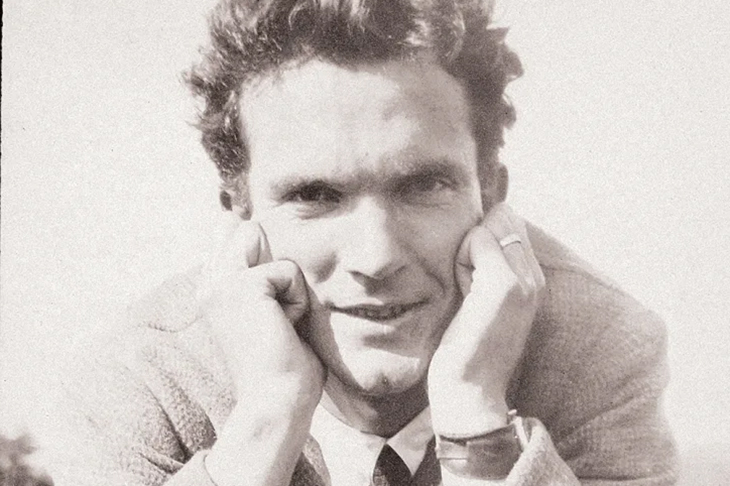
Before he died in 1973 at the age of 81, Neil Gunn was arguably Scotland’s greatest living novelist, a leading figure in its literary Renaissance and the author of 28 books (most famously his bestselling 1941 maritime epic The Silver Darlings). Now, to mark the centenary of his first novel, The Grey Coast, the independent Sutherland-based publisher North House Press is reissuing three of his works in nice clothbound editions. Taken together, they give an impression of his versatility and shortcomings.
Set in the late 19th century on the Moray Firth, in the fictional crofting community of Balriach (based on the Dunbeath of his birth, in Caithness, where his father was a fisherman) The Grey Coast follows the battle of wills between young Maggie and her controlling, miserly, Polonius-like uncle Jeems. He intends to marry her off to the local farmer, ‘a man of substance’ with a lascivious sense of entitlement in this traditionally egalitarian society. Maggie has her eye instead on the tongue-tied mariner Ivor Cormack, and there ensues a fine study of resignation and defiance with a few surprises along the way. (Jeems has a secret hoard of gold and is an accomplished poacher, always a redeeming feature in Gunn’s fiction.) It may lack the psychological reach of some of the later novels, but there is a nuanced evocation of smoored emotions and the importance of companionship, as well as themes which Gunn frequently revisited: the hunter and the prey and ‘the old pulse of the sea’.
This is no ‘romance of the glens’ saga in the tradition of kail yard sentimentalism but a hardscrabble, fatalistic depiction of a life that was tough without being coarse – one might call it ‘moorland noir’, for its chiaroscuro details and mineral-hard realism. There is no room for what the local schoolmaster – referencing the ‘Innisfree’ idyll of Yeats – calls, ‘all moonshine and sugar-candy’. The effects are built up slowly, like a cairn, in the manner of much traditional Highland storytelling.
After a spell as an apprentice civil servant in London in 1906, Gunn became a Customs and Excise officer, travelled extensively around Scotland and was later closely involved with the nationalist movement. Though never a communist, there was an anarchic streak in him, and his fictions frequently feature figures struggling for personal independence against the economic strictures of the modern world. But it is for the outstanding quality of his descriptions of Highland life across several periods that he should be remembered, for he was a supremely adept nature writer. In the elegiac opening to Morning Tide (1931), or the largely autobiographical Highland River (1937), a fluvial allegory splashed with the marvellous, he establishes a distinctive identification of landscape with human emotion. This culminated in his most ambitious novel, The Green Isle of the Great Deep (1944, a dystopian ‘phantasy’ which mixed folklore with contemporary politics and was admired by Jung for its archetypes and symbols.
Far from being quaint or folksy, his mechanisation motifs and landscapes of abandoned buildings (the Clearances underlie his vision like a skull beneath the moorland’s skin) are recognisably those of mainstream modernism; and indeed T.S. Eliot, at Faber, was impressed by his work, twice visiting him (having to share a caravan) and wrote his only Scottish poem as a result – ‘Rannoch, By Glencoe’. When Gunn went to live aboard a boat, Uncle Tom sent him a barrel of rum. Yet Gunn has been marginalised by some as being a ‘provincial’ writer. If he is, it’s only in the sense that Thomas Hardy is, or Halldor Laxness, because his rendering of the deeply shaded Highlands’ history can be as numinous and universal as any fiction in English from the past century.
However, his output was uneven, as evidenced by The Serpent (1943), a period piece hobbled by excessive abstractions and philosophical disquisitions which will not, I fear, garner him many new readers. This fraught psychodrama centres on ‘Tom the Atheist’, who, in the last days of his life, surveys in a series of articulated flashbacks the growth of his intellect, particularly when discovering rationalism and Rousseau in his formative years spent in Glasgow. On his return to the family croft, his freethinking ways clash with the Calvinistic beliefs of his father, Adam, who eventually dies in an apoplectic fit caused by his son’s apostasy. Tom also recalls his early love for the demure Janet (who later falls foul of a dastardly son of the Manse), but their relationship is kept inexplicably secret. One wonders whether this had anything to do with Gunn’s decades’ long covert affair with Margaret Mac-Ewen, despite his apparently happy marriage to Daisy. Either way, urban settings and impassioned polemical discourses were evidently not Gunn’s forte.
An altogether happier reissue is that of his penultimate novel, Blood Hunt (1952), in which he returned to fine form with a tightly plotted three-part thriller set in the Highlands of the 1950s. An honest young crofter, Allan, has inadvertently murdered his love rival, Robert, and is being obsessively hunted down by Robert’s grim policeman brother, Nichol. An elderly bachelor called Sandy harbours the fugitive, and in part the book explores that tricky novelistic subject: what makes a truly good person? Gunn was a professed ‘non-churchman’, but his work carries the cadences of the St James’s Bible as well as its mythology. New life in ancient places fascinated him, and here, as well as symbolic rebirth, there is an actual nativity scene. This is indirectly a Cold War novel, and Gunn wrote elsewhere: ‘I thought that the world after the bomb might well be like this.’ His friend Nan Shepherd called Blood Hunt his ‘Four Quartets’, but it’s more fun than that makes it sound.
In later years, Gunn was influenced by Taoism and Ouspensky, and his work became esoteric and full of ‘psychic stuff,’ as he calls it in his last book, the spiritual autobiography The Atom of Delight (1956). His sales declined. ‘That’s the way things are,’ he wrote to Naomi Mitchison, in a brave aperçu. ‘If one’s work is running counter to the prevailing current, one mustn’t expect much.’ He ended his days on the Black Isle, a gentle, popular, distinguished man, tall in his tweeds, a connoisseur of malt, a poacher turned sportsman. His work is well worth another look.
Got something to add? Join the discussion and comment below.
You might disagree with half of it, but you’ll enjoy reading all of it. Try your first month for free, then just $2 a week for the remainder of your first year.