From small beginnings, the elite have progressed to Covid lockdowns and net zero. Since the second world war, including my childhood, the ACT Children’s Libraries has banned all of Enid Blyton’s books, enough to stock an entire library with a single author. The charge, naturally, was moral rather than literary. She was said to be racist. She was said to be ‘insufficiently first-rate’. This was despite the prime minister, Sir Robert Menzies, providing a spirited defence of Blyton and her character, Noddy, to the Australian parliament. Surveys at the time showed she was the most popular children’s author in Britain and, almost certainly, Australia, but Canberra officials knew that children would be irredeemably corrupted by access.
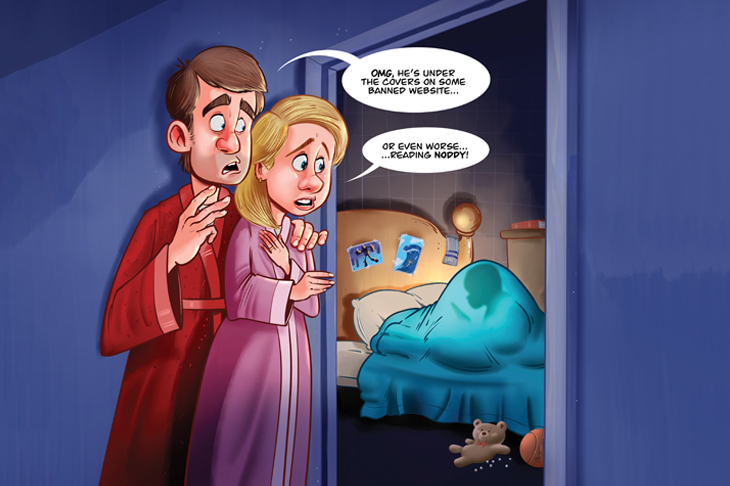
This was meant to be a triumph of enlightened gatekeeping. In practice, it did the opposite. Since the library would no longer supply Blyton, all my pocket money went on buying her books instead. To encourage my sibling to buy at least one, I even tried, unsuccessfully, to hide the copies I had already acquired. The books were passed around, fought over, and read under the sheets with a torch. The more adults tried to suppress Enid Blyton, the more Enid Blyton was bought and read.
That is the first truth about censorship, especially the priggish, bureaucratic censorship beloved of librarians, teachers and cultural officials: it backfires. Ban a book and you advertise it. Denounce an author and you canonise her. Tell children that something is forbidden and you make it irresistible.
Enid Blyton scarcely needed the help. She was one of the most prolific children’s authors who ever lived, with some 700 books, 2,000 short stories, and 500 million copies sold worldwide. Her work has been translated into 40 languages and adapted globally for stage and screen.
From the Famous Five and Secret Seven to the Adventure series, Malory Towers, Noddy and The Magic Faraway Tree, where other writers produced books Blyton produced the foundations of civilisation. Entire childhoods were built out of her worlds: midnight feasts, smugglers’ coves, secret islands, talking parrots, buried treasure and children surviving remarkable adventures without constant adult supervision.
What is often missed is the comfort Blyton gave to children in impoverished wartime and post-war England. In a drab world of rationing, austerity and adult anxiety, her young heroes almost always came from secure, often affluent, families. There was usually a house, a garden, a dog and often a cook to pack them off with all sorts of goodies before the adventure began.
Blyton’s children were plucky, adventurous and, above all, well fed. They might discover thieves, spies, smugglers or even a nest of Nazi U-boats, but they were never abandoned to despair. They would be sustained, protected, and bring themselves home safely. Blyton gave children what modern critics despise and children crave – hope.
That, of course, is one reason the modern cultural class despises her. Blyton understood something that today’s educationalists and diversity consultants cannot bear to admit – children do not read for ideological improvement. They read for pleasure. They want adventure, mystery, mischief, danger and enchantment. They do not want to be hectored by little sermonettes disguised as fiction. They want a story.
And Blyton gave them stories.
Take The Magic Faraway Tree. Its premise is absurd, simple and perfect: an immense tree, at the top of which different magical lands arrive and depart. You climb, explore, panic, laugh and escape before the land moves on. There is no therapeutic framework, no moral messaging unit, no sensitivity reader hovering in the branches. It is pure imaginative freedom. Which is precisely why it has lasted.
The new film adaptation only underlines the point. Blyton survives because she is readable, and readability is a quality the literary bureaucracy has never forgiven. Children chose her voluntarily. They read her because they wanted to, not because a school programme or library display told them she was good for them.
This is what so much of the campaign against Blyton has really been about. Not racism alone, though that is the charge always rolled out first and most theatrically. The deeper issue is control. The professional moralists cannot stand the thought that children might independently adore a writer who does not reflect their politics, language or priorities. A child who chooses Blyton over some earnest modern offering about identity, resilience and emotional processing is a child escaping supervision. That is what really rankles.
Australia has become especially prone to this sort of petty cultural authoritarianism. Libraries, schools and arts bureaucracies are full of small-minded guardians who imagine that culture is too important to be left to the public. Yet the first duty of a librarian, especially in a children’s library, is to get children reading. Success in life is closely tied to the ability to read well, and children hooked on Blyton do exactly that: they read greedily, constantly and to their hearts’ content. The librarian who bans Blyton is not promoting literacy but working against it.
It is a dreary, paternalistic mentality. The same people who insist that children must be ‘heard’ and ‘empowered’ are curiously hostile when children prefer exciting older books to approved new ones. Diversity gives way to conformity. Imagination is marched back inside the rails.
Yet Blyton exposes the stupidity of it all. Children do not care what the library officials think. They care whether the book is thrilling. They care whether the characters are as they would like to be. They care whether the story makes them want to stay awake for one more chapter. Blyton did that better than almost anybody. Which is why every campaign to suppress her has ended in the same way: more sales, more readers, more loyalty.
Financially, the bans and sneers may well have done her a favour. If libraries refused to stock Blyton, kids such as myself bought her instead. If schools disapproved, children sought her out privately. The censor, in his vanity, imagines he is starving an author of readers. More often he is acting as an unpaid salesman.
The larger lesson is plain enough. Childhood is not a branch office of the progressive state. It exists for adventure, discovery, danger, delight and the growth of a private imaginative life. Enid Blyton understood that. Her enemies still do not.
That is why she won. That is why she keeps winning. And that is why the little cultural wardens of Canberra, and every place like it, always lose in the end.
Got something to add? Join the discussion and comment below.
You might disagree with half of it, but you’ll enjoy reading all of it. Try your first month for free, then just $2 a week for the remainder of your first year.