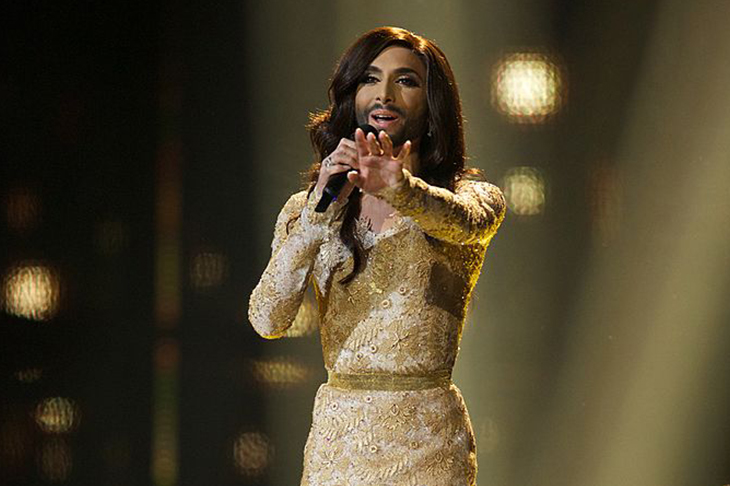
The annual Eurovision Song Contest grants us all a wonderful blend of music of varying quality served with performances that are even more varied. Sometimes, we get electro-industrial bands in full bondage gear (like Iceland’s Hatari) delivering songs that would obliterate every nightclub’s dance floor. Other times, we get drag acts ranging from Austria’s Conchita Wurst to Ukraine’s Verka Serduchka (whose performance of ‘Dancing Lasha Tumbai’ showed us precisely what Elton John’s drag persona would look like). Other times still, we get a rock band that we all cheer for (such as Finland’s Lordi, or Italy’s Måneskin). In any case, we can all celebrate the nations of a bloodsoaked continent coming together in the spirit of peace, and singing songs that are sometimes so terrible one would forgive them for declaring war on each other once more.
A lot of ink gets spilled annually about Eurovision. Many people debate contentiously about whether or not Russia or Israel should participate, for instance. Certainly one can ask if it is appropriate for Australia to participate at all, given that we’re an entirely different continent. That said, I believe the most interesting facet of Eurovision (other than the handful of acts that actually entertain me instead of making me entertain thoughts of suicide) is how it is an accurate microcosm of European politics.
Perhaps the most obvious example is the stark democratic deficit we see in both Eurovision – where national juries wield more than enough power to overrule the popular vote – and the institutions of the European Union, which are explicitly designed to thwart democratic majorities when said majorities refuse to empower supranational managerial technocracy. Just as Brussels is happy to undermine democratic election results, Eurovision juries will vote against songs perceived as ‘too popular’ (see what happened to Norway’s KEiiNO back in 2019). In each case, the institutional design elevates ‘expert’ opinion above that of the masses. As a classical liberal, I actually agree that countermajoritarian institutions have justification, but in the case of the EU the institutions serve to protect failed policies and the jobs of unproductive self-serving bureaucrats, not individual rights. In the case of Eurovision, whilst protection of individual rights isn’t really a relevant concern, one has to wonder why a pop music contest is attempting to restrain the most people-pleasing performance from achieving victory.
Another similarity between Eurovision and the European Union is that within these institutions, whilst all countries are equal, some are more equal than others. In Eurovision, five nations (the UK, France, Germany, Spain and Italy) automatically qualify to enter the grand final no matter where the contest is held (the host nation also automatically qualifies). To be fair, one could argue that this is justified by how the ‘big five’ contribute a disproportionate amount to the European Broadcasting Union (although it has likely diminished the quality of both the UK and Germany’s entries). But such justifications are harder to make for the European Union itself, which operates as a governance cartel through tax and policy ‘harmonisation’ that undermines jurisdictional competition (‘foot voting’). In brief, Germany doesn’t have to reduce its red tape, green tape or tax rates if no European nation offers a better business climate. And let us not mince words – it is Germany that pulls the strings when it comes to EU policy (a cartel can only be stable over the long run if there’s a single dominant member, see for example Opec). The common accusation of the EU being ‘the Fourth Reich’ is not just a taunt but a substantive reality.
A final thing that Eurovision has in common with the political discourse of the European establishment is that, whilst it claims to be apolitical, it smuggles in many political positions (some very divisive) under such a claim. It is common for the progressive-technocratic nations of Europe to deny that their policies represent ideology and to insist that they are merely following science (see for example European nations’ climate policies, or said nations’ Covid responses). Another tactic is to claim that these policies have nothing to do with ideology and instead merely represent common decency or kindness or politeness (see European ‘hate speech’ policies, or many European nation’s immigration policies). In all cases, the side claiming to be ‘non-ideological’ is anything but. The Eurovision Song Contest also claims to be non-ideological and does have rules against political statements being made by performers, but apart from the fact recent battles over which nations can compete (centring on Russia and Israel) are clearly functions of geopolitics, Eurovision juries are commonly believed to vote politically (whether as a kudos to friendly nations, or as a gesture of disapproval of nations with which they have policy disagreements), and Eurovision contestants often find ways to make political statements. For example, the 2024 edition of the contest had two participants who described themselves as ‘nonbinary’ – Ireland’s Bambi Thug (whose performance attire was in the colours of the transgender pride flag, and who also wore a badge bearing the gay pride flag and her preferred pronouns of ‘they/them’) and Switzerland’s Nemo (who ended up winning). Whilst gender dysphoria is ultimately a medical rather than a political question, pride flags are political by definition, and the prominence of ‘trans’ discourse in 2024 means that both of them could’ve just been calling themselves trans for political and/or social positioning reasons. Would Nemo have won in the absence of claiming to be a third gender?
Yes, Eurovision is entertaining. Plenty of people hold viewing parties, typically whilst intoxicated, and laugh themselves sore at the annual spectacle of terribleness (sometimes sprinkled with some genuinely fantastic acts). But culture matters, even if it is contemporary culture that some people look down upon, and it deserves serious study even if (or perhaps especially if) the cultural artefact in question is cynically manufactured and mass-market oriented. It really should not be a surprise that Eurovision reflects European institutions, societies and discourses. Soaring rhetoric of democracy and equality barely conceals an elitist and illiberal reality where the powerful are insulated from the consequences of their blunders. A belief in the brotherhood of nations is espoused, yet the reality is that the more powerful nations impose their will upon and protect their privileges from competitors. A very specific set of actually – contentious political positions is treated as apolitical common decency or simple scientific fact. Come to think of it, perhaps the biggest difference between an Ursula von der Leyen speech and a Eurovision drag performance is that the latter is more honest.
Got something to add? Join the discussion and comment below.
Dr Andrew Russell is an economist and philosopher. His substack can be found at www.drcasino.substack.com
You might disagree with half of it, but you’ll enjoy reading all of it. Try your first month for free, then just $2 a week for the remainder of your first year.