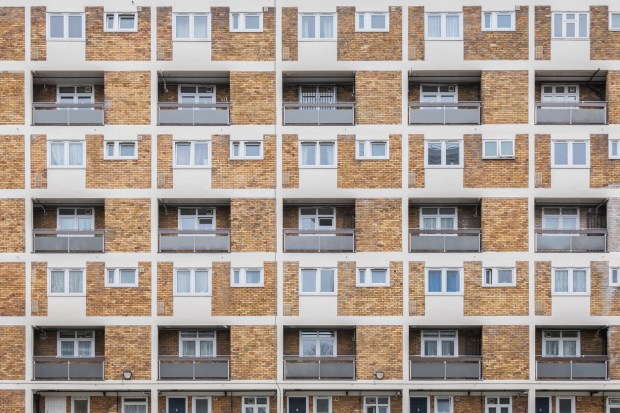
Flats have been getting a bad rap recently. There is the promised leasehold reform being stuck in the legislative and legal process; the many service charges spiralling far beyond inflation; the post-Grenfell Tower cladding issues blighting sales in hundreds of blocks across the country.
To all these negatives must now be added an admission that the value of many flats is plummeting, especially in London – a turn of events which is prompting wildly conflicting responses. On the one hand, are those hailing the price falls with glee – whether as evidence that prices have long been inflated, that investment in property, as in the stock market, can go down as well as up, or as nemesis for greedy housebuilders and investors. Nor is it only frustrated renters eyeing the lower prices, but smug house-owners, congratulating themselves on buying a property that usually comes freehold.
On the other hand, are those for whom the effect of lower flat prices is perverse, as highlighted in these pages last week. For many first-time buyers even these flat prices remain out of reach, while those who stretched their finances to buy a small entry-level flat are now trapped in negative equity for such time as the flat depression goes on. For them, this is a salutary warning that ‘the ladder’ can be a fickle and sometimes cruel metaphor.
It is high time that more people supplemented their British dream of a house with a garden
Perhaps one day, though, this hostile tide will turn. And, as a mostly contented flat-dweller for more than 40 years – as a leaseholder (in the UK) or renter (abroad) – I hope that it will. With housing generally at a premium, it is high time that more people supplemented their British dream of a house with a garden with a more favourable view of living in a flat.
Here are a few reasons why, in no particular order. The layout of a purpose-built flat can be more practical and provide a lot more usable space than a house – especially a house, like most British houses, with stairs. Flats can also be more convenient for a wider range of people – older, younger, disabled – than houses. At least, flats on a single level in a block with a lift are. They can also save taxpayers’ money. In the past 10 years or so, I have twice broken bones and been on crutches but was able to be discharged to my flat without needing additional help. An open layout, with fewer nooks and crannies, also suited my late husband, who had Parkinson’s.
Yes, service charges are often too high and opaque. But in most private blocks you get something for your money: such as security, maintenance of the common spaces, not having to put the bins out on a given day at a given hour, and someone responsible for enforcing rules about noise, disruptive works in other flats and the like.
Green lobbyists might want to skip this point, but many blocks will also have parking, which will reduce your car insurance costs to the extent that it is secure and may provide charging points as well. It is only recently that some developers practically abolished parking or garage space in the name of net zero, but the real reason is surely to save money.
Until the need arises, it can also be easy to overlook the huge and unanticipated costs of owning a house: a new roof, new plumbing, storm damage or subsidence from settling or tree roots. Of these, only the subsidence will generally be met by your insurance. Tot up the repairs and maintenance budget for your house over several years, and the service charges on a flat may not seem quite so extortionate after all. With fewer outside walls, your energy bills could be lower, too.
Flats have even more advantages from the macro perspective. They allow for greater density of housing – and they don’t, whatever developers say, have to be high-rise to warrant the investment. Nine storeys, which used to be the norm in Westminster, still allows for many more residential units than houses over the same footprint. I would be among the first to decry the soulless (and largely unpopulated) forests of high-rises in parts of London. Nine Elms, for example, is a disgraceful example of speculative development. But flats don’t have to look or be built this way – and potential buyers have, rightly, voted with their wallets.
For us, one of the compelling arguments – aside from the amount of liveable space – was that with a flat, you can often afford to live in a better-served, better-connected area, with a variety of shops and transport. You are also more likely to have a view from an in-town flat as opposed to a suburban house – if that is important. Living in central, purpose-built flats when posted to Paris and Washington is what persuaded us to try to do the same on returning to London.
But it is harder, for a host of reasons. One is the prevailing British assumption that professional people live in houses, unlike in many European cities, where flat-dwelling is the norm and a variety of well-built and -maintained blocks cater to different pockets and sizes of household. A related reason is the two negative stereotypes of city flats, as either high-density, run-down and potentially unsafe social housing, or super-luxury multi-million pound ‘apartments’ for the oligarch class.
Much of the flat market consists of conversions rented out, or offered for sale, by private landlords and owners looking for a retirement nest-egg. The popularity (and one-time tax advantages) of buy-to-let only made matters worse, by discouraging the building of new, professionally-managed complexes with leisure and other facilities, and a variety of tenure, such as are commonplace in US and some European cities. Even now, such eminently necessary developments – necessary, that is, both to boost the housing stock and to rehabilitate the image of flats – are slow to get off the ground.
Poor new-build standards, compared with many other industrialised countries, do not help. Even if the finish is acceptable, sound and heat insulation may be poor, with living and storage space skimped on. Post-war council housing remains prized because it was built to what were called Parker Morris standards, which included floor space. These were abandoned in 1980, with predictable consequences.
Specifics of UK practice, prejudice and aspiration combine to mean that flats are seen – except for a rich, itinerant minority – as second-best. This is also reflected in official attitudes, which all too often assume that everyone lives in a house. The promotion of heatpumps, for instance, is of little relevance to most flat-dwellers, as is the appeal to run appliances on off-peak energy. It’s hardly conducive to social harmony if your upstairs neighbours run their washing machine at 3 a.m.
So a lot has to change if your typical aspiring UK homeowner is to be reconciled to flat-dwelling. But now, with discounted flats aplenty and the prospect, albeit long-term, of leasehold reform, this could be your chance. Stop thinking about that cottage with a garden and think step-free floor space, a balcony, and a regular bus service instead.