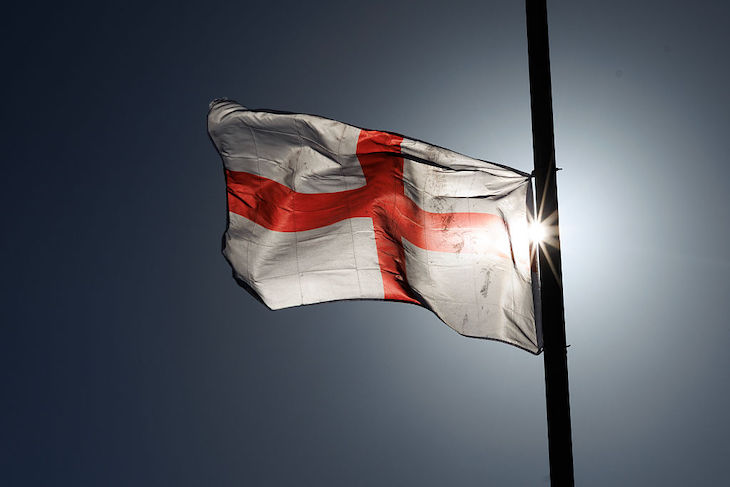
Every year it’s the same old story, and it’s always inaugurated by the usual collection of technocratic mediocrities and simple-minded leftists. Come 23 April, they’re always at the ready to remind everyone that St George wasn’t English actually, declaiming in a precocious schoolboy manner an earth-shattering fact which everybody knows already. Or else they will pronounce that the flag which bears his name actually stands for peace and inclusivity, and that it should never be the preserve of those who stoke hatred and prejudice.
Starmer is mistaken when he affirms that the St George’s flag stands for ‘unity’ and ‘decency’
As if on cue, early yesterday morning we had Kevin Maguire, resident sage of the Daily Mirror, pronounce on X: ‘Today we celebrate a Turkish migrant worker who never set foot in England and in 2026 would probably be barred.’ Barely half an hour later, Prime Minister Keir Starmer added: ‘St George’s flag stands for unity over hatred and decency over division. Those are the values I will always fight for. Some try to hijack our flag to spread hate, I reject their plastic patriotism.’
In their own different ways, both are wrong. The figure who became this saint and legend was born and raised the Roman province of Anatolia and he was not Turkish. The Turks would only arrive in this area in 11th century before going on to become imperialist oppressors themselves. And the real George would in all likelihood not be barred if he set foot in England today. We still have net immigration, our visitor visa rules remain lax and abused, and people are still crossing the English Channel and allowed to stay.
Starmer is also mistaken and disingenuous when he affirms that the St George’s flag stands for ‘unity’ and ‘decency’. For the majority of the people who hold this flag in affection, it simply stands for England: its history, culture, language, laws, institutions and people. North London types like Starmer who regurgitate such inanities as ‘decency’ and ‘unity over hatred’ are the kind who wouldn’t be seen dead displaying it.
Particularly in recent years, they have come to regard it as the embodiment of dangerous nationalism, proletarian impertinence and species of ghastly, non-U patriotism. That’s why Labour councils throughout the land have removed St George’s flags that have appeared in public spaces since the inception of last year’s Operation Raise the Colours. Unreconstructed leftists and progressive sophisticates see the flag as both threatening and uncouth.
In truth, of course, the St George’s flag has no meaning in itself. Like semi-mythical people of ancient times, symbols are floating signifiers, and what significance is ascribed to them changes over time and is dependent on context. Thirty years ago, at the height of the Euro 96 festivities in this country, its arrival in earnest on the stands of English football stadiums was largely welcomed as a more acceptable alternative to the Union Flag, one which in the eyes of many had been irredeemably tarnished by its association with skinheads and the National Front. Before then, the English flag was only regularly seen in public when flown from the spires of Anglican churches.
In recent times, the flag has unquestionably assumed more political connotations. But contrary to Starmer’s assertion, one that reflects a mindset endemic in metropolitan circles, it has not been hijacked ‘to spread hate’. It has been deployed in great numbers by a class of people in this country who feel they have been consistently ignored, denigrated and traduced over the past thirty years. There would be no proliferation of St George flags on lampposts, pavements or on the front of houses and pubs today had not the English people been remorselessly insulted and belittled by a cosmopolitan Anywhere class, and one in hock to a lopsided version of multiculturalism.
This is an echelon that is untroubled by the sight of Palestinian flags fluttering on street corners, one which enthusiastically celebrates cultures, all except the indigenous one of England. This is an entitled class which is apt to smear without distinction anyone with old-fashioned, sensible or moderately conservative views as ‘far right’.
While it’s true that the St George’s flag is sometimes flown by xenophobes and racists, for the majority of English people who aren’t of this persuasion it has become more a symbol of resistance and defiance. It’s a flag used to convey discontent with a detached class that has ignored their plight and dismissed their concerns, to one which continues to parrot platitudes about diversity while turning a blind eye to its manifest defects, to a ‘two-tier’ Keir who seemingly cares about some sections of society more than others.
In that regard, Starmer is unwittingly correct. The St George’s cross has become a symbol of ‘unity’. It has united under one banner great swathes of the populace who don’t like him or how his people have treated them.