The Nativity. In ‘Over 2,000 Illustrations and a Complete Concordance’, Elizabeth Bishop ends her travelogue-poem – St Peter’s, Mexico, Dingle, Marrakesh – by opening the Bible. ‘(The gilt rubs off the edges/ of the pages and pollinates the fingertips.)’ She gives us the famous stable, ‘lulled within, a family with pets’. Domesticated, nothing out of the ordinary, yet prefaced by strangeness: ‘the dark ajar, the rocks breaking with light,/ an undisturbed, unbreathing flame.’ Undisturbed because it is an illustration and therefore fixed. Undisturbed also because it is the Holy Spirit – steady, unchanging – not spirited, but spiritual.
Bruce Chatwin’s On the Black Hill has a school nativity: ‘“I am the Angel Gabriel,” he said in a suffocated voice.’ Kaspar has a bottle of shampoo, Melchior a box of chocolates. Jesus is a plastic doll. No matter: the grown-up twins, Lewis and Benjamin, are captivated.
Pamela Holmes, the late mother of the biographer Richard Holmes, wrote a Nativity poem in which the young woman playing the Virgin Mary salves ‘a nameless ache’ by rocking the Christ-child ‘Long before the play begins’. An ache for a lost child, evidently, but clearly a secret, something private and undisclosed. Miscarried? Put out for adoption? Cot death? Infertility? For which she is consoled by rocking ‘the King of Love’.
All three straddle the quotidian and the metaphysical – true to both. They co-exist.
These three instances, these three different poetic treatments, tell us something important about the Nativity. Two things, actually. One is that the given subject – godhead in a stable – is no longer the sensation it once was initially. A great, almost theatrical oxymoron. Alleluia and agriculture. (About as shocking as Marlowe putting Mephistopheles himself on stage in Doctor Faustus. It took an atheist to risk it.) But it has changed, lost its shock value and requires aesthetic refreshment.
The second thing is that the Nativity is an extreme version of the incarnation. God is made flesh in the helpless human child, but not simply human: proximate to the animal world. A coup. But a coup we are used to, a coup that is almost a cliché, and one that requires inflection and variation to restore its original force.
In the National Gallery, there is Piero della Francesca’s painting of Christ being baptised by John the Baptist. Another scene we are familiar with. Behind Christ is Piero’s tweak: a man pulling his linen shirt over his head, the next person in line.
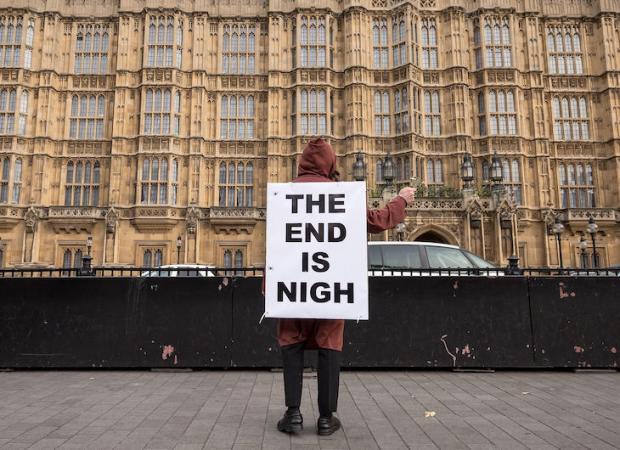
The nativity is almost a cliché – one that requires inflection and variation to restore its original force
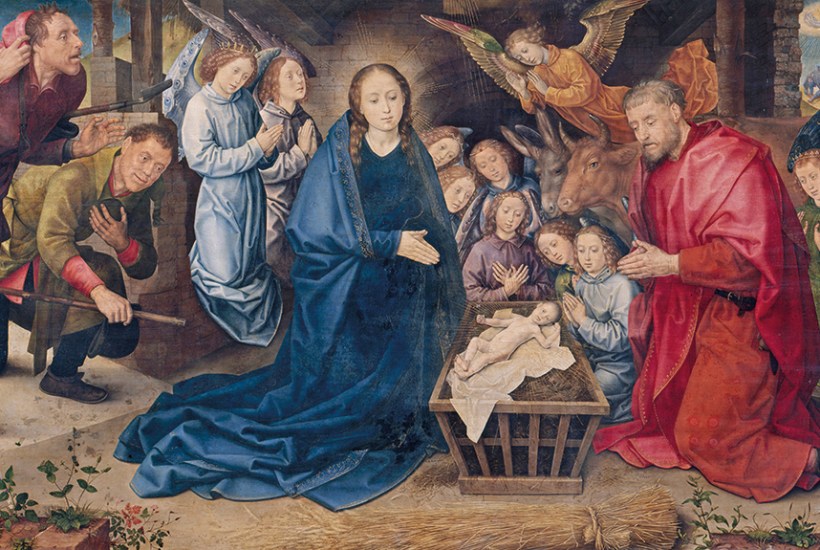
Hugo van der Goes has two paintings of the adoration of the shepherds – one in the Uffizi in Florence and another in the Gemäldegalerie in Berlin. The Uffizi picture, known as the Portinari triptych, gives us the faintly gormless shepherds, one with the top of his long-johns showing. Another in the rear has prominent teeth like a gum-shield and a jaw like the bucket-grab on a crane. The sky is filled with angels in their sleeping bags. Jesus is lying on the floor on a layer of hay that also does duty as a full-body nimbus. It is a great painting, but I want to write about the Berlin ‘Adoration of the Shepherds’ (c.1480), a lesser work but still one with hypnotic presence.
We could start with the hands – often a compositional embarrassment, all fingers and thumbs insisting on themselves, but here expert, intricate yet understated. Two figures at the left and right edges of the painting are drawing back a curtain to show us the tableau. They are sometimes said to be prophets, but I think they are patrons, benefactors being acknowledged. The figure on the right is bald with two side-wings of hair, one wing ruffled and unkempt. His ample beard ends in claws and curls. His garment is subdued in colour but rich in brocade. His left hand emerges from a sleeve bound pragmatically with leather at the cuff. It is raised to draw back the green curtain. The thumb grips the curtain material. The fingers are occluded. The fingers of his right hand below are folded into his palm.
Detail of ‘The Adoration of the Shepherds’, c.1480, by Hugo van der Goes FINE ART IMAGES / BRIDGEMAN IMAGES
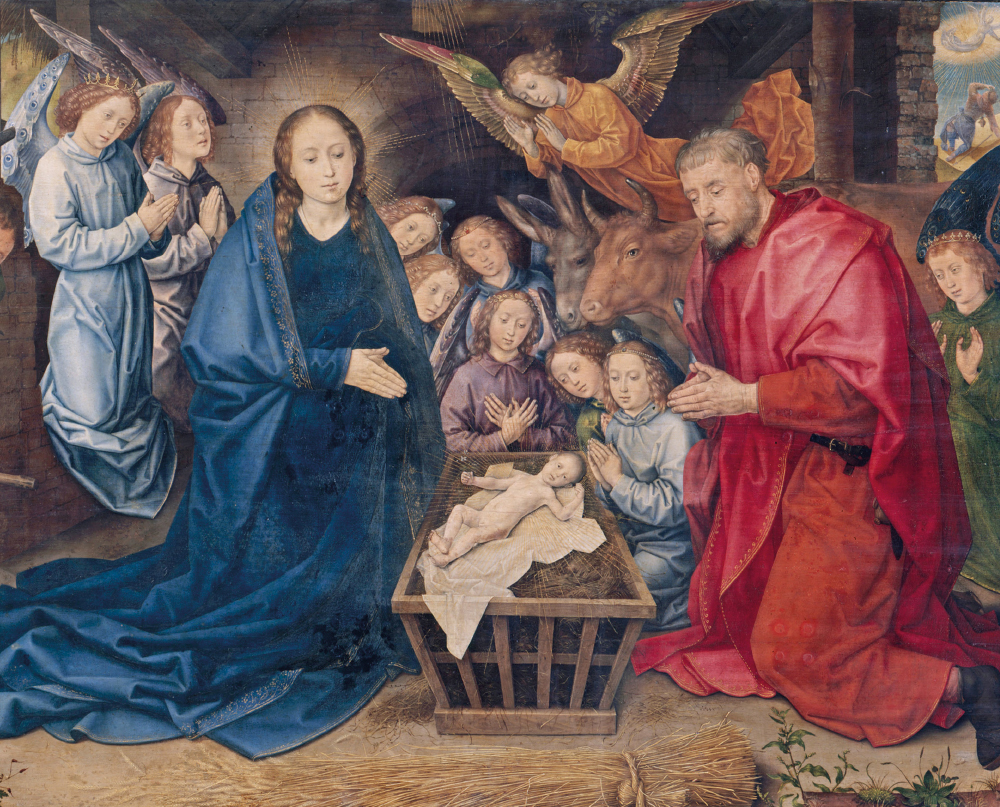
His counterpart on the left is more richly attired in red, possibly leather, possibly slub silk, stamped with silver-grey insignia. His left hand is cropped by the edge of the painting, the right folded over the thumb, intricate but far from the focal centre. Which is the naked Jesus, on a cloth, on a manger (see close-up above). The praying hands of the Virgin Mary and the hands of Joseph on either side point, like fingerposts, to the baby. The Jesus is rather lanky and scrawny and vulnerable. He isn’t swaddled (as he is in Georges de la Tour’s ‘Adoration of the Shepherds’). He is also subtly in a cruciform position – arms at right angles to his body; his ankles crossed, as if anticipating the single traditional thrifty nail through the feet. Just above there is an angel with crossed hands. No wonder no one is smiling. (Apart from the vestige of a smile on one of the shepherds.)
Joseph has a front parting and a fringe – a sort of comb-over suggesting male pattern baldness at the temples
The infant Christ is surrounded by a crowd of six angels. Above them, to the right and left, are three winged angels, with different coloured feathers like birds, fanciful finches. Their faces are interesting. They have a family resemblance – not identical but very similar – deriving, it seems, from the Virgin Mary, whose face, framed by beautifully painted loose plaits, is de facto angelic. This works in both directions: the angels are, in effect, her otherworldly progeny, evidence of effortless fecundity. (No Nativity painting, to my knowledge, even gestures towards the blood bath that is childbirth: delivery is painless, bloodless, and as placid as the face of the Virgin Mary. The miracle of parthenogenesis: not even a face pallid with exhaustion after a long labour.) In the other direction, Mary is elevated to the level of angels.
Joseph has a front parting and a fringe – a sort of comb-over suggesting male pattern baldness at the temples. He is wearing a black ankle sock and a pair of sliders. He is kneeling, so there is a gap between his heel and the wooden sandal. His red garment looks simple but has a patterned gilt edging. Just behind him are a cow and an ass – ears and horns in parallel to the wings of an angel hovering above in a sleeping bag like several of the angels in the Portarini triptych.
But what of the shepherds? (Two this time, not three.) In the background, top-right, we can see the prior narrative of their being summoned by an angel – one literally staggered by the news. Blown away. In the foreground, left, we see them at the very point of arrival. The shepherd nearest to us, a mouth-breather, out of puff, is in the process of removing his cap. Van der Goes captures his forward momentum, his weight on his leading left leg which is in a woollen gaiter, a long-handled trowel tucked under his arm. He and his companion (hat pressed to his chest) are in a hurry. They are afraid they are late. What makes the Berlin painting different from the Uffizi triptych is this: it is an action painting. The benefactors are drawing the curtain on a dramatic scene. It is theatre. Ta-dah. The features of the two shepherds are less stupid than the Uffizi painting, but they are definitely unrefined, plausibly weathered. They are character actors, not leading men, let alone matinee idols. They have been granted prominence, the attention of art.
I saw this painting in 1984 or 1985. In my epic poem, ‘History: The Home Movie’, I mention it in the final section with other paintings in the Gemäldegalerie. I pick on a detail that is invisible in the reproductions I have been working from:
In the foreground of the Van der Goes,
a single ribbon of straw, creased,
exactly seen and set down
on the canvas: impure gold.
The reproductions show a bound sheaf of wheat, not the single ribbon. But I know it is there, waiting for me to revisit the picture in all its greatness. In all its singularity, despite Van der Goes revisiting the subject itself, those shepherds in all their differentiated but unmistakable Dutchness.
PS: there are two male figures I can’t explain. They are standing just outside the stable. The one nearest us is playing a recorder. The other appears to be clapping time. The obvious explanation is that they are shepherds, celebrating, at an anterior stage of the narrative. However, a comparison with the shepherds receiving the tidings shows a crucial difference in treatment. The shepherds with their flocks are miniaturised and sketchy. The two problematic figures are 100 per cent to scale and fully rendered. They don’t look anterior at all. Nor do they look particularly rustic. Moreover, their leisurely musical interlude contradicts the hurry of the central shepherds. Though they belong spatially to the central tableau, they are paying no attention to the grand, humble event in their immediate vicinity. And perhaps this is their import. W.H. Auden’s ‘Musée des Beaux Arts’ makes the same ironic point – that life has its blind spots, its undeniable indifference.
Got something to add? Join the discussion and comment below.
You might disagree with half of it, but you’ll enjoy reading all of it. Try your first month for free, then just $2 a week for the remainder of your first year.