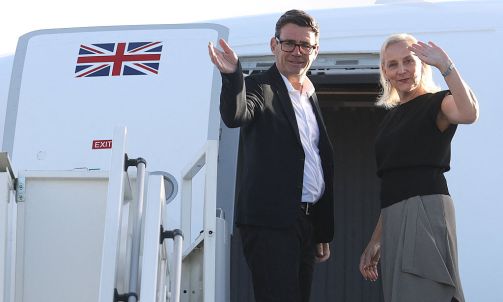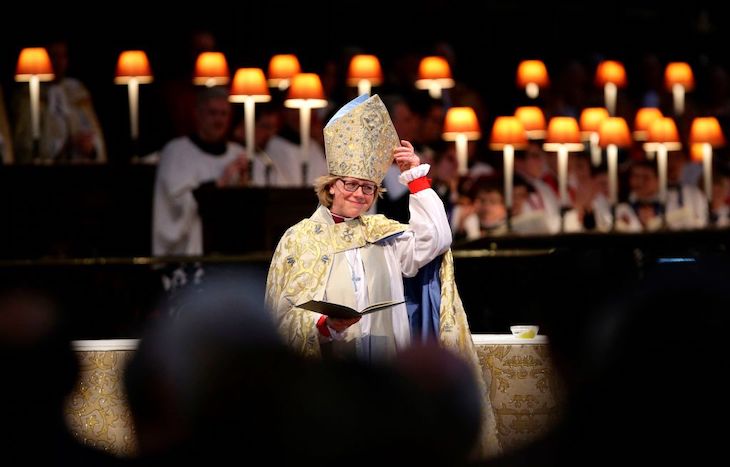
The Church of England has committed a huge mistake in appointing Sarah Mullally to be the 106th Archbishop of Canterbury.
At a time when there is a well-recognised demographic crisis in Church of England ministry, this could well be the thing which pushes the denomination over the edge into complete cultural and especially spiritual irrelevance.
In contrast to what Daniel French recently wrote in The Spectator Australia, Mullally won’t fix the church but further break it apart because she will take the denomination Henry VIII – not Augustine – first formed fully to the left.
Many are already predicting that this will result in what they are labelling as ‘The Impending Worldwide Anglican Schism’ and a ‘Turn Point for the Church’. As even satirical website, the Babylon Bee has stated: First Female Archbishop of Canterbury Is As Woke as You’d Imagined.
The Global Anglican Future Conference (GAFCON) issued an important statement in which graciously but boldly stated in response to Mullally’s appointment that the decision had ‘abandoned Anglicans’. As the statement said:
‘This appointment abandons global Anglicans, as the Church of England has chosen a leader who will further divide an already split Communion.
‘For over a century and a half, the Archbishop of Canterbury functioned not only as the Primate of All England but also as a spiritual and moral leader of the Anglican Communion. In more recent times, the See of Canterbury has been described as one of the four “Instruments of Communion”, whilst also chairing the other three Instruments, namely the Lambeth Conference, the Primates Meeting and the Anglican Consultative Council.
‘However, due to the failure of successive Archbishops of Canterbury to guard the faith, the office can no longer function as a credible leader of Anglicans, let alone a focus of unity. As we made clear in our Kigali Commitment of 2023, we can “no longer recognise the Archbishop of Canterbury as an Instrument of Communion” or the “first among equals” of global Primates.’
Let me expand and briefly explain why the members of GAFCON are completely correct.
First, when it comes to the topic of abortion, Mullally is a confusing mixture of pro-choice and pro-life. Back in 2012 Mullally wrote:
‘I would suspect that I would describe my approach to this issue as pro-choice rather than pro live (sic) although if it were a continuum I would be somewhere along it moving towards pro-life when it relates to my choice and then enabling choice when it related to others – if that makes any sense.’
No, I’m sorry but that doesn’t make any sense at all and only sounds as though you’re trying to have a bet each way. It’s the same kind of contorted logic which says, ‘Personally I’m in favour of the abolition of slavery, but I’m also fully supportive another person’s right to be the master of another human being.’
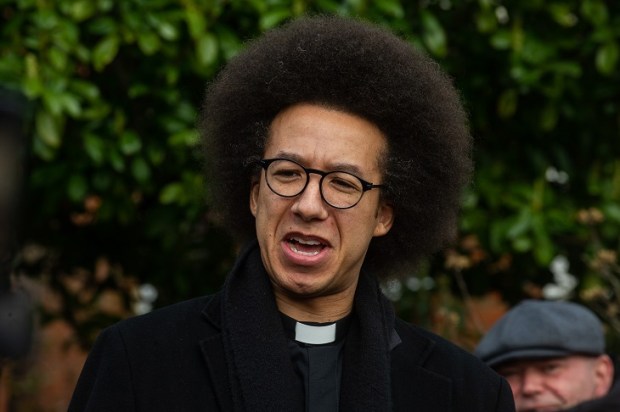
No wonder Dr. Callum Miller posted on X:
BREAKING: New Archbishop of Canterbury supports abortion
"I would suspect that I would describe my approach to this issue as pro choice rather than pro live [sic]" Sarah Mullally
The Church of England has lost all moral credibility. It is over. pic.twitter.com/WEChO3Ox9b
— Dr. Calum Miller (@DrCalumMiller) October 3, 2025
Second, Mullally is just as inconsistent – or what Anglicans would like to refer to as, ‘theologically nuanced’ – on the subject of everything LGBTIQ+.
Mullally has desperately tried to weave a convoluted path between historic Christianity and the present sexual zeitgeist. As Rev Dr Michael Bird, Deputy Principal: Academic and Lecturer in Theology at Ridley College in Melbourne, Australia, explains:
‘She supports the Church of England’s current teaching that marriage is between one man and one woman for life, though she has advocated for inclusive pastoral care for LGBTQ+ individuals.
‘Crucially, Mullally led the Living in Love and Faith project for many years, a church-wide consultation exploring questions around marriage and sexuality. This work eventually led to the Prayers of Love and Faith, services of blessings for same-sex couples now available in Church of England parishes.’
So, once again, Mullally’s doctrinal and pastoral position has the same spiritual certainty of nailing jelly to the wall. My personal prediction is that, just like one of her predecessors, Rowan Williams has done, Mullally’s view will ‘evolve’ to be more and more inclusive. Although, unlike Williams, I’m pretty sure Mullally will reach the same – and possibly even more progressive – position he did while she is still Archbishop.
The reason I say this is because of how she has already responded to questioning around Pride events and the safety of children. For example, see below the post on X by Lois McLatchie Miller:
When Sarah Mullally was questioned on how the Church would protect children from sexualisation & “queer theory”, she remained silent.
Today, she was appointed as Archbishop of Canterbury ? pic.twitter.com/Ek0k4XAAkv
— Lois McLatchie Miller (@LoisMcLatch) October 3, 2025
Third, Mullally is an institutional bureaucrat and not a spiritual leader. Daniel French admirably writes that, ‘Mostly I long for the new Primate of All England to dismantle this careerist, corporatist, managerial culture. Burn it down. Return to basics, starting with prayer?’
As the former Chief Nursing Officer of England, bureaucracy is in her blood. As Michael Bird – who by the way was ‘delighted’ by her appointment – explains:
‘As Bishop of London, Mullally has demonstrated significant administrative capability, having been tasked with modernising and professionalising what had been described as a diocese riven with factions between warring theological tribes and dogged by safeguarding troubles. Her NHS leadership experience equipped her for this managerial challenge, though her bureaucratic approach has raised some complaints, particularly among traditionalists.’
In case you still had any doubts, Gerry Lynch, who formerly worked with Mullally has also written on social media this blunt assessment:
‘It’s not easy to give a fair and balanced public assessment of someone you know personally, even slightly, but here is my best attempt as someone who knows Sarah Mullally slightly – she was Canon Treasurer at Salisbury Cathedral when I arrived in the city 12 years ago.
‘The strengths: Sarah is a superlative behind-the-scenes operator of the Church’s machinery; she knows what governance is about and how to make machinery of governance work. Her colleagues regularly spoke exceptionally highly of her in this regard, spontaneously and without prompting, when she was in this diocese. She has succeeded as a liberal, Central Tradition, Bishop of London, in holding together a notoriously difficult diocese with large blocks of Conservatives on both the Evangelical and Anglo-Catholic ends of the C of E. It isn’t even that the Diocese of London is a microcosm of the entire Church of England – it’s actually far more difficult and far more divided than most of the rest of the Church, and it has been for decades. I presume that’s why she got the job – she’s seen as the person to improve the operation of central machinery and hold the Church together in an era of threatened splits and repeated criticism of poor governance.
‘The weaknesses: Sarah isn’t a great preacher and isn’t a great public communicator. She’ll have people round her to help with this. She’ll need them…’
Hence, rather than ‘dismantle this careerist, corporatist, managerial culture’ Mullally is more than likely to only further build it up. If you’re hope for the new Archbishop is ecclesiastical iconoclasm, or passionate preaching which inspires, then you’ve sadly backed the wrong horse.
Fourth, Mullally is a believer in Critical Race Theory or as others have more accurately referred to it as being, ‘The New Religion of Woke’. Ironically, I would have thought that, that was more than a little inappropriate for the most senior Archbishop in the Church of England to hold to, but then again, it is 2025.
Just to be clear, the worldview of wokeness is completely antithetical to the Christian faith as I have sought to explain before here:
The next Archbishop of Canterbury. I already don’t like her. pic.twitter.com/dmHl1xSqtw
— Chris Rose (@ArchRose90) October 3, 2025
Fifth, Mullally does not have the proper disposition. One of the more cringe-worthy clips going around is of Mullally weeping at being a victim of unspecified ‘micro-aggressions’ and then receiving a 45-second stand ovation.
This sobbing weak-limbed open-borders fanatic is now the Archbishop of Canterbury.
How @churchofengland has fallen. pic.twitter.com/skiDXkj7eL
— Madeleine Emerald ? (@emeraldthiele) October 3, 2025
This is part of the reason why men, in particular, are leaving the Church of England for more conservative – i.e. Biblically faithful – expressions of Christianity. At a time when other religious faiths are growing rapidly in Britain, appointing someone to the highest ecclesiastical office in the worldwide Anglican communion, but is also triggered by the slightest disagreement is only going to end in more tears!
Sixth, closely connected to the previous point, Mullally is a fervent evangelist for open borders. For the pagan world coming into Britain rather than Christians being sent out into the world. One has to seriously question how committed she is in seeing anyone coming to following Jesus because the Islamic proselytisation of the UK is already well advanced.
Seventh, Mullally’s main passion seems to be saving not people but the planet itself. The only crusade the new Archbishop of Canterbury will be leading will be the ‘global fight’ against Climate Change and especially the use of fossil fuels. As Mullally wrote when Bishop of London:
‘As stewards of God’s creation, we have a responsibility to doing whatever we can to act sustainably and protect the world we live in. Across the globe, we are already seeing the impact of climate change affecting lives and communities, particularly in some of the poorest parts of the world. Motivated by our own faith and our care for all of God’s people, we are committed here in London to reducing our carbon emissions as far and as fast as possible.’
O dear… Well, at least when they close their buildings maybe some of them can be converted – if it’s still okay to use that term – into community gardens to offset the carbon emission from all the candles they historically burned.
All of which is to say – as my children would express it – if Mullally is the best candidate for archbishop then the Church of England is officially ‘cooked’. That said, the writing has been on the wall for some time.