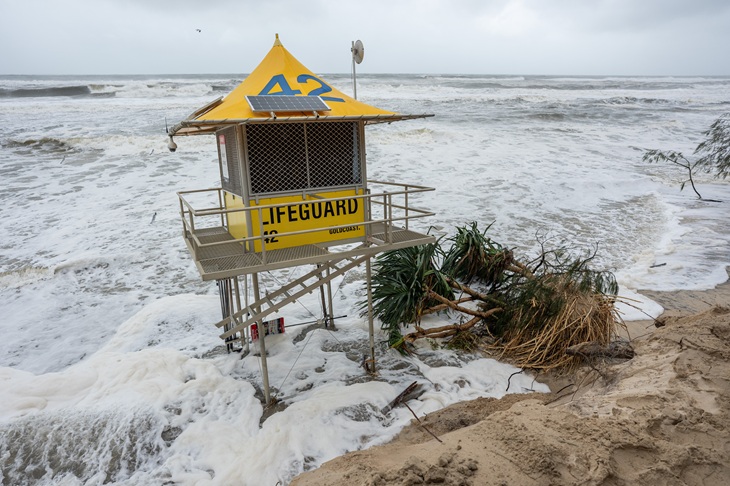
As I commence this post, I am currently ensconced in my office (okay, it’s a spare bedroom) in my home on the NSW far north coast, not 200 metres as the crow flies to the currently frothing ocean beyond. My scenario is not unique. There are many tens if not hundreds of thousands along this stretch of coast in a similar position, some with commanding views of said ocean. It’s mid-morning on Friday, March 7, and Tropical Cyclone Alfred looms large, if not through its physical presence then through the breathless reporting of it to the nation as a whole through all the usual media channels.
Outside, my house is being lashed by constant rain, around 60-80 mm in the last 24 hours, which is significant but bettered on more occasions over the decades than one could readily list. Some other locations nearby have topped 100 mm in last 24 hours but again this is not especially unusual. The current wind speed is averaging about 35 knots (65 km/h) out of the south-east with gusts approaching or just topping 100 km/h. This is the ‘whip tale’ to the south of the cyclone’s centre passing over me as I write and is the expected peak of wind conditions for my location south of the Queensland border. While not pleasant, these conditions are not ‘tear buildings apart’ kind of conditions, à la Cyclone Tracy. One power-line has come down in my coastal village and that was in a small side street over a day ago now and very few trees have fallen throughout the area although many branches have come unstuck.
It is already evident to me that TC Alfred, although still around 18 hours from landfall (at this stage) is not going to wreak untold destruction through its wind speeds, nary a roof will be lost. The maximum wind speeds TC Alfred will generate will be the kind of wind that is an every-other day occurrence in locations like Invercargill in New Zealand and King Island in Bass Strait. This is not to underestimate the impacts of flooding that TC Alfred may yet bring – this is by far its greatest threat, but images of cyclonic winds flattening everything in their wake will be conspicuous in their absence in the aftermath of Alfred, albeit undoubtedly some power lines will fall along with some large trees and power outages in some areas have all.
There is a reason why the stated Category 2 cyclone Alfred will be thankfully underwhelming in its destructive wind speeds and that reason rests with the Australian Bureau of Meteorology (BoM). You see, not all cyclones, typhoons, or hurricanes are created equal and one man’s tropical cyclone is nothing more than another man’s tropical depression or east coast low as many would be familiar with on the Eastern Seaboard of Australia. It may surprise many that the categorisation of cyclonic storms (including typhoons and hurricanes) varies in every major ocean basin around the world that has the potential to generate such storms. These ocean basins and the correlating categorisation system are as follows:
- The Atlantic, Central and Eastern Pacific – Saffir – Simpson Scale (US System)
- Western Pacific – JMA RSMC Tokyo Scale (Japanese System)
- North Indian Ocean – IMD RSMC New Delhi Scale (Indian System)
- South-West Indian Ocean – MFR RSMC La Reunion Scale (French System)
- Southern Pacific – ATCIS (Australian BoM System)
- Saffir-Simpson Scale (US System) – Tropical Storm (lower than a Category 1 system)
- JMA RSMC Tokyo Scale (Japanese System) – Between a Tropical Storm and Severe Tropical Storm category (lower than a Typhoon category)
- IMD RSMC New Delhi Scale (Indian System) – Cyclonic Storm (lower than severe Cyclonic Storm category)
- MFR RSMC La Reunion Scale (French System) – Between a Moderate Tropical Storm and Severe Tropical Storm (Lower than the Cyclonic Storm category)