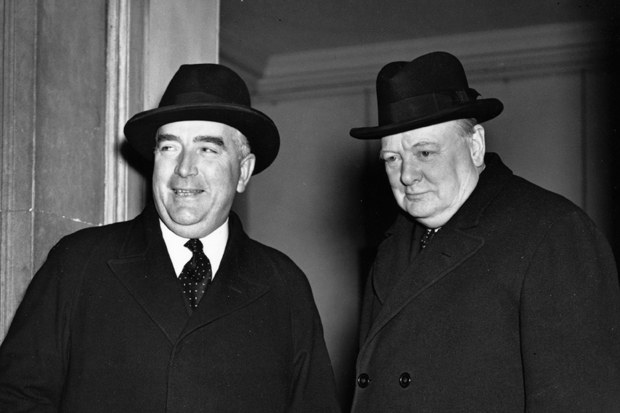
The Liberal party has moved much further to the right than in the days of its illustrious founder Sir Robert Menzies. While the party continues to celebrate Menzies’s life and political achievements, it has no wish to recreate the sort of closed in, protected nation which Menzies did so much to preserve in the 1950s and 1960s. Neither has the party shown much interest in looking further back to the Menzies of the late 1930s, when he was a supporter of Neville Chamberlain’s policy of appeasing Nazi Germany.
Menzies was not the only politician in the 1930s who was anxious to avert war and who was willing to buy peace at almost any cost. In fact, Winston Churchill was almost alone among British politicians in believing that the cost of appeasing Hitler would be too great. Indeed, it was likely to be impossible to achieve. At the time, though, it seemed reasonable to search for ways to avoid a conflict which would lead to millions of deaths and the possible defeat of Britain and the break-up of its empire.
However, it was less reasonable to search for ways to bring about a negotiated peace once the war had broken out and Hitler had sent his armies storming east into Poland and then into Norway, Denmark, Belgium, Holland and France. Yet that is what Menzies sought to do prior to his four-month visit to Britain in early 1941. As I showed in Menzies and Churchill at War, once he arrived in London, Menzies was also drawn into a circle of leading political, military and press figures who were critical of Churchill’s leadership and wanted to curb his untrammelled power. Or even get rid of him altogether.
As incredible as it might seem today, Menzies was led to believe that he might be one of the possible replacements for Churchill. With his political support crumbling in Australia, and with the war going very badly for Britain, it didn’t take much for the very Anglophile Menzies to fancy himself as the next leader of the British Empire, with a mission to bring the war to an early end and save the empire. In the end, the task proved too great and Churchill proved too wily. Menzies lost his prime ministership in Australia and was prevented by Churchill from returning to London while the war was on.
Although the evidence for Menzies’s activities and his ambition is set out clearly in my book, there has been an interesting contrast in the responses to the book in Australia and Britain. Contrary to Peter Coleman’s baseless assertion to the contrary (Spectator Australia, 5 July 2014), British historians universally hailed the book when it was first published in 1986.
Lord Blake, the historian of the Conservative party, reviewed the book for the Financial Times, and concluded that the book made ‘an important contribution to the historiography of the second world war’. Likewise, Ritchie Ovendale reviewed it for the Times Higher Education Supplement, describing the book as ‘a fascinating and highly readable work based on shrewd detective work’. And there are many more. Indeed, the publication of the book led to my appointment as a research fellow at Clare College in Cambridge.
Not surprisingly, I suppose, the Liberal party and its historians have been loath to accept the reality of Menzies’s first prime ministership. His official biographer, the late Allan Martin, led the way. After doing minimal research in Britain, he dealt with the question by simply dismissing all the evidence I’d assembled and denying that Menzies might have had political ambitions in Britain. The right-wing political commentator Gerard Henderson took his cue from Martin when he wrote his account of the Liberal party, Menzies’ Child (1994), simply citing Martin and calling my book ‘bunk’.
Now his wife and helper on Menzies’ Child, Anne Henderson, has done a book of her own, Menzies at War, helped by Gerard, in which she has gone back to some, but not all, of the archival sources that I used for my book. Not surprisingly, she has come to the completely opposite conclusion. Although it purports to be a work of serious history, she is more intent on arguing that my book, and the later ABC docu-drama of the same name, were part of some dark left-wing conspiracy to denigrate the Liberal party’s founder.
In the world of the Hendersons, it’s all a pernicious myth that Menzies was a staunch supporter of empire and a politician who had London as the focus of his ambition in 1941-42. Instead, he is portrayed as a steadfast Australian nationalist who only went to London to secure planes and ships for the defence of Singapore, the supposed linchpin of Australia’s defence.
Unfortunately for Anne Henderson’s argument, she fails to explain why Menzies spent so little of his time in London actually trying to obtain these defence resources and left London having achieved nothing of any consequence.
Neither does Henderson explain why Menzies spent so much of his time in England exploring political options with Churchill’s critics and, almost as soon as he arrived back in Australia, was determined to return to London.
Indeed, he was so determined to take his chance in London that he was prepared to resign his position as Australian prime minister. None of that sits very well with the portrait that Henderson is determined to paint of the Liberal party founder whose supposed primary focus was the salvation of Australia.
It is ironic that Menzies, who would go on to be the longest-serving prime minister of Australia, harboured a secret aspiration to be prime minister of Britain. Although he wanted to use that position to negotiate peace with Germany, it should perhaps be seen to Menzies’s credit that so many leading Britons in the darkest days of 1941 regarded the young Australian politician as having the potential to become the leader of the empire. Instead, we are provided with yet another vain attempt to deny that it was ever his aim.
Got something to add? Join the discussion and comment below.
David Day’s first book was Menzies and Churchill at War (1986), which was republished by Thistle Books in 2013 as Churchill at War. His biography of Paul Keating will be published in November.
You might disagree with half of it, but you’ll enjoy reading all of it. Try your first month for free, then just $2 a week for the remainder of your first year.