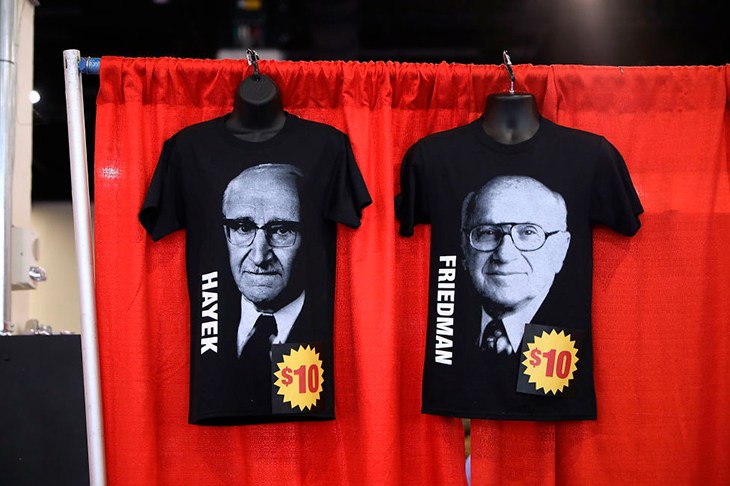
Milton Friedman said it plainly half a century ago. Inflation is always and everywhere a monetary phenomenon. It happens when the quantity of money grows faster than the quantity of goods and services it has to buy. No amount of official modelling about supply chains, Ukraine or the weather alters that arithmetic. Australia has now had two bouts of inflation in five years. Each has a monetary cause, and each was made in Canberra.
Start with the first. In 2020, the Commonwealth and the states chose to shut down large parts of the private economy. Output fell by about 7 per cent in a single quarter, the largest fall on record.
Spending did the opposite. JobKeeper cost $88.8 billion and paid an average of 3.6 million people a month in its first six months. Total direct Covid support came to about $311 billion. The Commonwealth ran deficits of $85.3 billion, $134.2 billion and $32 billion over three years, a total of $251.5 billion.
The Morrison government did not pay for this with taxes. Nor, in the end, did it pay with genuine borrowing from savers. The Reserve Bank bought about $260 billion of Commonwealth bonds between March 2020 and February 2022, almost exactly the size of the deficits. It bought another $57 billion of state bonds. It lent the banks $188 billion at 0.1 per cent. The legal nicety was that the bank bought the bonds from investors rather than straight from Treasury. The economics were identical. The deficit was paid for with money created from nothing.
So Friedman’s two conditions were met at once. The supply of goods was cut by decree. The supply of money was expanded by decree. Households, locked at home, banked the windfall. When the doors reopened, they spent it. Annual inflation went from minus 0.3 per cent in mid-2020 to 7.8 per cent by the end of 2022, the highest in more than three decades.
The official explanation still blames global supply shocks. But every country faced those shocks. The countries that suffered the worst inflation were those that printed money most freely. Australia was among them. Josh Frydenberg and Philip Lowe deserve most of the credit for the 2022 price surge, and Vladimir Putin rather less.
The printing presses stopped in February 2022. Since then the Reserve Bank has bought no bonds. Its holdings have shrunk by more than $120 billion as bonds mature. Yet inflation is back at 4.3 per cent, higher than in America, Britain, France or New Zealand. Friedman would ask where the money is coming from. The answer is now the banks.
Broad money has grown by roughly a quarter since the Albanese government took office in mid-2022, or close to 6 per cent a year. Bank credit is now growing at 8.4 per cent a year, with business credit up 11.3 per cent. When a bank writes a loan, it creates a deposit. The quantity theory does not care whether the money comes from the central bank or a commercial one.
Set that money growth against real output. Real GDP has grown at barely 2 per cent a year, and output per head is still lower than in June 2022. Money growing at close to 6 per cent, chasing output growing at barely 2, leaves roughly 4 per cent to be absorbed by prices. That is almost exactly the inflation rate we have. Friedman’s arithmetic works. The Treasurer’s excuses do not.
Government has not stood aside from this credit boom. It has fed it. Labor expanded its home guarantee scheme so that any first home buyer can borrow with a five-per-cent deposit, with Canberra standing behind the loan. Every such loan creates new money and new demand for a fixed stock of houses. Policy is pushing credit out of the banks while the Reserve Bank tries to rein it in.
Meanwhile the fiscal side has been funded the old-fashioned way, by tax and borrowing. Commonwealth payments rose from $616 billion in 2021-22 to $787 billion in 2025-26. Receipts rose by $180 billion over the same period, swollen by bracket creep that no parliament voted for. Gross debt rose by $76 billion. The states, led by Victoria, are borrowing heavily too. None of this is money printing. But it pulls labour and resources out of the private economy and into the public one.
The scale is extraordinary. Public spending has reached a record 28 per cent of GDP. The non-market sector of health, disability care, education and public administration produced 93 per cent of jobs growth in the year to late-2025. NDIS payments to participants were growing at 16 per cent a year.
And the productivity of that expanding sector is collapsing. Productivity in the non-market sector fell 6 per cent in the three years to 2024-25, the largest decline on record. Productivity across the whole economy has not grown in six years. Canberra is moving workers from activities where output per hour rises to ones where it falls. That shrinks the real output on which all the extra money must be spent. It is the denominator in Friedman’s equation, and the government is squeezing it.
So the two bouts of inflation share a single logic, but they differ in their mechanics. Under Morrison the numerator exploded. The Reserve Bank printed money to cover deficits while governments closed the private economy. Under Albanese the numerator keeps growing through bank credit, encouraged by government guarantees, while the denominator stalls. An ever larger, ever less productive public sector absorbs the labour that private firms need to grow.
The remedy follows directly. The Reserve Bank must never again finance a government deficit, through the front door or the back. Canberra should stop underwriting mortgage lending that inflates both credit and house prices. Spending growth, above all in the NDIS, must be brought back below the growth of the economy that pays for it. Tax brackets should be indexed so that inflation stops rewarding the Treasury. Above all, the private economy must be allowed to produce more.
Friedman also warned that inflation is a disease that can destroy a society. Australians have now caught it twice in five years. The first dose came from the printing press. The second comes from the banks and the bureaucracy. Both came from Canberra.
Got something to add? Join the discussion and comment below.
Peter Swan AO is Emeritus Professor of Finance at the UNSW-Sydney Business School
You might disagree with half of it, but you’ll enjoy reading all of it. Try your first month for free, then just $2 a week for the remainder of your first year.