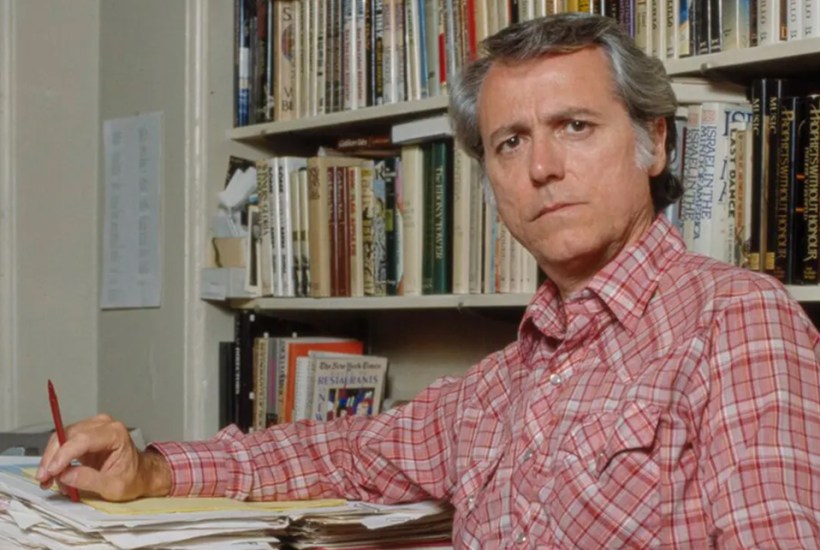
In Don DeLillo’s 1985 novel, White Noise, there’s a scene in which the narrator’s wife asks him to choose a book for her. ‘But I don’t want,’ Babette says, ‘anything that has men inside women, quote-quote, or men entering women. “I entered her.” “He entered me.” We’re not lobbies or elevators.’ What most readers didn’t know at the time was that DeLillo – then beginning his most celebrated period and about to become a novelist of ideas whose ideas are taken seriously – had himself written just such a book. Well, sort of.
Amazons, published five years earlier under a female pseudonym, was the product of a transitional moment in DeLillo’s career. His first six novels had been fairly well received but barely read. So he decided it was time for a potboiler – specifically a satirical hockey-erotica potboiler. (A former advertising colleague, Sue Buck, collaborated with him, but this seems to have been at the level of ideas rather than sentences.) Remarkably, it worked, easily outselling everything else he’d written; but it also became an embarrassment. DeLillo disowned it, and never allowed it to be reprinted – until now.
Amazons has an attention-grabbing premise but little plot. Its narrator is 23-year-old Cleo Birdwell – a likeable if unconvincing creation, half ‘Badger, Ohio’ naïf, half toyingly sceptical sophisticate – whom we follow on her first year with the New York Rangers. The hockey season is mostly a narrative device – a way of getting Cleo from one snowy North American town to another and racking up sexual encounters along the way. Unfortunately, the sex itself – and there’s loads of it (rule of thumb: if a male character has more than five lines of dialogue, he’s next) – is a slog. White Noise’s Babette would be fuming: sportswriter Murray ‘calmly, neatly, firmly entered’; Manley, a fencer (and thus deserving of the high style), ‘effected entry’; while Sanders, her lowly manager, simply ‘entered, entered, entered’.
It’s in the conversations around the sex where the novel really works. ‘“Sanders, are you telling me that just because I said the word Watergate, you’re not going to be able to function?” … “It’s the central fact of the decade. No male American has emerged unscathed. We lost so much, in so many ways.”’ It’s easy to see how a few contemporaneous reviewers identified this as DeLillo. But don’t get your hopes up. Stylistically, Amazons is well below standard: its sentences tend to be slack and weightless; there’s little of his usual pressurised lyricism or virtuosic exactitude. Still, even dashed-off DeLillo is better than most; and it really is funny. Lines such as ‘the home team comes out like woodchoppers in some crazy German operetta’ occur on almost every page.
Its pleasures, though, are strictly local. There are a few gestures towards something bigger – some symbol-play, maybe, with Cleo-as-Eve – but really (and exceptionally for DeLillo) it’s farce that stays farce. Nothing carries a moral charge; there are no consequences in its world, and certainly no sin. As Cleo herself admits in uneasy meta-fictional asides (‘I didn’t think major thematic material would be this hard to turn up’), it’s a daftly insubstantial book.
With this reissue, Amazons, now that its author is securely canonised, will likely be given more respect than it merits. Still, it’s a welcome addition to the DeLillo corpus, if only as an antic postscript to his underappreciated early period: a last bit of play before he got down to the serious – occasionally overserious? – work on which his reputation rests.
Got something to add? Join the discussion and comment below.
You might disagree with half of it, but you’ll enjoy reading all of it. Try your first month for free, then just $2 a week for the remainder of your first year.