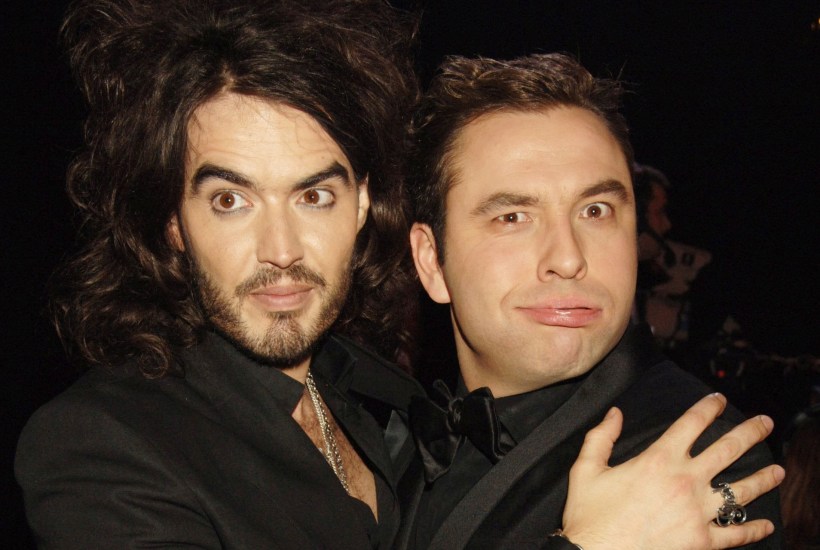
With Russell Brand’s conviction for rape and sexual assault, and the allegations swirling around David Walliams, there has been another bleak period of introspection at Broadcasting House.
Once again, well-known BBC alumni are making headlines for all the wrong reasons. My colleagues and I have experienced déjà vu, once again covering men who have tarnished the reputation of our employer. Unlike the Huw Edwards affair, at least this time it wasn’t a key figure in the newsroom.
These stories usually follow the same blueprint. There’s a pattern of behaviour that, for many years, is ignored, winked at or even enabled. Then, when the dam finally breaks and the truth comes out, there’s a rush for cover, accompanied by implausible denials of any knowledge of what was going on.
The desperation to shake off the BBC’s stuffy image and appear edgy, cool and youthful was one of the factors that led to the hiring of Russell Brand and the commissioning of Little Britain in the first place
Indeed, it’s astonishing how so many people missed the red flags so large they wouldn’t look out of place at the national congress of the Chinese Communist party. The questions about why this keeps happening at the BBC aren’t going to go away.
Has the broadcaster simply suffered a run of bad luck with celebrity scandals, or have the corporation’s own priorities made them more likely? Has my employer prioritised success over safeguarding, and ratings over respectful conduct? Crucially, has it learned the right lessons and taken the necessary steps to stop the rot?
David Walliams’s career with the BBC stretches back more than two decades, his star rising considerably when the sketch show Little Britain hit our television screens in 2003. I was never a fan. With its array of grotesque characters and stereotypes, Little Britain was to comedy what the Big Mac is to cuisine. Unsurprisingly, like Walliams’s reputation, Little Britain has aged like milk.
If only someone, anyone, had known back then that Walliams might be a problematic personality to feature on a high-profile BBC show. If only there had been some clue that might have spared the broadcaster from another PR own goal?
Well, as is becoming clear, Walliams’s alleged proclivities seemed to be an open secret. Hosting the 2004 British Comedy Awards, Jonathan Ross made a joke about him taking home a drunk 15-year-old girl. Did the assembled celebrities gasp in horror at the suggestion? No, they hooted with laughter, suggesting the gag had landed bang on target. Walliams smiled and stuck two fingers up at Ross. Nobody’s laughing now, though. Ross has since said he didn’t write the quip and was ‘horrified’ to learn of the claims against his friend. But whoever did write the joke surely didn’t pick Walliams as the punchline at random.
Walliams’s career flourished at the BBC from that day forward, until the end of last year, when the BBC confirmed it had no future projects directly involving him. His last television outing for the broadcaster was in January this year, when he featured in a rerun of a festive edition of Would I Lie to You? As another Christmas approaches, and despite his categorical denials of any wrongdoing, it feels as though his goose is well and truly cooked.
There’ll be no roast fowl for Russell Brand this Christmas. His yuletide fare will be porridge. The BBC can take some comfort in the fact Brand hasn’t worked in any substantial capacity for the corporation for nearly two decades. But the question remains why somebody who built his career on boasting of dubious sexual escapades should have been hired in the first place.
It was predictable this compromise with standards would end badly, and so it proved. The infamous 2008 ‘Sachsgate’ scandal, when Brand and Jonathan Ross left lewd messages on the answerphone of Fawlty Towers actor Andrew Sachs, which were then broadcast to the nation on Radio 2, heaped shame on the corporation.
Brand resigned in the wake of the sordid episode, but subsequently returned to the BBC in triumph after reinventing himself as the revolutionary mouthpiece of the new progressive left. He secured invites onto flagship current affairs programmes Question Time and Newsnight to pour forth his gospel in a manner that was both risibly reductive and inanely garrulous. Never has a man spoken more and said less, but the BBC again decided his pulling power (drawing audiences rather than seducing women in this context) was more important.
He also fronted serious programmes for the BBC about substance abuse and recovery as a former addict. And an appearance on Radio 4’s Desert Island Discs gave him the opportunity to attempt to reframe the Sachsgate controversy as a conspiracy by elements of the media to harm the BBC.
Inevitably, Brand’s incarceration and the allegations surrounding Walliams have added to the impression – planted in the public imagination by the revelations about Jimmy Savile and cemented by the subsequent disgrace of other high-profile figures – that the BBC has a habit of harbouring paedophiles, predators and sex pests, even after the warning lights have started flashing.
Unfortunately, the BBC can’t do anything thing to escape the sins of the past. But as it looks to the future, a seismic cultural shift is required to prevent history from repeating itself.
Some efforts are already underway. Tens of thousands of pounds have been spent on a ‘Call It Out’ campaign designed to encourage whistle-blowers to highlight instances of inappropriate behaviour by staff. But are mugs and keyrings emblazoned with the slogan really enough to root out a pervasive problem that is beginning to look institutional?
Calling out bad behaviour after it has happened is shutting the stable door after the horse has bolted. What is also required is meaningful vetting at the recruitment stage to weed out the flawed characters who seek fame for nefarious ends. And BBC leaders need to have a serious think about what their priorities are, or this corporate messaging begins to look meaningless.
Take the oft-stated goal of attracting younger audiences, for instance. You can see evidence of this in the vacuous clickbait content that is posted regularly on the BBC’s website masquerading as news. The desire to connect with Gen Z has been so great it has even led to a deliberate skewing of editorial standards and impartiality (see the BBC’s lamentable record on coverage of gender ideology, for instance).
The desperation to shake off the BBC’s stuffy image and appear edgy, cool and youthful was one of the factors that led to the hiring of Russell Brand and the commissioning of Little Britain in the first place. The potential value Brand and Walliams offered seemed worth the risks involved. That sort of Faustian thinking has to change.
As he reshapes the BBC to make it fit for an uncertain future, Director-General Matt Brittin has talked about ‘meeting audiences where they are’, presumably online. But should the BBC really be pandering to the TikTok generation, or aspiring to set higher standards by providing something better?
By choosing the former, the risk is that, once again, presenters and performers who are seen as successful in attracting the readers, viewers and listeners the BBC is anxious to reach will be given a pass.
Meeting audiences where they are is all well and good if that is in a dignified and intelligent space. Where people want to be ‘informed, educated and entertained’ in a manner befitting a once-cherished and respected national broadcaster. But if certain elements want to meet in the gutter, the BBC would be best advised to steer clear.