I’m generally sceptical when our leaders claim Australia needs to import more people because of skills shortages.
But there is one field in which we do seem to have a serious shortage of skills: economic policy.
For nearly two decades, Australia’s politicians and bureaucrats have struggled to deliver strong productivity growth and rising living standards. Instead, they have largely relied on population growth to increase the size of the economy.
This demonstrates a serious lack of skill. So, in this case, perhaps we should look overseas for people who have the skills we need. Fifty really sharp operators should suffice.
I have a suggestion about where to look: Taiwan.
If Australia’s population and real GDP per capita had followed the same trajectory as those of Taiwan since 2007, there would have been about six million fewer people living in Australia in 2025 – and our real GDP per capita would have been nearly A$60,000 higher.
We would have far fewer people but be much richer on average.
Don’t believe me? Check out these charts.
Two similar economies, two different trajectories
The charts start in 2007, just before the 2008 global financial crisis. Data are from the International Monetary Fund. The IMF measures each country’s GDP in ‘international dollars’, a US-dollar equivalent adjusted for differences in countries’ purchasing power. This allows comparisons across countries with different currencies and price levels. That measure is then adjusted for inflation to give real GDP in each year at constant 2021 prices. Dividing that by population gives real GDP per capita.
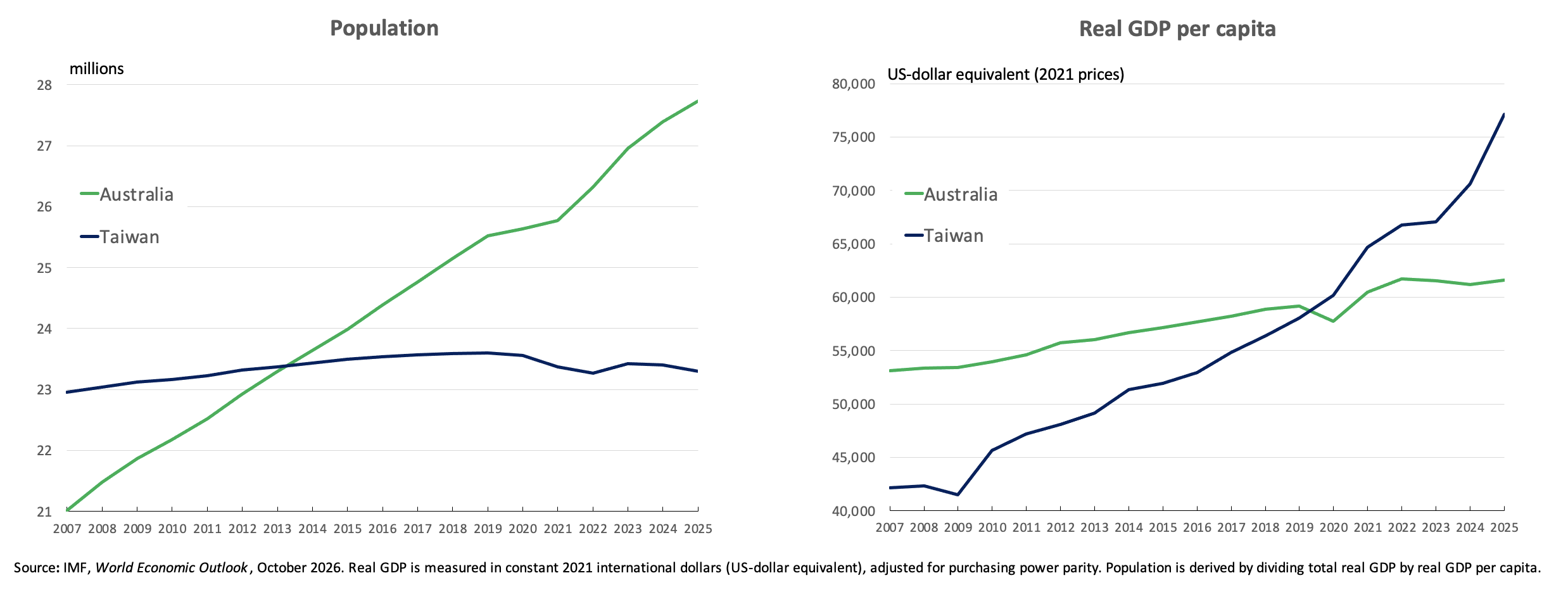
Back in 2007, Australia and Taiwan were both prosperous, developed economies. Taiwan had about two million more people than Australia, while Australia had higher real GDP per capita. By 2025, the situation had reversed. Australia now has about four million more people than Taiwan. But our real GDP per capita is now much lower than Taiwan’s.
The next pair of charts shows the divergence more clearly.
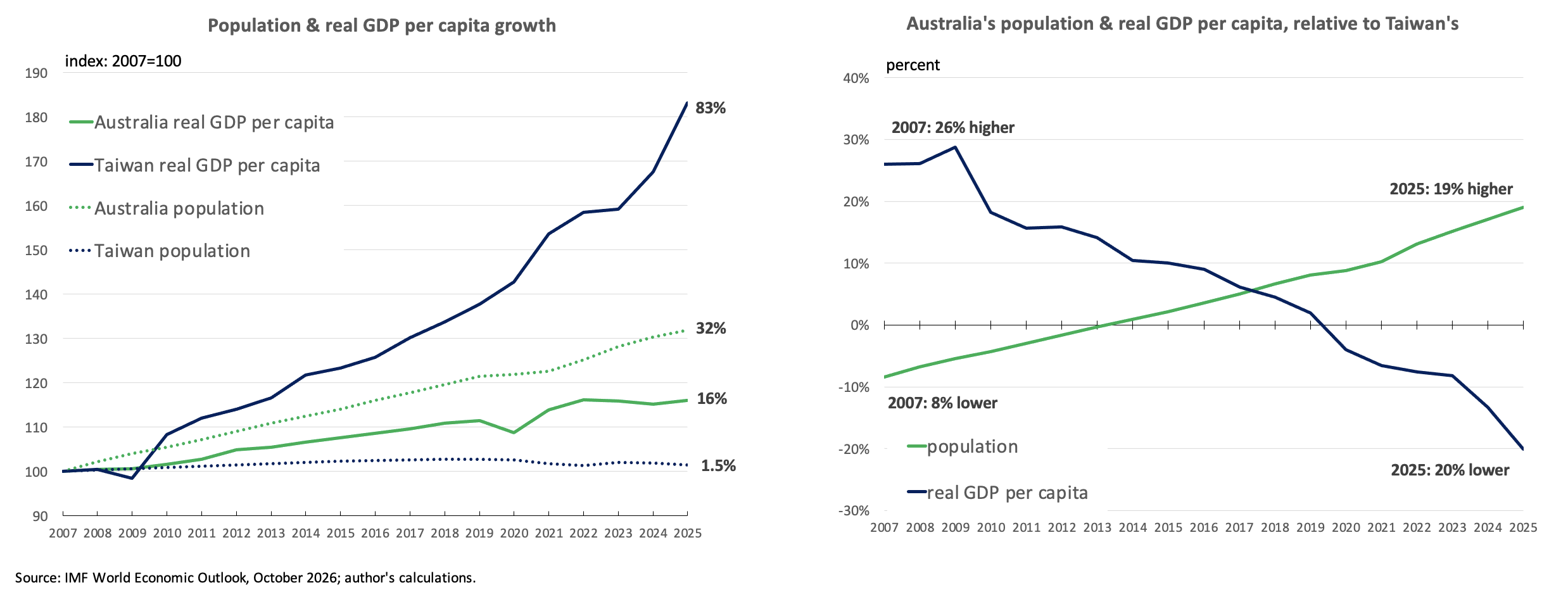
The first panel shows cumulative performance, with each series indexed at 100 in 2007. Australia’s population has grown 32 per cent since 2007; Taiwan has just 1.5 per cent more people. Australia’s real GDP per capita is up 16 per cent since 2007; Taiwan’s has surged 83 per cent higher.
The second panel shows relative performance. Australia went from having 8 per cent fewer people than Taiwan to 19 per cent more. Meanwhile, our real GDP per capita went from 26 per cent higher to 20 per cent lower.
The divergence in the trajectories is stark, and it does not depend materially on the start or end date. Starting in 2010, after the 2008 crisis, or ending in 2024, before Taiwan’s recent AI-driven boom, Taiwan still has recorded much lower population growth and much stronger growth in real GDP per capita.
And this raises an intriguing question – where would Australia be today if we had followed Taiwan’s trajectory?
The A$60,000 shortfall
The calculations are straightforward.
Had Australia’s population, like Taiwan’s, grown by only a cumulative 1.5 per cent since 2007, we would have had 21.3 million people here in 2025 instead of 27.7 million – that’s 6.4 million fewer people.
And had Australia’s real GDP per capita, like Taiwan’s, grown by a cumulative 83 per cent since 2007, it would have been about $97,000 instead of about $61,500 in 2025, using the IMF’s US-dollar equivalent units. That’s a difference of $35,500 per person, in 2021 prices.
That US-dollar equivalent amount can then be converted back into 2025 Australian dollars by using the IMF’s 2021 conversion rate of 1.417 and adjusting for cumulative inflation of about 18 per cent since 2021. The result is that Australia’s real GDP per capita would have been almost A$60,000 higher in 2025 than it actually was.
This gives us an idea of what Australia’s underperformance since 2007 cost us in 2025 – almost A$60,000 of economic output per person. And a lot of that underperformance should be attributed to poor policy decisions.
Since 2007, Australia’s leaders have imported millions of people to keep the aggregate economy getting bigger. But real GDP per capita – the metric that matters – has grown at a woeful pace.
Taiwan’s leaders, meanwhile, have presided over very low population growth but have delivered a huge boost in living standards for the average Taiwanese resident.
And Taiwan has achieved this even as its population has aged more quickly.
Both older – but who is wiser?
Both Australia and Taiwan are ageing as birth rates remain low and life expectancy increases. But the next pair of charts show there have been very different responses to this demographic reality.
The data here are from the United Nations. The old-age dependency ratio measures how many people over the age of 65 there are for every 100 people aged between 15 and 64. In Australia, this ratio has kept increasing since 2007, but we have curbed its rise with relatively high net migration. Taiwan, in contrast, has kept net migration rate close to zero or even negative over this period. This has contributed to a sharper increase in its old-age dependency ratio.
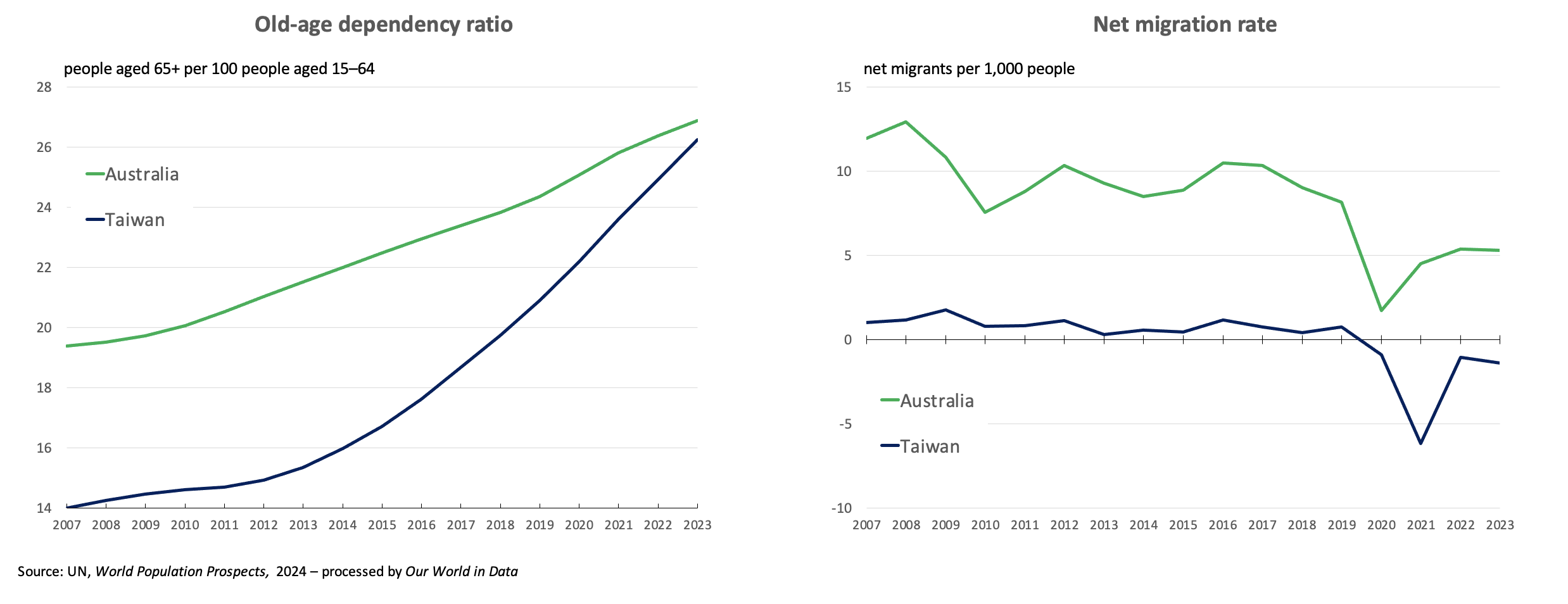
Taiwan has got older faster. It has also got richer faster. And it has shown that a developed economy can substantially improve living standards while its population ages, without relying on high levels of migration.
Taiwan hasn’t imported huge numbers of additional workers to juice headline GDP. Anyone can do that. Instead, it has made its own workers much more productive, thereby increasing real GDP per capita.
That takes skill.
So, what are they doing that we aren’t?
Taiwan shows us how it’s done
Taiwan’s economic performance has been particularly impressive over the last 12 months. Data published last week showed its economy grew by more than 14 per cent year-on-year in the latest quarter, largely driven by strong demand for AI-technology.
This is not a new thing. And it hasn’t happened by accident.
Decades ago, Taiwan invested heavily in research institutions, advanced manufacturing capabilities, and technological development. Today, its manufacturing sector is world-class, particularly in the production of semiconductors and electronics. Its services sector is also advanced and diversified.
The economy is resilient, too. During the pandemic, Taiwan’s economy grew by around 3 per cent in 2020 and by more than 6 per cent in 2021, while most other developed economies – including Australia – experienced substantial contractions.
That also took a lot of skill.
I’m no expert on Taiwan’s economic model, but it’s clear that Australia’s economic policymakers could learn much from their Taiwanese counterparts.
For example, how does Taiwan provide affordable and reliable energy to its manufacturing sector? Why can Taiwan make heaps of complicated stuff at a competitive price, and we can’t?
Does Taiwan have a better-designed welfare system? Does Taiwan do a better job of directing young people towards technical training and vocational education?
What can we learn from Taiwan’s industrial policy? Its tax system? The way it regulates businesses?
And how has Taiwan managed to maintain much lower interest rates than Australia while generally keeping inflation under control?
We should find out.
It’s time to fix Australia’s economic policy skills shortage
Australia’s poor productivity performance predates the current government. Successive Labor and Coalition governments have struggled to reverse the slowdown.
That doesn’t absolve today’s policymakers of responsibility.
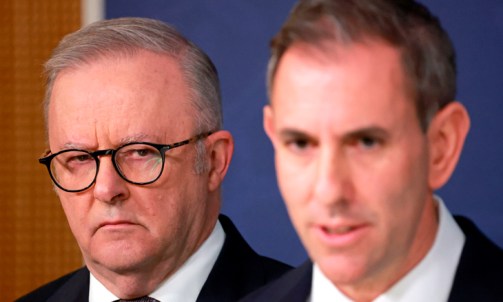
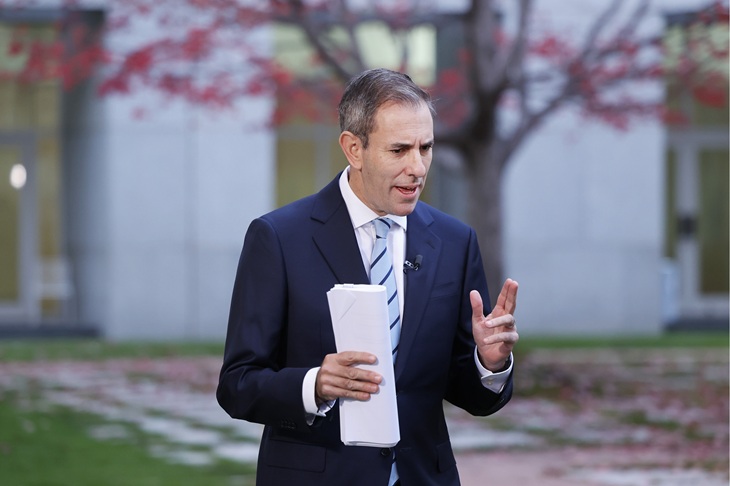
Treasurer Jim Chalmers and Assistant Minister for Productivity Andrew Leigh are supposed to be developing and implementing policies that improve Australia’s economic performance. Yet real GDP per capita has fallen under their watch, while they continue to rely on migration-driven population growth to prop up headline GDP.
That takes no skill. And it leaves the average Australian no better off.
Not all of Taiwan’s superior performance can be attributed to economic policy. Our economies have different resources, institutions and industrial structures. But after eighteen years of such divergent performance, surely there are lessons worth learning.
So, perhaps Jim Chalmers and Andrew Leigh should arrange a few meetings with Taiwan’s Minister of Economic Affairs, Kung Ming-hsin, and the Minister of National Development, Yeh Chun-hsien. When’s the next flight to Taipei?
And if Australia’s economic policymakers don’t start doing their job properly, we could resort to the solution so frequently proposed for other skills shortages.
We could just import 50 economic policymakers from Taiwan to do the jobs ours can’t – or won’t – do.