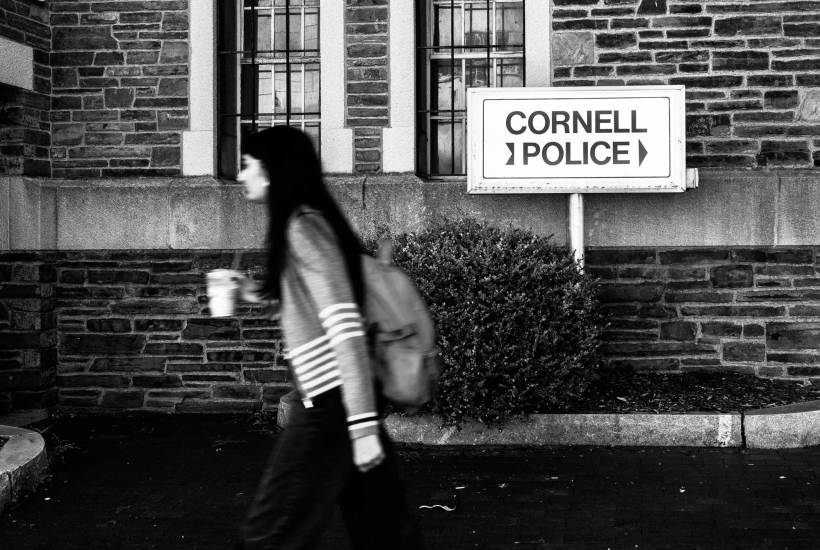
I’ve had hexes put on me by a university professor, had online vigilantes send packages of dogshit to my childhood home in New Jersey and been hounded by the trauma-informed journalists of the New York Times. CNN, Reuters, Agence France-Presse and other estimable sources have credited me with starting a dark new anti-#MeToo movement. Along the way, I have received tens of thousands of rabidly embittered phone calls, emails and texts. “Hope you get held down and raped for seven hours and wake up with a blistered fucking asshole,” is a fairly standard example of the unremitting torrent of vitriol. Naively, I had thought it would be a straightforward journalistic endeavor to seek out, corroborate and publish the identity of “Jane Doe.” She is the litigant in the Cornell 7 civil complaint involving questionable claims of an Ivy League drugging and gang-raping rampage. All I’ve sought to do is publish her identity. The names of the accused men have been widely circulated. It only seems fair that their accuser is subject to scrutiny.
Almost immediately, a woman named Kelly Cuccolo emailed to implore me to change course and adhere to the journalistic code of conduct set forth by an organization called RAINN – or the “Rape, Abuse & Incest National Network.” Ms. Cuccolo, who identifies as a “Senior Research Specialist” in something or other, and proudly touts her PhD in psychology from the University of North Dakota, wrote me on October 1: “Hello, here is a resource for you on how professional journalists cover sexual violence in the media.” She helpfully supplied a link to a RAINN-produced guide on how “responsible journalism” should be in furtherance of “survivor-centered advocacy.” This entails “best practices” for “trauma-informed” reportorial methodologies. First and foremost: never so much as dream of “identifying a survivor,” under any circumstances, regardless of whether “survivorship” has been established through any sort of reasoned evaluation or adjudicative process. “Survivor” status can be self-declared, and is then to be presumptively accepted. It should go without saying that these “guidances” are not for carrying out “journalism” as such, but are instead part of an ideological mission by political actors. Thanks to organizations such as RAINN, this “survivor-centered” paradigm has already been adopted as the default consensus across the media. Case in point (as with so much else that bedevils us in this troubled era): the New York Times.
On the evening of October 18, I had the honor of spending an hour on the phone with the NYT’s Amy Julia Harris. She and her “trauma-informed” colleagues were gearing up for a blockbuster of an article in which I would be cast as the viciously depraved ringleader of an online mob. All I had sought to do was to identify the woman who has ruined the lives of seven young men. Jane Doe’s lawyer Thomas Giuffra had complained that Jane was being badgered with nasty messages and made to feel unsafe. For once, I believe her. But I had nothing to do with it. Harris seemed to be interested in almost anything but the fact that I had accurately identified Jane Doe after talking to people who knew her at Cornell and in her hometown, cross-checking details with court records, university records, material from her sorority, her social media pages, and so on. Again, this was done in service of an objective that I stressed over and over. Real journalism is about publishing the truth.
Harris suggested I was “doxxing” Jane Doe. But I hadn’t published her home address, phone number, email address, parents’ private information or anything like that. All I’d sought to do was name a central figure in a highly contested story. I even texted Jane Doe before I published her identity, making clear that I hold no animus against her. If there’s anyone who could be said to have doxxed Jane Doe, it’s her own lawyer. Giuffra left her signature partially unredacted on the affidavit he had her sign, along with numerous other identifying details in his mad publicity scramble. He even published her former address in Manhattan on the public court docket. And yet here I was, being fingered by Harris and her band of NYT hall-monitors as the big bad doxxing culprit. “I mean, are you conceding that it’s correct at this point?” I asked Harris, in mild desperation. “Was the identity of the Jane Doe claimant that I reported correct? Because that’s what ultimately matters most here… right?” There came a pregnant pause. “I guess…” she finally mustered, before steering the conversation right back to ancillary queries about how personally disreputable I must be. “We’re not going to say that you were correct or incorrect.”
The article they eventually conjured featured no fewer than 11 coauthors and “contributors,” as though they had all spent years doggedly laboring to uncover a byzantine classified CIA operation. Naturally, the article presents the disclosure of Jane Doe’s identity as something I, this weird “independent journalist” guy, had haphazardly “announced to his followers on X,” like I was just throwing out a random guess. As maddening as my interactions with Harris were, in the end she actually went against type and shared something rather startling and unexpected. Giuffra had told one of her colleagues that I had phoned him in shame to apologize for my dastardly deeds. The problem is that I have never spoken to Giuffra. He has never returned my calls, texts, or emails. I told Harris that this purported phone call never happened. Eventually, she said: “I don’t think we’re going to report that.” Which is strange, when you think about it. The lawyer who engineered this massive nationwide “gang-rape” uproar was going around making up completely fake conversations with journalists.
I have since learned of other tirades Giuffra has reportedly launched against me to select journalists, and I am eager to clear up any misunderstandings. So if you’re reading this, sir, please know that should we ever have a chance to speak one-on-one, I will make doubly sure to employ all the appropriate trauma-informed “best practices,” so as to studiously avoid revictimizing you.