André Previn began his career at MGM. And after he’d quit the studio to become conductor of the London Symphony Orchestra, he liked to share an anecdote. His old Hollywood pal Norman Jewison, the director of Rollerball, brought a film composer friend to hear Previn conduct the LSO. ‘It’s nice, isn’t it, to see André here at the Festival Hall, with his own orchestra, getting cheered because of his performance of Beethoven’s Ninth?’ ventured Jewison. His colleague nodded: ‘Sure, but you have to admit – it’s a shame how completely he screwed up his career.’
I’d rather watch Malkovich in full wig-out than revisit the award-chasing pretensions of 2022’s Tár
The movie business has always struggled – sometimes in awe, sometimes in horror – with the figure of the classical conductor. The latest example is The Yellow Tie: a biography of the Romanian conductor Sergiu Celibidache, and it’s got all the classic maestro movie tropes. The child genius, opposed by his overbearing father (‘Music is for gypsies!’). The zero-to-hero debut (an outdoor concert amid the heavily CGI’d ruins of postwar Berlin). The clashes with uncomprehending money men; the rehearsal sequences in which the maestro expounds the meaning of art to the Berlin Philharmonic when he could be, well, rehearsing. (In fairness, that was by all accounts a genuine Celibidache trait.)
The Yellow Tie is directed and co-written by Celibidache’s son Serge. Hagiography is to be expected, and hagiography is what we get. It’s a pity, because few postwar conductors are more intriguing than ‘Celi’ – a Zen-obsessed cult figure who rendered himself almost unemployable with his insistence on marathon rehearsal periods and his blanket refusal to make recordings. He was the conductor who said (and you’d better believe it’s in the script) that ‘listening to recorded music is like making love to a photograph of Brigitte Bardot’.
At its greatest, Celibidache’s Bruckner could touch the transcendent; on a bad day it sounded like living death. There was a darker side to his achievement, and perhaps The Yellow Tie would never have been made if there had been any question of exploring (say) the 12-year sex-discrimination lawsuit that marred Celibidache’s tenure with the Munich Philharmonic, or the fact that from his hundreds of adoring students (shown in The Yellow Tie sitting, literally, at the Master’s feet) you probably won’t have heard of a single one.
None of that here; just standard maestro-movie fare – as formulaic as any romcom, and just as enjoyable, if you’re prepared to roll with it. Does modern cinema offer any pleasure purer than witnessing John Malkovich delivering truly awful dialogue? ‘People like you are killing classical music!’ he screams as the elderly Celibidache, while a huddle of Japanese record execs scamper for the door. ‘You motherfucking criminals!’ Your call, but I’d rather watch Malkovich in full wig-out than revisit the award-chasing pretensions of 2022’s Tár. Cate Blanchett stars as a fictional conductor in career meltdown, complete with tasteful, colourless cinematography and tasteful, colourless lesbian power games.
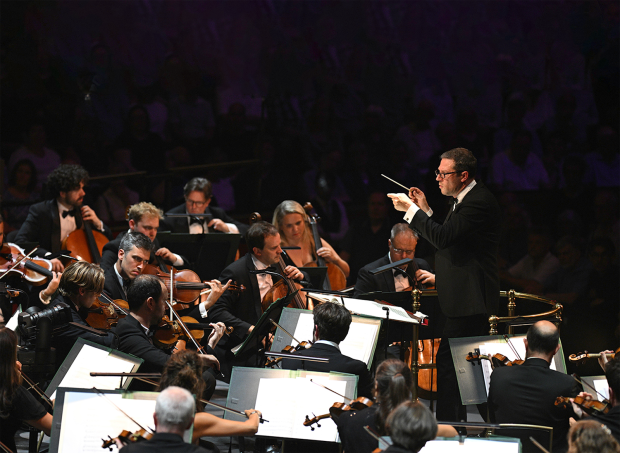
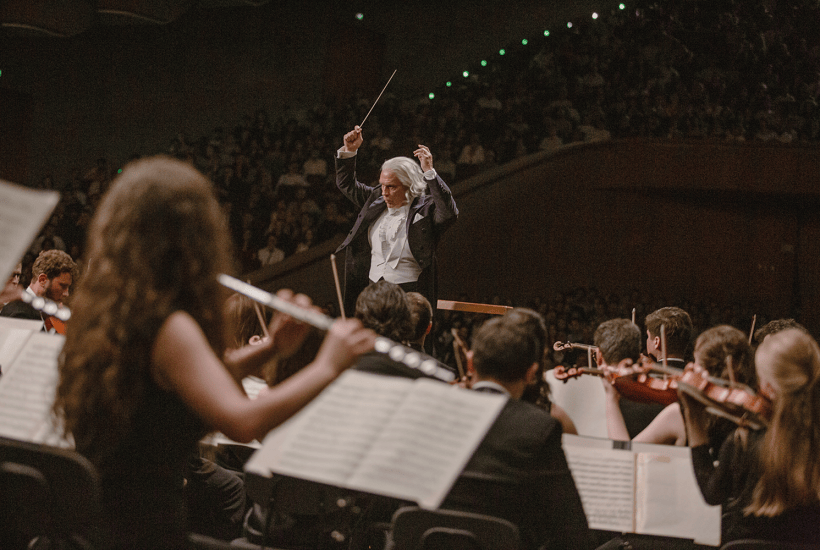
It can be done differently, of course, and the 2023 Leonard Bernstein biopic Maestro – starring Bradley Cooper in a controversial but persuasive prosthetic nose – succeeded by focusing on Bernstein’s bisexual personal life. The familiar story beats are all present (the 25-year-old Bernstein’s last-minute debut in 1943 is one of classical music’s best-documented big breaks), including that other staple of conductor flicks: the panoramic shot of our hero (or heroine) in command of a vast orchestra while sublime noises (Beethoven or Mahler is good) swell on the soundtrack. But not for too long. You can’t expect the actual music – all that scary European dead-guy stuff – to hold the viewers’ attention.
Maestro, sensibly, emulates countless music biopics and uses music largely as set-dressing and (when needed) a quick emotional caffeine shot. That’s the commonest trait, and the biggest failing, of the conductor-movie genre. There are other common errors of course, and if you sit through one of these pictures with a musician, you’ll get a crash course. Mozart on a podium, semaphoring frantically away in Amadeus? Never happened: he directed from the harpsichord. Maestro tapping baton on music stand to get the orchestra’s attention? He wouldn’t last long in a professional rehearsal, and the baton would probably snap. ‘Conductor’ whose left hand mirrors the actions of the right, in a sort of flouncy breast stroke? A dead giveaway that he’s bluffing for the camera.
The only trait that makes a conductor interesting is the one thing that cinema can’t convey
If you’re bothered by all that, you’re probably the wrong person to be watching films. The unfortunate truth is that the only trait that makes a conductor interesting – their musicianship – is the one thing that cinema can’t convey. There was a time, though, when directors did at least try; in fact, when conductors could be screen stars in their own right. The great Hollywood composer Bernard Herrmann conducts on screen at the climax of Hitchcock’s The Man Who Knew Too Much (1956), which takes place during a concert at the Royal Albert Hall. Arthur Benjamin’s music drives and shapes the plot, in real time.
Erich Korngold appears in a fake beard as the conductor Hans Richter, in the schlocktastic 1955 Wagner biopic Magic Fire. He agreed to do it (he said) ‘to protect Wagner’, though with lines like ‘Tristan is dying, and you ask me how I am?’ that ship had long since sailed. Korngold had previously written a full-scale cello concerto for the 1946 noir thriller Deception – a further, rare, example of music driving a Hollywood plot, though it’s overshadowed (like everything in the movie) by Claude Rains’s scenery-chewing performance as yet another unhinged conductor-composer, the fictional Alexander Hollenius.
Meanwhile, the British-born Leopold Stokowski played himself in the 1937 picture 100 Men and a Girl, with Deanna Durbin as a very handy Mozart soprano. Three years later he conducted the Philadelphia Orchestra in Disney’s animated spectacular Fantasia (1940) – possibly Hollywood’s most ambitious attempt to meet classical music on its own terms. In retrospect, the scene where Mickey Mouse steps up to shake hands with Stokowski was probably the high water mark of an era in which European culture was still regarded as something to which ordinary Americans might aspire.
Even here, though, Stokowski appears almost entirely in silhouette. The conductor, on film, is a superhero: a mystery man (Tár is a very rare woman) commanding a force – music – that is too elusive to explain. So directors lean into the power and the charisma instead, and it rarely ends well. There’s a book to be written about American Europhobia; how the aspiration and wonder that inspired Fantasia degenerated to the point where Bach’s Goldberg Variations could symbolise the psychopathic delusions of Hannibal Lector. Istvan Szabo toys ingeniously with the subject in Taking Sides (2001), with Harvey Keitel’s philistine GI attempting to prove, fairly or not, that Wilhelm Furtwängler (Stellan Skarsgard) was a convinced Nazi. For once, the music wins.
If there’s one thing the maestro movie teaches us, it’s that the more you insist upon realism, the less fun you’ll have
And since all superheroes are flawed superheroes these days, it was probably inevitable that Blanchett’s Lydia Tár would end by physically assaulting a colleague, live in concert – though if you’ve been following the career of John Eliot Gardiner, you’ll know that classical reality can still catch Hollywood napping. Tár’s climactic punch-up is prefigured in another Szabo maestro movie, Meeting Venus (1991), in which a Hungarian conductor finds his production of Tannhäuser derailed by obstacles which anyone who’s worked in classical music will find grimly familiar. Obstructive unions, clockwatching musicians, the sexual magnetism of a predatory Glenn Close. OK, maybe not the last bit.
But if there’s one thing the maestro movie teaches us, it’s that the more you insist upon realism, the less fun you’ll have. A straw poll among musical friends produced a runaway win for the 1961 British comedy Raising the Wind. Think Carry on Conducting: this cheerful farce set in a London music college stars James Robertson Justice, channelling Thomas Beecham and delivering a cavalcade of one-liners (‘skeletons copulating on a tin roof’) that are now routinely attributed to Sir Thomas himself.
It was written by a composer (Bruce Montgomery, a British comedy stalwart) so the musical jokes have the authentic ring of the band room. And if no one could conceivably believe that Kenneth Williams is actually conducting the final, anarchic performance of the William Tell overture; well, no one ever expected you to. ‘Never settle for less than perfection! Never!’ bawls Celibidache, in The Yellow Tie. It’s unlikely that Sid James and a runaway bass drum were what he had in mind, but still – he had a point.
Got something to add? Join the discussion and comment below.
You might disagree with half of it, but you’ll enjoy reading all of it. Try your first month for free, then just $2 a week for the remainder of your first year.