The Three Choirs Festival always feels so nourishing, so eternally English, that you sometimes forget how much history has been made there. It was in Gloucester in 1910 that the young Herbert Howells and Ivor Gurney heard the world première of Vaughan Williams’s Tallis Fantasia while Elgar, in rented digs, tried out his Violin Concerto with Fritz Kreisler. Three years later you’ve got Sibelius despatching Aino Ackte to première Luonnotar, and Saint-Saëns, at 77, playing Mozart by day, then cracking out his celebrated musical impersonations at the post-show party. Apparently his Cosima Wagner was quite the knockout.
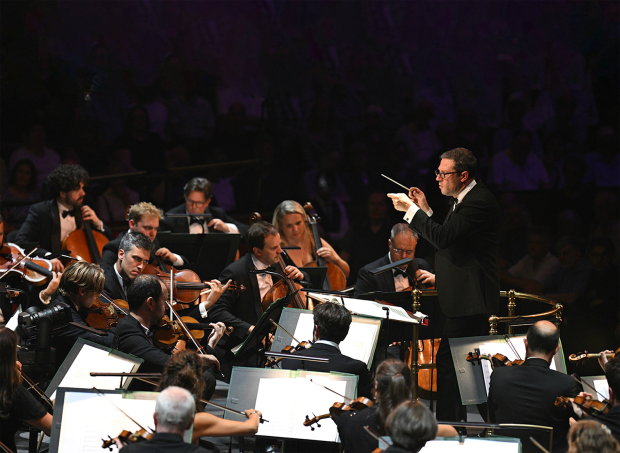
The point is that there have been moments when the musical universe pivoted around this quiet cathedral close. The 2026 festival wasn’t quite as epic but what it did offer – as always – was ambitious, locally rooted music-making on the most generous scale. Tuesday evening’s concert had a maritime theme, so Martyn Brabbins conducted the Philharmonia in Mendelssohn’s The Hebrides and Elgar’s Sea Pictures. Instead of the usual contralto, the soloist was Roderick Williams, whose baritone might have been lost beneath the surface of the orchestration if he hadn’t been so eagerly attentive to the articulation and colour of the words.
In between came a choral anthem, Never Weather-Beaten Sail, by the Victorian church composer Charles Wood and later, a setting of Psalm 107 by Gloucester Cathedral’s former organist Herbert Sumsion, who grew up in Elgar’s world and died in the summer of Britpop. There’s tradition for you, and his anthem – like Wood’s – moved with the measured dignity and glowing harmonies that we call Elgarian because we’ve lost any other frame of reference. It was fascinating to hear that context restored, and it was a nice idea to follow Wood and Sumsion with Cecilia McDowall’s Ave maris stella. Premièred in 2001 in Portsmouth, McDowall’s motet combined vigorous choral and string writing with a restless, luminous sense of the sea.
More inspired still was the decision to entrust these works to the Festival’s Youth Choir. They’re not a huge group – just 50 or so singers, aged between 14 and 25 – but they delivered focused, shining sweetness at the top of their range and a splendid vigour and precision further down, carrying effortlessly over the orchestra even in the final item, Stanford’s Songs of the Fleet. This was the piece that drew me to the concert: five settings of Henry Newbolt, written in the dying months of the Edwardian era. With their shanty-like choruses and imagery of dreadnought battle squadrons, they’re a snapshot of British culture at a very particular moment – a potent mixture of sunset melancholy and chin-up defiance.
People dismiss Stanford as a dry old stick, but can you picture any living composer of comparable eminence even touching a subject like that? Imagine Adès writing a choral society banger about the Royal Navy’s frigate shortage. Coming after the Elgar in the first half, and briskly conducted by Brabbins, Songs of the Fleet also underlined the gulf between national-level talent and enduring genius. But if the Three Choirs Festival’s 298-year run proves anything, it’s that you can’t have the one without the other.
Also in Gloucestershire, Longborough Festival Opera is ending its season with Hansel and Gretel (sung in English): operatic methadone for Wagnerites who are still struggling to come down from the high of last month’s LFO Tristan. The orchestra is almost as fine, and the conductor Karen Kamensek finds endless subtleties in Humperdinck’s score. There are gruff, peaty basses and a Siegfried-like ecstasy of tenderness as the children wake up in the forest.
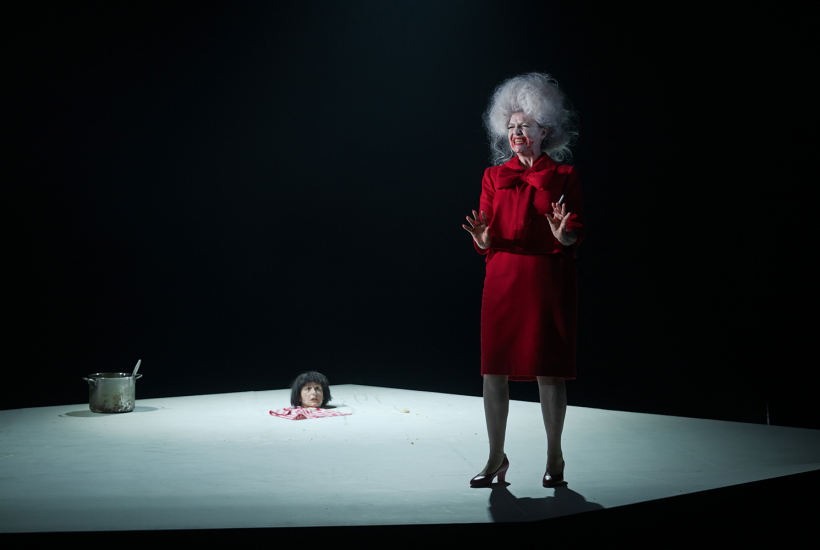
With Lee Bisset as Mother (and the Witch) and Darren Jeffery as Father there are some glorious sounds on stage too, where Hansel (Joanna Harries) and Gretel (Rosalind Dobson) are a pair of sooty, fractious brats in a monochrome dreamscape. Lucy Bailey’s production, meanwhile, rifles through the macabre subconscious of Central European folklore, from Struwwelpeter to Jan Svankmajer. The result is lucid but multilayered; fantastic enough for adults but cruel enough for children, and filled with visuals (a rain of ashes, a monstrous red tongue) that can be as disturbing or as playful as your imagination permits. A dark jewel of a staging, and tickets are still available.
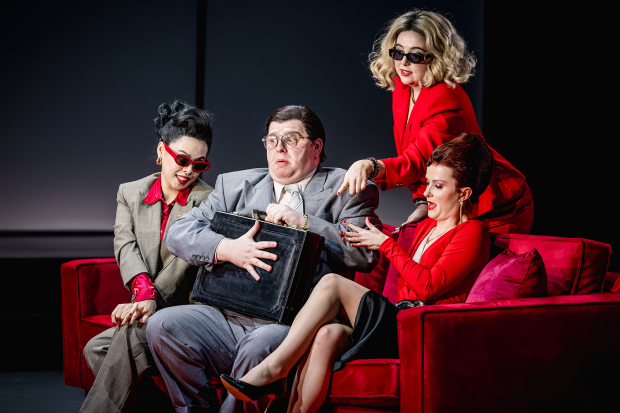
The fundamentals are also sound in Liam Steel’s new production of Die Fledermaus for Opera Holland Park. The English translation is witty, and the action has been updated to London in the Roaring Twenties. There’s a dashingly sung Eisenstein (Thomas Atkins), a sensuous-sounding Rosalinde (Alison Langer), a feline Orlofsky (Clare Presland) and a Frosch (Robert Burt) who actually knows when to stop. I wanted to love it, I really did; but the orchestra under George Jackson had the snap and sparkle of warm lettuce. It dragged and dragged. Let’s blame it on the heatwave; because in most other respects this Fledermaus has a lot going for it.
Got something to add? Join the discussion and comment below.
You might disagree with half of it, but you’ll enjoy reading all of it. Try your first month for free, then just $2 a week for the remainder of your first year.