Environmentalists once worried that Prince William was interested only in ‘posh nature’ – rhinos, elephants and pangolins being arguably more glamorous than the bees, trees, squirrels and salmon that preoccupy the King. But since inheriting the Duchy of Cornwall, the Prince of Wales has pivoted homewards. He has attended Groundswell, the flagship regenerative farming festival in Hertfordshire, two years running. Last year he made a surprise speech declaring that regenerative farming was no longer a ‘fringe alternative’ to high-input intensive farming but must become the ‘foundation stone of British agriculture’.
Last week the Prince made good on his word, granting the Duchy of Cornwall’s first regenerative farm business tenancy (FBT) on the 900-acre Monkshall Farm in Herefordshire to 25-year-old Harry Davies. He is not alone. The Church Commissioners, Crown Estate and National Trust are all racing to ‘go regen’. Between them they own roughly 384,000 hectares of Britain’s farmland: what they do with it matters to all of us.
The terms on which tenant farming families live and work rarely make it onto petitions, picket signs or tractor blockades. They should. A third of agricultural land in the UK is tenanted. What happens on it shapes not only what goes into our kitchen cupboards but our soils, rivers, air and wildlife, and who is – or isn’t – drinking in the country pub. A change in tenancies means a change to the countryside. The question is how far big landlords will go to achieve it and whether rural communities, a quarter of whose residents are aged over 65, are ready.
Farmers currently face a tsunami of challenges
Until now, an average new farm business tenancy lasted three years. Introduced in the mid-1990s as subsidies shifted from rewarding production to payments by land area, these short contracts maximised rent for landowners and production from tenants straining to pay it. This extractive model valued only what grew above ground, not below. The consequences are stark. Government figures show intensive agriculture has stripped arable soils of up to 60 per cent of their organic carbon and left 2 million hectares at risk of erosion, at a cost of up to £1.4 billion a year. Farming remains a major source of river pollution, whilst farmland birds – agriculture’s canary in the coal mine – have more than halved since the 1970s.
On a short lease, few tenants put down roots, literal or metaphorical, lest the landlord finds someone to squeeze harder. This affects not just what is done on land, but who is on it.
It wasn’t always so. Rural communities were once built by families who, like my farming grandparents, never owned the land or homes in which they lived, worked and died, yet tended for generations. A post-war drive for food production gave tenants tenure for life, later extended to three generations. For tenant farmers this meant belonging to a place, even if the rent bill made it clear it belonged to someone else.
Today’s FBT barely outlasts a crop rotation. By contrast, the Duchy’s new tenancy runs for 25 years, with reduced rent for six whilst shattered soil fertility recovers. Tenants get advice built around six regenerative pillars, with progress verified by Regenified, the certifier founded by Dakotan rancher and ‘godfather of regen’ Gabe Brown, which already marks the homework of some farms supplying Waitrose and the boujee bakery chain Gail’s.
Davies plans to bring rotationally grazed cattle onto his arable and potato farm, sow mixed-species pastures and cover crops, and direct-drill crops rather than plough, reducing soil disturbance and helping retain soil carbon. ‘We had over sixty applicants [for tenancies],’ says Matthew Morris, the Duchy’s Executive Director of Rural.
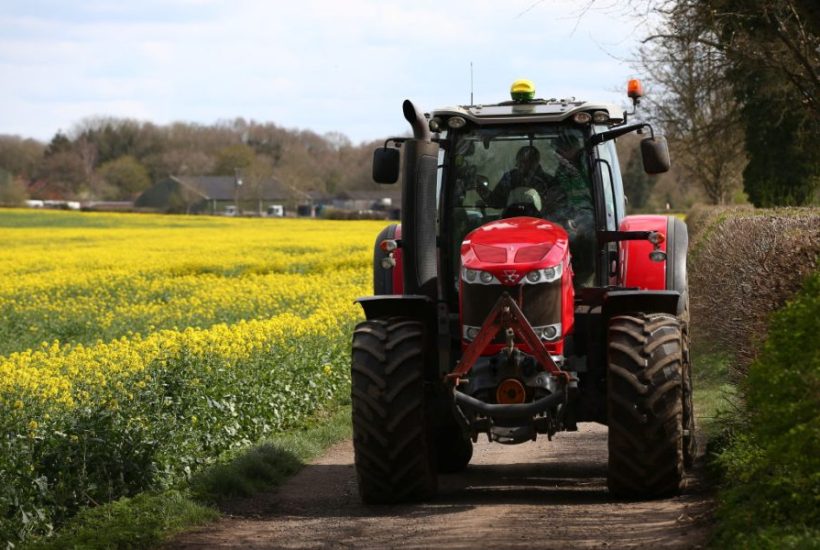
Little wonder. Farmers currently face a tsunami of challenges. This summer’s cereal harvest was officially the worst on record, capping three years of heatwaves, droughts and floods that cost farmers a collective £4.8 billion. Public payments make up a third of an average farm’s income, yet last month the government’s entire £253 million sustainable farming incentive budget, which pays farmers to farm with nature, was gone within six hours. Some said the subsidy scramble was ‘harder than the scramble to get Oasis tickets’.
From pension providers to Oxbridge colleges, landowners may be keen to claim regenerative credentials, but what happens when a tenant misses their targets? Institutional landlords talk of ‘collaborative working’ and ‘supporting farmers on their journey’ rather than ‘get off my land’ but with farmers being an independent breed, time will tell whether all this cajoling delivers real change or merely well-intentioned greenwashing.
Further obstacles remain. George Dunn, chief executive of the Tenant Farmers Association, who helped develop the Duchy’s tenancy scheme, contrasts legacy land owners with disinterested private landlords treating farmland as ‘an investment vehicle’, managed at arm’s length by a small army of land agents. Agents paid per tenancy or renewal may explain their enthusiasm, as Dunn puts it, to ‘let short, hard and inflexibly at the highest rates’. Farmers seeking to build long-term resilience rarely get a look in, even if a slash-and-burn contractor degrades the very asset that gives land its value: the soil.
With applications for food, farming and related university degrees up 20 per cent in 2024, the youngest generation seems to be keen. But first older farmers, with an average age of 69, must retire. Many hang on far longer. Max Beddall, whose family sold Farnborough Hall and much of its Banbury farmland to the National Trust in the 1960s, hopes to take on the tenancy surrounding his family home and farm it regeneratively. Beddall says ‘it makes sense ecologically and for soil quality. It would be exciting to improve the farm, especially as so much is visible to Trust visitors’. The existing tenant, however, must first retire. How old is he? ‘Over 80’ admits Beddall.
Some institutional landowners have found a way to hurry things along. Stories abound of National Trust tenants whose leases go unrenewed or who are offered cheques to hand back agricultural land for rewilding and carbon-credit tree planting. This was the fate of my grandparents’ farm, most of which the Trust has taken out of food production. William Cobbett, riding through rural England in the 1820s, found its fields ‘purely agricultural – their hilliness, bleakness, roughness of roads, render them unpleasant to the luxurious, effeminate, tax-eating crew who never come near them’. He might be bemused to find that crew now wandering through rewilded fields that once grew wheat.
Defra minister Jenny Riddell-Carpenter recently landed in hot water for dismissing rural Britain’s nostalgic vision of warm ale, black Labradors and fox hunting as a fantasy ripe for right-wing weaponisation. These tenancies could deliver the rural revival she says she wants. Whilst the name may be new, the ideas are not. Stability, realistic rent, long-term thinking and mixed farming seem less a revolution than a reversion. Riddell-Carpenter may discover that, like warm ale and black labradors, the old ways may be unglamorous, but some may just offer us a path to our future.