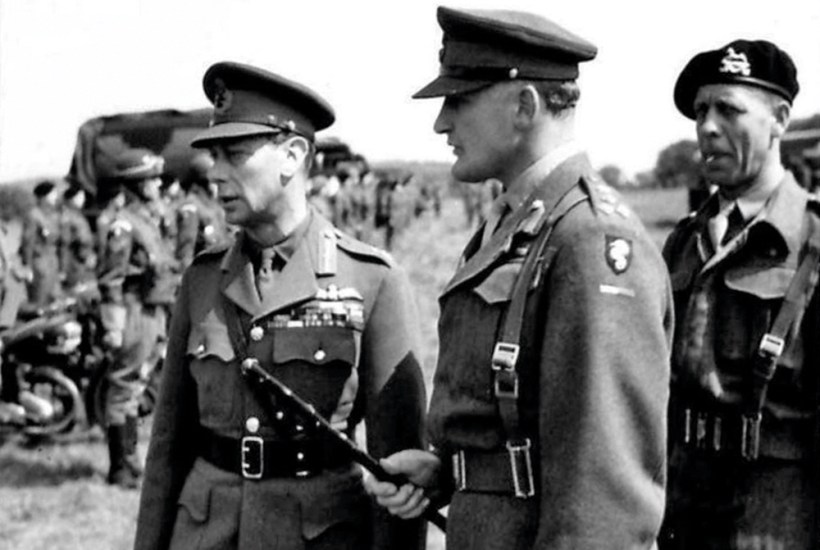
Erroll Prior-Palmer had one decision to make on D-Day. It wasn’t as momentous as Eisenhower’s to launch the invasion, having postponed it for 24 hours due to bad weather, but, for the 40 or so tanks that were meant to swim ashore and give covering fire to the infantry as they stormed Sword Beach, it was life and death.
Sword Beach, the easternmost of the Allied landing sectors, guarding the vulnerable left flank of the entire Allied landings, was entrusted to the 3rd (British) Infantry Division. Their task was to reinforce the overnight airborne landings and take Caen, the route centre that would open up Normandy to rapid advance inland. The divisional commander, Major-General Tom Rennie, had three infantry brigades with which to complete the task (plus a commando brigade to reinforce the airborne division) and Prior-Palmer’s 27th Armoured Brigade. It is probably fair to say that Rennie would have been well satisfied if by evening he had got his division ashore in one piece and ready for the inevitable German counter-attacks, and that Caen could wait.
His three infantry brigades were to land in sequence: the first, the assault brigade, to gain a beachhead and then clear inland so that the follow-on forces would not come under direct, or observed indirect, fire as they landed; the second, the ‘intermediate brigade’, was to take Caen; the third was to be the divisional reserve. Prior-Palmer’s brigade comprised three armoured (tank) regiments, one regular and two yeomanry, but each detached to one of the infantry brigades.
The two yeomanry regiments were assigned to the intermediate and reserve brigades, while the regular, the 13th/18th Royal Hussars, were to support the assault brigade, for which they were equipped with ‘Duplex Drive’ (DD) Shermans. The DD gained precarious buoyancy from a canvas screen, with a freeboard of just 4ft, and made headway (100 yards per minute) by means of propellers driven by off-takes from the tracks.
The idea was that they would launch from landing craft and swim ashore, presenting too small a target for the German gunners, and put down suppressive fire in the critical minutes before and during the infantry assault. The planning figure for the launch point was 7,000 yards, but it depended on the sea state and the incoming fire. It was a trade-off between tanks being overwhelmed in the swell (the storm that had led to the 24-hour postponement of D-Day had not fully blown itself out) or destroyed by fire as the landing craft neared the shore. In either case the poor bloody infantry would be left to assault alone – as the Americans found to their huge cost at Omaha Beach. The decision to launch at Sword Beach would be Prior–Palmer’s.
What manner of man was he? One of his yeomanry commanding officers wrote in his diary: ‘I can never like him as a man, though he is a capable soldier.’ It is a measure of the author’s far-from-uncritical biography that he leads with this summary, and that much of the book unsparingly reveals his father’s complex character. In fact, when Prior–Palmer passed out of Sandhurst in 1923, he was the most promising officer of his generation, winning both the Sword of Honour and the Saddle of Honour – the best all-round cadet and the best equestrian, a unique double, whose qualities in the latter prize would be carried on to Olympic heights by his daughter Lucinda.
His prewar life looked pure F. Scott Fitzgerald. Orphaned young, but handsome and with a small fortune with which to cut a dash in the 9th Lancers, the hunting field, the polo ground, the Season and ‘Stateside’, he had a glittering life which imploded when his much younger and flighty wife bolted with the painter Raoul Millais. Arguably the war saved Prior-Palmer. Post-war, he would serve in high rank and key appointments, but then left the army after a near-fatal accident, forging a second career in shipping. Indeed, he has a strong claim to being the father of containerisation, not inappropriately for a man who once set steel boxes afloat in the Channel.
In his perceptive foreword, Max Hastings describes Prior-Palmer as ‘an archetypal figure of his time – a natural leader who cared much more for doing what he thought right than for making himself loved by comrades’. His decision to launch the tanks at 5,000 yards on D-Day saved the lives of many a poor bloody infantryman on Sword Beach, as well as many a tank crew. Tellingly, he had prepared himself for the moral aspect of the decision by putting himself through the DD crews’ training, including the forlorn hope of the Davis submarine escape apparatus. Had he been allowed to regroup his brigade as an entity once ashore, with his infinite determination it is conceivable that Caen could have fallen on D-Day rather than more than a month later. But that’s another story. Meanwhile, we must, I suppose, ponder on Hastings’s sad conclusion that ‘men like Erroll are not made any more’.
Got something to add? Join the discussion and comment below.
You might disagree with half of it, but you’ll enjoy reading all of it. Try your first month for free, then just $2 a week for the remainder of your first year.