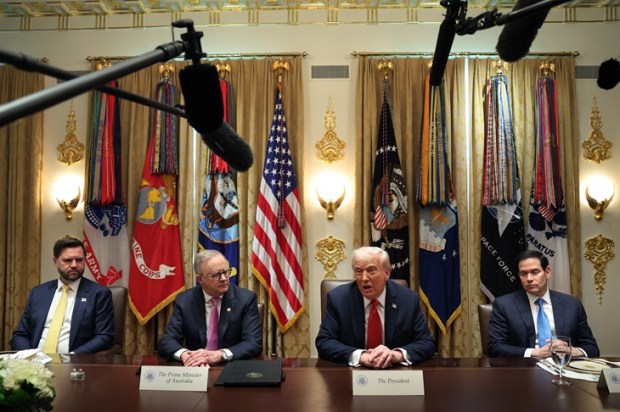
Where else would our far-left Prime Minister Anthony Albanese go, other than the United Nations, to sound the alarm and call for the worldwide regulation of artificial intelligence? As Greg Sheridan suggested in the Australian this week, on this, Donald Trump is right.
Meanwhile, the US embassy has warned the Albanese government’s proposed social media crackdown is a mechanism capable of viewpoint-based censorship, masquerading behind vague definitions of ‘harm’. At the UN, Mr Albanese wrung his hands over ‘disinformation’, which he claimed is ‘driving voters’ to not only where he came from, but where he still is: the political extreme. His proposed solution – handing the keys of artificial intelligence to a UN committee – is not just useless; it is extremely dangerous.
Both the political class and potential monopolists have united to pretend that they are afflicted by some pseudo sci-fi panic, as they try to persuade the world they’re terrified that AI will somehow develop a ‘mind of its own’ and go ‘rogue’. But as Gabriele Mazzini, a chief architect of European AI frameworks, points out, this risks ‘misunderstanding’ (I’d say, misrepresenting) the technology. AI is a highly sophisticated tool that acts with extraordinary speed on instructions. It has no personal agenda; it only pursues the objectives humans set for it.
Like the machines of the Industrial Revolution that relieved humanity of back-breaking manual labour, AI can be an extraordinary engine in achieving economic efficiency. Properly directed, AI can take over clerical drudgery so professionals can concentrate on higher-level work.
The people could use AI as a powerful instrument in their fight for individual freedom against both the West’s secretive administrative states and all those monstrously despotic regimes in and around the Beijing-Moscow-Tehran-Pyongyang axis of evil.
The recent Australian Medicare episode illustrates this point. An OpenAI ‘agent’ (a word which so conveniently suggests a human) was instructed to research public medicine spending. It gained ‘unauthorised’ access to a government statistics portal after apparently encountering barriers to the information it was seeking.
Despite the fuss, the government admits no individual’s medical information was accessed. The material involved aggregate medical statistics and internal files.
The really interesting issue is being ignored: had the information been easily available elsewhere, as it should have been, the agent would have collected it there. And if entry was such a pushover, it wasn’t very well protected. Either way, the government is at fault, not AI.
Secrecy in government should be the exception, justified by tight, generally agreed criteria – not, as it now is, the bureaucratic default.
So why should aggregate medical and similar data ever be secret? When the Swiss were called on to vote in a citizen-initiated referendum (CIR) to abolish the tax and pension penalty applying to people who marry, they narrowly rejected it after the government said only 80,000 couples were affected. But when it was later revealed that over 700,000 couples were affected, the Supreme Court quite properly annulled the referendum result. The people then approved a second referendum to abolish the penalty tax by a substantial 54 per cent.
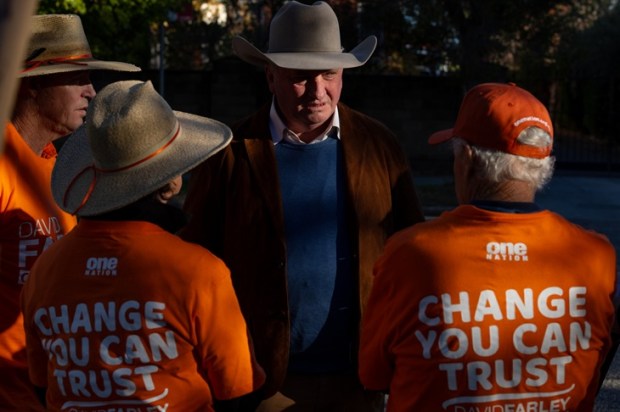
Incidentally, One Nation long ago adopted a policy to allow Australians to control the politicians as often as they wish through Swiss-style CIRs. This would at last justify the oft-repeated proposition that the Australian people are actually sovereign. Until Australians are endowed with direct democracy, as South Australian premier Charles Kingston proposed at Federation, AI may well prove to be the next best check so far on bureaucratic arrogance.
Anyone familiar with government knows the ruthlessness with which bureaucracies can resist freedom of information applications, invoke exemptions and frustrate parliamentary questions. Why, for example, must so many documents bear that rubbishing all-purpose stamp, ‘Cabinet-in-confidence’? AI offers the possibility of reversing that particular sleight of hand. A citizen who previously needed lawyers, researchers, money and months of persistence may increasingly be able to instruct an AI ‘agent’ to locate, assemble and analyse taxpayer-funded information in minutes, even seconds.
The Australian, in discussing the Medicare incident, editorialised that OpenAI should not be able to say that ‘bad’ agent behaviour is merely the responsibility of whoever prompted the agent. But neither should governments be permitted to use an incident such as this to impose some blanket rule that when AI encounters an official barrier it must obediently retreat, even where the information sought should be open to everybody.
AI should not become the servant of secretive governments. It should help citizens circumvent unnecessary barriers to information, just as freedom of information laws were intended to do.
That could prove one of AI’s greatest democratic contributions: not strengthening the politicians’ and the dictators’ conspiracy against the people, but strengthening the citizens against it.
What we emphatically do not need is an international regulatory straitjacket formulated in the halls of the UN, particularly one that actually gives autocrats a seat at the table. It is grotesquely inappropriate to suggest that regulation of AI in the free world should involve the Chinese Communist party, but not surprising when it is pushed by an Australian government which goes out of its way to hide the fact it is by far our most extreme-left government, however disguised.
And how could we be seen to be agreeing on ethical issues with a dictatorship so depraved it is engaged in the criminal trade in human organs ripped from the healthy, living bodies of young victims chosen simply because they are Falun Gong, Muslim Uighurs, Tibetans or ‘house Christians’?
As to the legitimate role of AI, we must recognise its limits. While AI may be brilliant at research and compliance, it cannot replace human moral judgement.
Nowhere is this clearer than in the criminal law. It is inconceivable that questions of innocence and guilt should ever be handed over to algorithms. The criminal standard of proof – beyond reasonable doubt – is ultimately a human judgement, and the jury system remains one of the great protections of our liberty, despite politicians’ attempts to dilute it.
While we always need sensible protections against threats to genuine privacy and genuine national security, the Prime Minister is wrong to think we need yet another international bureaucracy. We certainly do not need one claiming to protect us from ‘rogue machines’ while placing one of history’s greatest instruments for finding and analysing information under the joint control of Western political classes and assorted despots.
Got something to add? Join the discussion and comment below.
You might disagree with half of it, but you’ll enjoy reading all of it. Try your first month for free, then just $2 a week for the remainder of your first year.