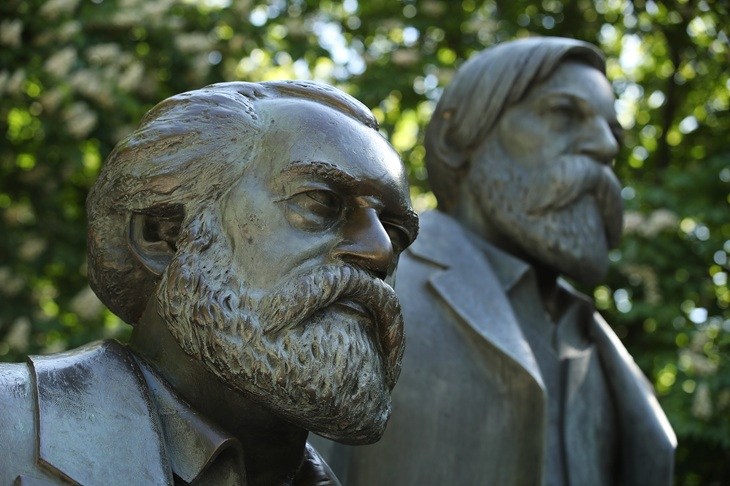
If Marx were rolled out of Highgate cemetery and landed in Marrickville today, the surprise wouldn’t be that he had been wrong. He would take one look around and say, ‘Das ist schön!’ (dis is nice, vere’s Albo, did you lose zie vor). He imagined a society in which a man might hunt in the morning, fish in the afternoon, rear cattle in the evening, and criticise after dinner, without ever becoming hunter, fisherman, herdsman, or critic.
In 2026, that’s a career with a title, a lanyard, or a grant.
Yet Marxism had already arrived, not just in Marrickville but firmly embedded in Australian public policy, not by revolution, by evolution, one election at a time, until people forgot the challenging journey of those before them.
The Grand Bargain
Imagine this, a table in Soho in the 1850s, Marx and Engels are several glasses of red into the evening and Mephistopheles arrives to join them with fresh industrial terms, to be delivered in full across the 20th Century, posthumously: Universal literacy, suffrage, and medicine; pensions funded by the state; an eight-hour day; paid holidays with a loading deserved or not; a working class that owns property.
In return, Mephistopheles bargained that the terms would last for only as long as the beneficiaries could remember how the good times came to pass, so Karl and Friedrich, drunk on the notion of their profound deal, agreed. Any sane Marxist would have agreed.
None of it was original though, as Mephistopheles had borrowed the same deal warned of by Moses at Moab in (Deuteronomy 8):
‘A land of wheat and barley, vines and figs and pomegranates, bread without scarcity, goodly houses to dwell in, herds multiplied, silver and gold multiplied …’ but ‘…when they had eaten and were full they were to remember who had delivered it, and not say in their hearts that their own power and the might of their own hand had gotten them this wealth.’
Mephistopheles had not left that clause out, legend has it that he never does, nor had he forgotten that to break it was to ensure the wrath of God, only this time, that God was Cronos, the God who ate his children.
The Delivery
Once Britain had emptied its villages into its towns and the 70 years of waiting for the sole rising in Russia had passed, the proletariat of the industrial West were a flop.
If the revolution was ever going to happen in the industrial West it was going to happen between 1929 and 1933. A quarter of the workforce idle, banks collapsing in rows, savings erased, and a generation with nothing left to lose. Marx had specified those conditions almost to the letter and nothing happened.
Max Weber, writing as the century turned, had already explained why it would go that way. Bureaucracy, he saw, is the most durable structure men build, indifferent to whoever is nominally in charge and very nearly impossible to dismantle once established. His argument was not destroying the fabric of Marxism, it was explaining what Marx and Engels were blind to on that fabled night. The dream of revolution to bring about their Grand Bargain would be delivered as agreed, but by clerks, in brown suits and cardigans.
What the cunning Mephistopheles had kept secret was that capitalism would do the heavy lifting for as long as it could sustain itself and by the roaring ’20s it appeared that Cronos would continue to go hungry: But the Austrian school economics, like Moses, had warned of exuberance.
Ludwig von Mises, and after him his student Friedrich Hayek, argued that credit expansion does not create wealth but misdirects it, that cheap money inflates the price of assets and calls forth investment that should never have been made. That the correction is not an accident but the result.
The Great Depression
‘Now a wind went out from the Lord, and it brought quail from the sea and let them fall beside the camp … but while the meat was still between their teeth, before it was chewed, the wrath of the Lord was kindled against the people, and the Lord struck the people with a very great plague.’ Numbers 11:31–34
The rescue – John Maynard Keynes
In 1936, Keynes wrote his General Theory of Employment, Interest and Money, and while his General Theory was a defence of the system, he argued it required a competent hand to stabilise the system, a lever, spend into the slump, withdraw in the boom. It was, in my words, the economic piano accordion.
What Keynes had not priced was who would end up holding his lever. The expansion was taken and the contraction quietly forgotten, the temporary became permanent, the permanent became structural, and every crisis since has ratcheted the state one notch further out and never back.
Mephistopheles was grinning; the playbook had been written in stone.
Hayek, who had watched the whole thing from the beginning, gave the behaviour its proper name, the fatal conceit.
But the three decades following the war gave the ordinary man more than the preceding two centuries had managed between them. It was the bargain being delivered, or was it.
The Reckoning
There has been no recent moment of expiry, just a new generation that arrived having never known anything else than the benefits of the Grand Bargain. And so, we became busy believing we had created all this, with the esoteric, the fads, the volcano gods, and the shortcuts.
The 20th Century was an amazing gift from the gods. Yet we sacrificed ourselves on the altar of greed and ignorance twice. The lessons from history were there but not once did we realise we were in breach of the Grand Bargain, deaf to the warning of Moses, a productive malaise dressed as a golden age.
A decade of the cheapest money in recorded history has brought the curtain down and the Grand Bargain is at an end. It culminated in the unbridled revaluation of everything the older population already owned, exactly as Moses and Hayek said it would, and a whole country said in its heart that its own hand had gotten it this wealth.
The generation that has fallen foul of the bargain now requires young workers to fund transfers to asset holders while pricing those same workers out of ownership and out of family formation. A system that cannot reproduce its own labour force or capitalise productivity gains is the Cronos clause falling due.
The demographics will not save us either, because this time they run the other way. The cohort Bernard Salt has mapped is not a protest movement; it’s the great-great-grandchildren of the Grand Bargain, now reaching the age at which the arithmetic becomes personal. Howling at the climate gods is a young person’s pastime. Rent, a mortgage that will not come, the job an algorithm is circling, and children you cannot afford are not.
The Antithesis
What we have built cannot be overthrown, because there is nobody to overthrow. It’s a clever plot. Unless somebody finds a reset button, this is peak Marxism, and peak Marxism turns out to look like a good deal gone bad.
So Hegel’s dialectic is back on the table. But here’s the thing about the antithesis, and it is the reason nobody can forecast it. It is not philosophical. The forgotten are not buying an ideology, they are walking away from one. It is the correlative, formed across a generation: It is fractious, cranky, ill-informed, alienated, easy to harness, and very difficult to steer. And there are hundreds of thousands of them, growing rather than shrinking; a revolution no less.
Smirk of Cronos
This section of the population is growing and replacing itself for the next 50 years. What will they want, and it isn’t capitalism as taught. Nobody under 35 is marching for Hayek. The problem is they don’t really know, other than to say not this, because the guardians of justice and equity are themselves hostage to the bargain Mephistopheles struck.
The grievance has no content, so it cannot be argued with. It can only be removed, which means supply, energy, housing and productivity, the unglamorous work of the C20th: and that will take rather more than another bargain with Mephistopheles, because the first one has already been performed and the fatal conceit has rendered it dead
Old Karl, sipping his latte, would look at Freddie and say: We did it, comrades! But how does it feel for the Millennials? It feels the way it has always felt for the workers in, say, Engels Manchester factory, like losers. The difference this time is that the losers are young, numerous and arriving, and the god who underwrote the contract is still laughing.
Is this the revolution?