Watercolours can be fatal for your standing in the art world. ‘As soon as you say you paint in watercolour,’ says Gerard Stamp, ‘you can see people popping you into a pigeonhole – ah, you’re a Sunday painter doing vases of flowers.’ There are many flaws in the aesthetics of the ‘art world’, but this one is unusually absurd. Stamp’s paintings are some of the most beautiful of our time.
‘I presented one to Queen Elizabeth II when she opened Norwich Cathedral Hostry on behalf of all who love the Cathedral. I had an exhibition there… and showed her round together with the Duke of Edinburgh, who took me aside, pointed to a large charcoal drawing and said: “How the bloody hell did you do that?” I’m told the painting is still hanging in Sandringham.’
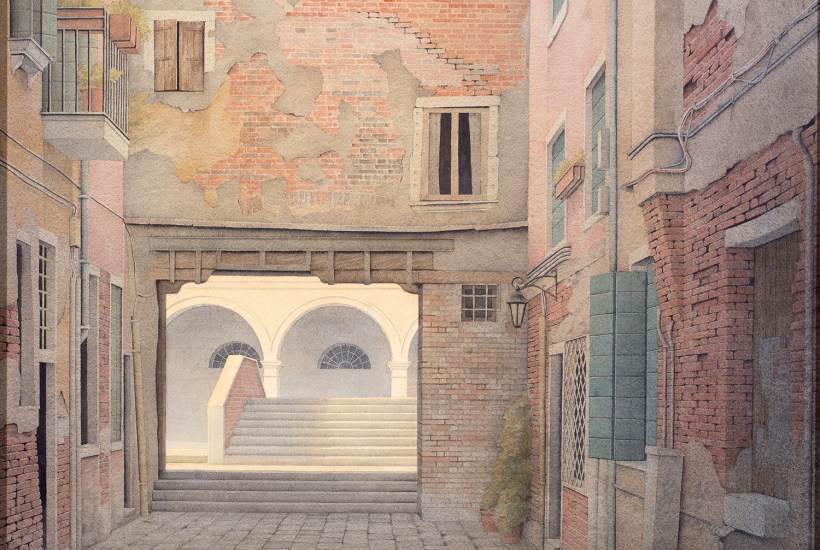
His work hangs in the Royal Collection as well as the private collections of Judi Dench, Simon Jenkins, Dan Cruickshank and many others. The word should now spread. A new biography by Ian Collins – Gerard Stamp: At The Still Point – illustrated by Stamp’s paintings of Venice, comes out this autumn. A new exhibition of these pictures at Jonathan Cooper gallery opens on 21 October.
‘It’s taken me a long time to tackle Venice,’ he says, ‘because very many years ago another gallery owner in London said to me: “Whatever you do, don’t paint Venice, it’s such a cliché” and so I took him at his word. But if you love beauty and beautiful architecture at some point you have go to Venice.’
Readers of this magazine will remember Gavin, Gerard’s older brother, who died, unexpectedly, in 2017. Gavin shared with his brother a certain defiance – he was an architectural critic and wrote anti-car columns for The Spectator.
‘He died far, far too young at 69,’ says Gerard, ‘and he had so much more to do, but he had a big influence in his chosen career of journalism, architectural criticism, teaching.’
Gerard, like Gavin, is a mighty presence in any room – though a little more benign. For 25 years he worked in advertising. His favourite ad was a rather brilliant one for McDonald’s called ‘Birds and Bees’ – you can still find it on YouTube. Then he decided to paint full time. His income fell to zero and it stayed there for three years until he sold his first painting for £2,500. From the beginning he was inspired by places of worship. ‘His pictures,’ says Simon Jenkins, ‘evoke the mystery of English churches. Under his brush, buildings that have often become functional and banal are restored to their gothic glory.’
He was, and still is, a lover of all things Norfolk. ‘I went to school under the shadow of Norwich Cathedral, surrounded by medieval architecture.’ Like me, he is especially thrilled by Binham Priory, a partially ruined masterpiece combining Norman and gothic styles. ‘We lived in Binham for a while and I used to walk round the ruins at night – a full moon, fabulous. It is my favourite. John Betjeman said, “You’re either a Salle man or a Cawston man”, referring to two magnificent Norfolk churches but I’m definitely a Binham man. The west window is partly bricked up. Lots of people say, “Oh no we need to restore it”, but I rather love it.’
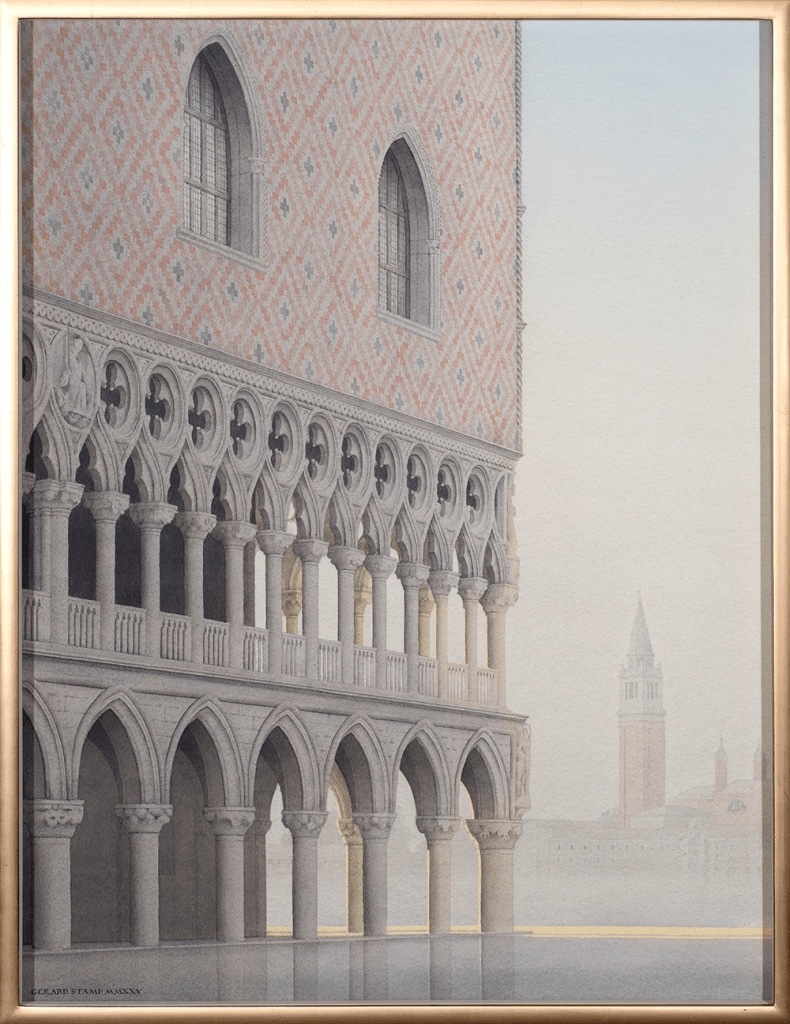 ‘L’Alba a Venezia’, 2026, by Gerard Stamp
His church paintings have many moods – bright with sunlight, dark with shadows – and they often emerge from mists, the spirit and meaning of each changing with his palette.
He is uninspired by the usual package of modernist stars that underwrite the mainstream art world. But he is inspired by John Sell Cotman, a Norwich artist who died in 1842. His exquisite paintings, etchings and drawings, like Stamp’s, evoke moods and places better than any of today’s daubers.
‘The Duke of Edinburgh pointed to a charcoal drawing and said: “How the bloody hell did you do that?”’
‘My early paintings, most of which I’ve destroyed, were rather bad copies of Cotman. It took me a long time to develop my own voice and my own style – three years in all – working in the corner of the bedroom, and then, after we built this, in here.’ His studio, known as the Boathouse, was built in a landscape of fields, sheep and water in an area known as Gunton Park, which lies south of Cromer. The style is very Stamp – the interior full of comfortable heavy furniture, the exterior touched by the arts and crafts movement of the late 19th century.
Once again royalty intruded. King Charles, then the Prince of Wales, turned up unexpectedly. They talked for 20 minutes before the King and his three-car escort decamped to the Gunton Arms. ‘I sent him the catalogue from an exhibition on Ely Cathedral because he knew the cathedral very well indeed. He… ultimately acquired one of the paintings of Ely.’ I ask him, nervously, why his work is not better known. ‘A more flippant response to that would be because I’m an old, white, middle-class, able-bodied, heterosexual male with boring pronouns…’.
In reality the tedious ineptitude of much of the current art market makes him an outsider. The Venice paintings are, I think, his best yet, so all that might – should – change things.
Got something to add? Join the discussion and comment below.
You might disagree with half of it, but you’ll enjoy reading all of it. Try your first month for free, then just $2 a week for the remainder of your first year.