Australians are right. Regular polling confirms a consistent majority believe the country is ‘on the wrong track’. At most, 30 per cent think we’re on the right track.
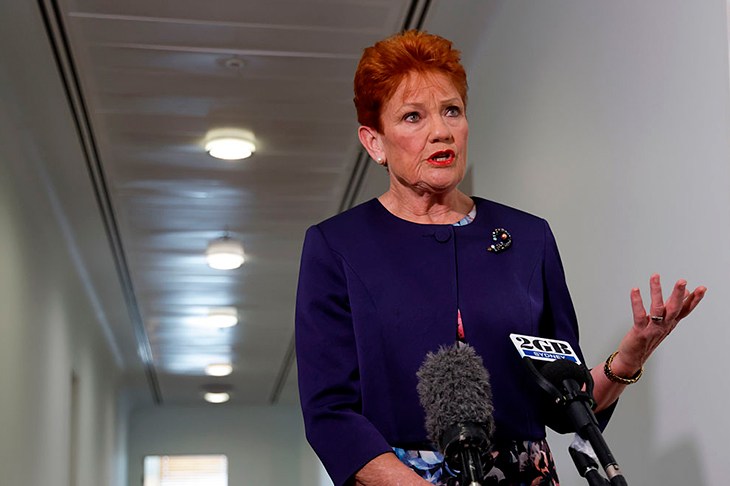
On Friday, 13 November, introduced by editor Rowan Dean, Senator Pauline Hanson will take part in a dialogue on the Constitution. The centrepiece of Australians for Constitutional Monarchy’s 27th Conference, this will be at a cost-friendly lunch in Sydney. (For tickets: https://events.humanitix.com/acm-27th-national-conference).
Australians everywhere are asking: ‘How is it possible that, with all our mineral wealth, we’re struggling with the cost of living?’ and, ‘Why are things getting worse?’
As Jai Martinkovits and I argued in our book Give Us Back Our Country (2014), solid research by experts such as Niall Ferguson in his prestigious BBC Reith Lectures and by Daron Acemoglu and James A. Robinson in their monumental work, Why Nations Fail (2012), demonstrates overwhelmingly that national success in democratic states is driven essentially by the quality of their institutions.
So national prosperity does ‘not depend on geography, race, or natural resources’, but on whether institutions are ‘inclusive’ (distributing power and securing property) or ‘extractive’ (concentrating power in a narrow political elite that tailors governance to entrench its own privileges).
At Federation in 1901, Australians were among the richest people in the world. So, with vastly more mineral wealth discovered since then, how is it that we are in decline economically and on so many other fronts?
Clearly, at Federation our institutions were first-class. The people in each of the six colonies – and not just the elites – were intimately involved in the development of the Constitution. Their consent was secured at different stages of the project over an extraordinary ten referendums, a democratic tool borrowed from Switzerland. That involvement was to continue. It was specifically agreed that the Constitution could only be changed by parliament with the approval of the people in a referendum. Again following Switzerland, to ensure approval would not just be concentrated in the big cities, the referendum had also to be won in a majority of states. The result was that for the first time in the world, responsible government under the Westminster tradition was successfully grafted onto a federal legislature with a US-style Senate.
This ensured governments were directly accountable. Meanwhile, the rule of law continued, with all serious criminal trials heard before juries. We were decades ahead of Europe in education, having pioneered universal, compulsory and secular schooling in the 1870s and 1880s. We were determined to build up our defences and did so. The Constitution was a sensible compromise aimed at ensuring the centre possessed only those powers it could – and should – handle, principally defence, immigration, and free trade and commerce across state borders.
Crucially, the original bench of the High Court of Australia comprised men who were intimately involved in drafting the Constitution and knew what it meant: Sir Samuel Griffith (Chief Justice), Sir Edmund Barton, and Richard O’Connor.
Yet over subsequent decades, fatal weaknesses emerged that compromised the original intention.
The first weakness was that High Court judges were appointed by the federal cabinet without state or parliamentary confirmation, or any external vetting. Through decisions such as the 1920 Engineers’ case and the Uniform Tax cases, successive centralist judges re-interpreted the Constitution to expand Canberra’s powers far beyond its capacity, dismantling state financial independence. They made significant changes to the Constitution, and by calling it ‘interpretation’, they did this without obtaining the constitutionally required approval of voters in a referendum.
Over time this has led to Australia no longer being a true federation. It explains how career politicians have been able to wreck our economy and have us indebted to an extraordinary $1 trillion.
Those who framed the Constitution were wary of the dangers of centralism; they knew a continent as vast as Australia could never be managed in detail from a distant capital.
Nor did they anticipate the rise of the career politicians – people untrained in productive enterprise, beholden to backroom power brokers and disciplined by the rigid party caucus rule which, with the advent of the two-party system of Labor and the Coalition, has reduced too many parliamentary representatives to the status of rubber stamps.
Uniquely among federations, Canberra now monopolises roughly 80 per cent of all national taxes, handing roughly half back to the states laden with centralist directions. This ‘vertical fiscal imbalance’ breeds all sorts of viruses such as the recently revealed ‘grey corruption’ – closed-door discretionary grants designed to buy marginal electorates, subverting Section 83 which mandates that ‘no money shall be drawn from the Treasury of the Commonwealth except under appropriation made by law’.
The consequent economic loss is staggering. With no mineral riches, Switzerland’s decentralised, direct-democracy federal model yields an income per head roughly 35 per cent (or more than $30,000) higher than Australia’s.
In Singapore, an incorruptible administration and rigorous meritocracy – free from Western culture-war doctrines in schools – have produced an average national income more than double our own. Yet at independence in 1965, Singapore’s income was only one-quarter of ours.
Groundbreaking research by Professor Anne Twomey and Professor Glenn Withers AO demonstrated long ago that restoring genuine, decentralised federalism like Switzerland’s would lift Australian GDP by 8 per cent – roughly $240 billion annually. That would go a long way to help water this dry continent.
The surge has changed this. Pauline Hanson is now the agenda setter, with the other parties and the media following in her wake. As Kel Richards explained on News 24, One Nation possesses a singular strength: it has no left faction cajoling it into a ‘Labor-lite’ agenda. Its mission is to install permanent institutional guardrails against executive waste.
The ultimate solution lies in Citizen-Initiated Referendums – initially reviving SA Premier Charles Kingston’s 1891 proposal. (On that, it is crucial we follow the tried-and-tested Swiss example and not California’s poorly designed process). By giving voters the power to veto bad legislation and initiate Section 128 referendums, the people gain the power to control both career politicians and activist constitutional judges, restoring ultimate sovereignty where it belongs: with the Australian people.
Got something to add? Join the discussion and comment below.
You might disagree with half of it, but you’ll enjoy reading all of it. Try your first month for free, then just $2 a week for the remainder of your first year.