The way US prosecutors tell it, Huawei is a bunch of racketeers whose crimes range from stealing technology to evading sanctions against Iran. The company allegedly ran what it called a “competition management group,” whose purpose was to award monthly bonuses to employees who stole the most valuable information from competitors. Staff were invited to submit entries via a special encrypted email box.
“The entire business operated through a pattern of theft, lies and cover-ups,” according to Taylor Stout, a federal prosecutor in the Justice Department, as he laid out the government’s criminal case to jurors. The trial of China’s global technology champion, whose revenue hit $127 billion last year, got underway in a Brooklyn court this month and is expected to last well into the new year, with Huawei potentially facing enormous fines.
Beijing seems intent on creating by fair means or foul a comparative advantage in almost everything
Huawei denies the allegations. “The government’s overarching narrative is demonstrably false,” it said in a statement. “Long-term investment in innovation, backed by the utmost respect for intellectual property, has been the driving force behind Huawei’s business success.”
The case dates back eight years, which is when Meng Wanzhou, Huawei’s chief financial officer and daughter of the company’s founder, was detained in the Canadian city of Vancouver under a US extradition warrant. Soon after that, in apparent retaliation, Chinese security agents seized two Canadians who were working in China and accused them of spying – effectively holding them hostage. Meng fought extradition for three years before being released as part of a deal with prosecutors (the Canadians were released simultaneously), but the US continued to build a case against the company.
The trial presents a difficult backdrop for a summit between presidents Donald Trump and Xi Jinping, which is scheduled to begin in Washington DC on 24 September. It will also reinforce the view of those who have long argued that China’s rise was built on theft – a multi-decade technological heist. And it will strengthen concern over Beijing’s tightening grip on global supply chains.
Xi heads to the US at a time when China is running a record trade surplus – $1.2 trillion in 2025, the highest ever recorded, with some economists predicting that it will be even bigger this year. China is now responsible for a third of the world’s manufacturing output – an astonishing concentration of industrial power.
These raw figures are scary enough for Western policymakers, but the detail behind them is even more alarming, as China is moving away from its long domination of low-value trade (dubbed “China shock 1”) to a tightening grip on more advanced and increasingly strategic goods and their supply chains. This has been dubbed “China shock 2,” and ranges from “green” technologies such as electric vehicles, batteries, solar panels and other renewable technologies to critical minerals, pharmaceutical ingredients, machine tools and printed circuit boards.
“An ongoing flood of low-cost Chinese goods is spilling into global markets amid a second China ‘Shock,’ threatening to put global competitors out of business in sector after sector and positioning China for dominance over ever more supply chains,” warned the US-China Economic and Security Review Commission (USCC) in its latest report to Congress. The USCC argues that China’s prowess was built on naked mercantilism – exports underpinned by massive state subsidies and other support.
This is echoed by the Organization for Economic Cooperation and Development (OECD), which calculated in a June report that nearly 60 percent of China’s gains in global manufacturing market share between 2005 and 2024 were driven by state subsidies. It says that Chinese companies in sectors including solar panels, cars and steel, received up to eight times more government subsidies than their peers in OECD countries over the two decades to 2024.
Rattled European Union leaders fear “China shock 2” will decimate key European sectors. They have prepared an arsenal of counter-measures against what they see as unfair trade practices, which have resulted in a growing Chinese trade surplus with the block of more than $1 billion a day. These include anti-dumping and anti-subsidy duties and a proposal to require public bodies to favor local suppliers. Brussels has also ramped up investigations into subsidized Chinese companies, blocked Chinese investments and sanctioned companies that use coercive practices.
But there are divisions within the block, which China is adept at exploiting, and critics accuse Brussels of being too timid. Earlier this month Eurometal, a trade body, organized a march around the European Commission headquarters in Brussels carrying 10 coffins to symbolize the death of the metals industry in the face of its “colonization” by Chinese component manufacturers. It predicts the loss of 300,000 manufacturing jobs in the rest of 2026 because of Chinese competition.
Beijing is threatening retaliation, raising the specter of last year’s weaponization of its dominance of rare earths supply chains, where it controls roughly 70 percent of extraction and up to 90 percent of processing of these metals that are critical for high technology manufacturing. Beijing’s export restrictions were aimed principally at the US, successfully forcing Trump to back down on tariffs, but they also hit European industry, threatening to shut down the German car industry.
The export controls have been paused, not scrapped and will hang over the meeting between Trump and Xi this week. The restrictions would have forced foreign companies – both inside and outside China – to supply commercially and militarily sensitive information about their products in order to obtain a license to use Chinese rare earths. This would in effect give the Chinese communist party (CCP) a veto over who uses these critical minerals and how they are used.Western strategists fear it could become a model for other sensitive supply chains controlled by Beijing.
Xi Jinping has made no secret of his plans to leverage dependence on China, telling the CCP’s Central Financial and Economic Affairs Commission, “We must tighten international production chains’ dependence on China, forming powerful countermeasures and deterrent capabilities based on artificially cutting off supply to foreigners.”
More recently the CCP has introduced a raft of coercive measures aimed at maintaining China’s supply chain dominance and thwarting Western attempts to “de-risk” or “de-couple” their economies. These include broad regulations to investigate and punish foreign companies that stop using suppliers in China in response to political pressure from their own governments. Security agents are able to examine corporate records and question employees of foreign companies working in China in their efforts to “prevent security risks in industrial and supply chains.”
Last week, the CCP introduced sweeping new controls on overseas travel for Chinese citizens, taking China back towards the era of Mao Zedong. Citizens can be banned from leaving for anywhere from six months to indefinitely if deemed to have contravened industrial and technology import and export controls.
One purpose of the controls is to obstruct efforts by companies to shift supply chains out of the country. It formalizes and extends a system that appears to have been in place for some time. Last year it was reported that the Chinese authorities were delaying and blocking the shipment of iPhone equipment to India, part of Apple’s effort to diversify its supply chains away from China. Apple’s contractors were also put under pressure to stay put.
Earlier this summer, Elon Musk strongly denied reports that he was weighing divesting his interests in China, where Tesla has a sprawling plant outside Shanghai. “This has never even come up in a discussion ever. Absurdly fake news,” he insisted. Such is the sensitivity of discussing Chinese supply chains that he even said he was reporting online speculation to the police and doubled down on his praise of of the country – “China is awesome,” he wrote on X.
The country desperately needs to conquer foreign markets on which to offload its over-production
Apple and Tesla are two of the most high profile investors in China. Apple built the world’s most sophisticated supply chain in the country, and both received multiple favors in setting up operations there and are highly dependent on China as a base and a market. For its part, China benefitted enormously from their technological expertise, and both have been instrumental in the building of unrivalled technological ecosystems in China for consumer electronics and electric vehicles (EVs).
While the raw figures of China’s industrial output and exports suggest strength, they are also indicative of deep-seated structural problems, and Beijing’s aggressive defense of its global supply chain dominance has become a matter of economic survival. China’s economy is really two economies. The first is the much hyped China of humanoid robots, AI models and renewable technologies, the second the struggling economy of high debt, a collapsed property market, wasteful infrastructure investment, soaring youth unemployment and stagnant domestic demand.
The new economy, Xi Jinping’s “new productive forces,” is only a small proportion of an economy that is riddled with structural issues, subsidies and other perverse incentives – an investment-led economy which cannot stop building factories for which there is no demand, and desperately needs to conquer foreign markets on which to offload the over-production.
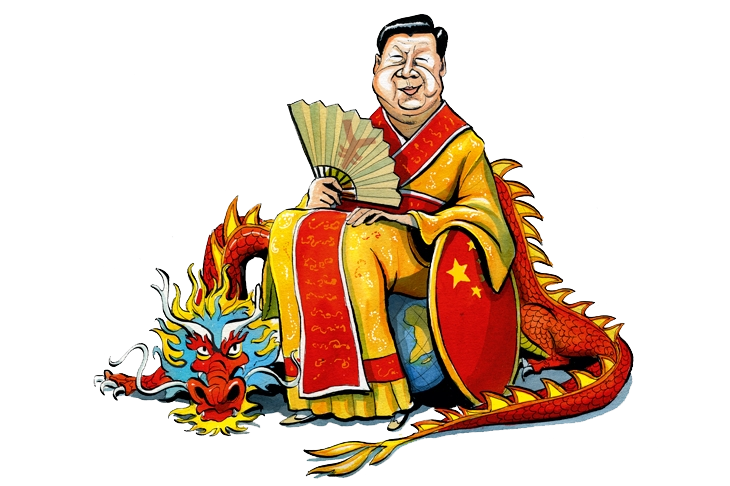
China’s professed aim is to lead the world in the technologies of the future. It wants the world to be dependent on China, while having no dependencies of its own – which makes a mockery of the principles of comparative advantage that underpin theories of free trade. Beijing seems intent on creating by fair means or foul a comparative advantage in almost everything, especially technology. One image that comes to mind is of a plundering army retreating to its castle, pulling up the draw bridge behind it.
Beijing argues that it is simply more efficient and cost-effective than other countries and denies having vast overcapacity, though this cuts little ice with those on the receiving end of “China shock 2.” And the pushback is not just coming from advanced economies, with some of the loudest complaints from the Global South, with Brazil, Indonesia, Mexico, South Africa, Thailand and Turkey among those placing restrictions on Chinese imports. There has also been anger in southeast Asia at China’s efforts to disguise supply chains by re-routing (and re-labelling) exports as made elsewhere in order to sidestep tariffs.
Xi has done much to court the Global South, which has been a principal target of his Belt and Road Initiative (BRI), an umbrella program for just about everything China does internationally to spread its influence. The $1 trillion BRI started life as a scheme to invest in infrastructure, spawning debt dependency. Often opaque projects typically employed Chinese labour, companies and capital, and have been accused of corruption, human rights abuses and environmental degradation. More recently the BRI has concentrated on spreading Chinese technology, seeking to lock poorer countries into Chinese supply chains and technological eco-system. Xi has suggested for example, Xi has suggested that Chinese AI models be made available to the world as an “international public good.”
The accusations against Huawei, now being aired in the New York trial, will serve as a reminder of the alleged subterfuge that has driven China’s technological rise and the difficult questions surrounding Chinese technologies and the supply chains that underpin them. Part of the challenge is economic, countering Chinese mercantilism, part is about security. Western intelligence agencies have spent much of the last four decades trying to keep Chinese hackers out of the systems of our companies and governments. China is now exporting those systems themselves – from AI models to EVs and other renewables – presenting a whole new challenge.
And it is not just finished systems, but critical components within them, which may be made in China, but hidden by the complexity of the supply chain. It used to be that economic geeks were the only ones kept awake at night dreaming about the complex routes down which products were produced and came to our markets. But the distortions and dominance created by China has ensured that the once obscure world of supply chains has become central to geopolitics – and to the future of the world economy.