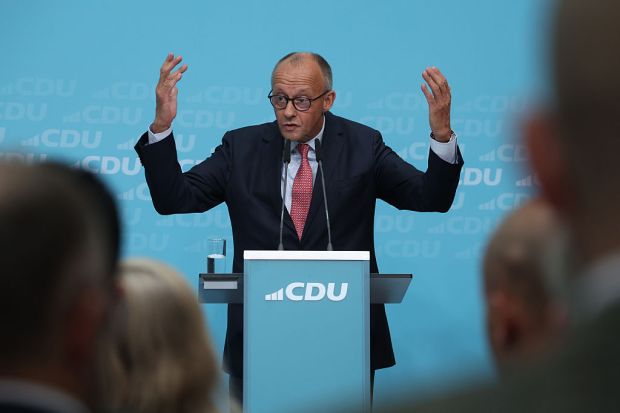
Yet another election Sunday in Germany turned in to yet another devastating blow for Chancellor Friedrich Merz and his Christian Democrats (CDU). In the north-eastern state of Mecklenburg-Vorpommern, the CDU dipped below the five per cent threshold needed to stay in parliament. In Berlin, the CDU looks set to be defeated by Die Linke (The Left). Merz called it ‘a disaster’ for his party, but he remains defiant.
Merz’s biggest challenge is that his claim of ‘wealth for all’ is hardly achievable
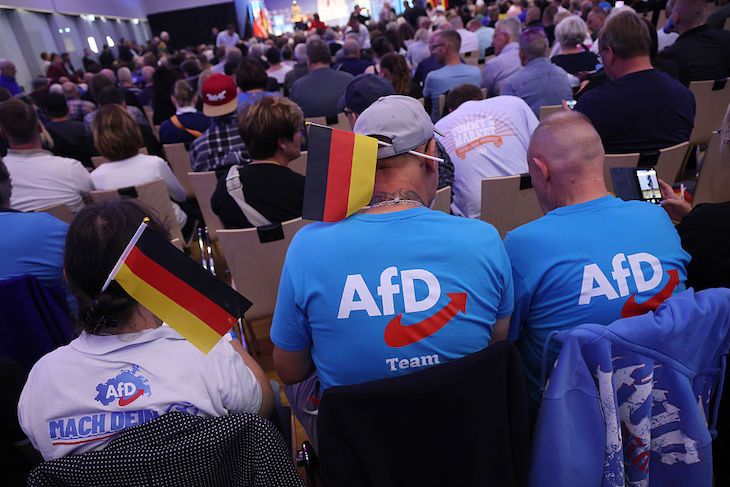
If Merz is the loser, Alternative for Germany (AfD) is the big winner. The anti-immigration party won the most votes in Mecklenburg-Vorpommern ahead of the Social Democrats (SPD) who had a fighting chance thanks to incumbent government leader Manuela Schwesig. As things stand, Schwesig may be able to continue her work in office by forming a new coalition with the socialist Left (Die Linke) and the Greens (Bündnis 90/Die Grünen).
Schwesig, who ran a dedicated campaign against the AfD in the last few weeks, said on Sunday that roughly 60 per cent of the electorate don’t want the AfD in office. The AfD scored 38.2 per cent of the voters, an increase of 21.5 percentage points compared to 2021, with the SPD coming in at 25.5 per cent.
Schwesig put the blame for the rise of the AfD on Merz and the federal government which is formed by the CDU and her SPD. “We have to ask ourselves self-critically why the AfD has become so strong in our country,” Schwesig said, pointing out how promises in the coalition agreement regarding pension regulations remained unfulfilled.
The result was certainly dissatisfying for the Social Democrats, but by far not as devastating as it was for the CDU. Merz’s party did not pass the five-per cent threshold, meaning the CDU has no seats in a state parliament for the first time in history. The Christian Democrats lost ground in the polls in the weeks leading up to Sunday’s election. A survey suggests that 35,000 voters moved from the CDU to the AfD and 25,000 from the CDU to the SPD, causing the party to fall to 4.9 per cent.
At the same time, Berlin saw a historic win for the socialist Left with frontrunner Elif Eralp. She could be the first governing mayor of Berlin with a migrant background. The capital, which is technically a federal state, was under the Social Democrats’ control for 25 years until the CDU took over in 2023. But governing mayor Kai Wegner’s reign was riddled with scandals to the point that he had to drop out of the race in July. Instead, the CDU tried to pull back votes with Stefan Evers, currently Berlin’s state minister of finance. In the end, Evers’s efforts were not enough to prevent the Left from winning the election. The socialist party scored 25.7 per cent, almost doubling their voter share compared to 2023. The CDU won 18.8 per cent of the voters, while the AfD came in third with 16.3 per cent.
Berlin, with its young population and a high proportion of migrants, is something of an exception in German politics. The city tends to lean to the left more than any other region in the country. Both the Left and the CDU will try to persuade the SPD and the Greens to form a coalition in the coming weeks.
Critics say that Eralp and her party will be unable to govern effectively. Most notably, the Left’s approach to Berlin’s pressing housing shortage remains a point of contention, as it wants to socialise housing stock and build new apartment buildings through public funding.
But whether or not Eralp defies the odds and succeeds, one thing is clear: Chancellor Merz is under immense pressure amid a set of devastating election results. Not only is the CDU losing votes by the week, but party leaders view Merz’s performance increasingly critically.
But perhaps there is still, some, hope for the CDU. In a trenchant speech on Sunday minutes, after the polling stations had closed, Merz managed to concisely outline his political programme for the first time. He wants to remain the ‘reform chancellor’, he said, calling an end to speculation about snap elections which would certainly favour the AfD to win dominantly. He vowed to crack on with the coalition government’s plans to push through a package of economic, tax and welfare reforms.
Merz’s biggest challenge is that his claim of ‘wealth for all’ is hardly achievable, not least given that he must push forward with social reforms that will not gain him much sympathy from voters. The Chancellor’s seat remains shaky.