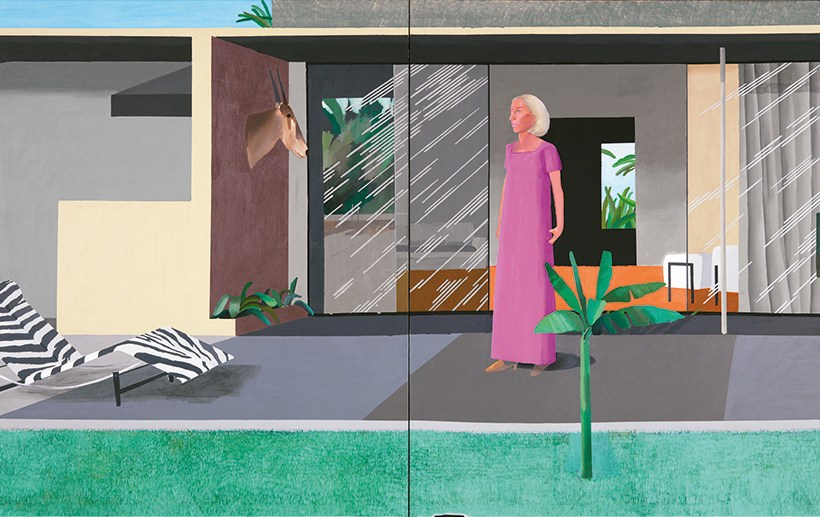
David Hockney painted ‘Beverly Hills Housewife’ between l966 and 1967, during an exceptionally happy period of his life. He was thrilled to be living in Los Angeles and was enjoying his first great love affair, with Peter Schlesinger, who loved him back. John Kasmin, his art dealer, came out from London to introduce him to various collectors. One of them was Betty Freeman, who lived at 703 Hillcrest Road, a fairly typical Beverly Hills house. Hockney asked if he could take some polaroids, which became the source for the painting.
Hockney and Freeman liked each other from the start and would become lifelong friends. She was not pushy or show-offy like many collectors’ wives, and it was typical of her to suggest that the painting should be called ‘Beverly Hills Housewife’, to preserve her anonymity. She was the wife of Stanley Freeman, a rich, self-made businessman, and the mother of four children. But she was 45 when she met Hockney and her marriage was cooling. Stanley liked big-game hunting – hence the antelope’s head on the wall and the zebra skin on the recliner. But after accompanying him to Africa once, Betty never went again. In fact Stanley was absent most of the time; and when Betty discovered that he was having an affair with his secretary she was glad of the excuse to divorce him in l971. She kept the house and lived there for the rest of her life, with Hockney’s painting on the wall. Much later, she had a happy second marriage to the Italian artist Franco Assetto, and they shuttled between Los Angeles and his home town Turin.
Betty had hoped to become a concert pianist and used to spend up to seven hours a day practising; but, in 1964, she realised she would never be good enough and stopped playing entirely. Instead, she switched to becoming a great music patron. It started when the composer La Monte Young (whom she had never met) was jailed for drug possession and she donated $100 to help bail him out. She said: ‘I thought it was terribly undignified putting a composer in jail for marijuana.’ He responded by sending her a record of his music and she loved it and sought out other avant-garde composers. She paid John Cage an annual grant of $5,000, and he entitled a set of violin studies ‘The Freeman Etudes’. John Adams dedicated his opera Nixon in China to her and Thomas Ades became a close friend. She said: ‘I like being a patron. Mozart could have used a patron like me in the last years of his life.’
‘She was totally bored by old music or old paintings. She wanted something new’
She encouraged young composers by holding musical soirees where they could perform their work. Hockney took Kasmin to one of them and warned him beforehand: ‘It might be a bit dull.’ It surely was; it consisted of a musician playing one note for four hours. But her musicales were keenly attended, with sometimes 100 people crammed into the house. She only stopped them when her husband Franco died in 1991, and she took up photography instead. Her portraits of Alfred Brendel were particularly admired.
Some people didn’t get Freeman at all, finding her aloof and detached. James Cahill believes her detachment was ‘really a sort of cosmic nonchalance, a freedom from any need to ingratiate herself’. Kasmin remembered his first meeting with her:
She had a sort of atmosphere about her, as though she were in Cloud Cuckoo Land… She had a slight appearance, on first meeting, of a dumb broad with money. But she knew what she wanted to do… She was really unlike most art-buying women. She was quiet; she reserved her opinions.
Her friend Julia Bloomfield described her as
a most unusual and powerful and wonderful and wacky woman, with this extraordinary love for the contemporary. She was totally bored by old music or old paintings. She wanted something new.
She was diagnosed with pancreatic cancer in 2006 but refused treatment. Instead, she asked Ades to wheel her along the boardwalk of Venice Beach, which she loved. She died in January 2009 and the Hockney painting, which she bought for $4,500, was soon sold for $7.9 million. It is now in a private collection, whereabouts unknown.
I wondered at the beginning of this 272-page book how it would be possible to write about one painting, but Cahill has a simple answer. Digress, digress, digress. Basically, he includes whatever takes his fancy, from Piero della Francesca’s ‘Flagellation of Christ’ to Jan van Eyck’s ‘Arnolfini Portrait’. He even gives us a whole chapter on the TV reality show The Real Housewives of Beverly Hills, which has nothing at all to do with Hockney’s painting.
If you find such digressions irritating you will have no truck with this book. But Cahill writes beautifully, and his account of Hockney and Freeman’s friendship is deeply moving.
Got something to add? Join the discussion and comment below.
You might disagree with half of it, but you’ll enjoy reading all of it. Try your first month for free, then just $2 a week for the remainder of your first year.