Here’s a quiz for you. On the third floor of the New York Public Library is a vast mural painted by Edward Laning in the 1930s. It’s called ‘The Story of the Recorded Word’ and it’s divided into four scenes, each one a pivotal stage in the development of writing. Can you guess what they are?
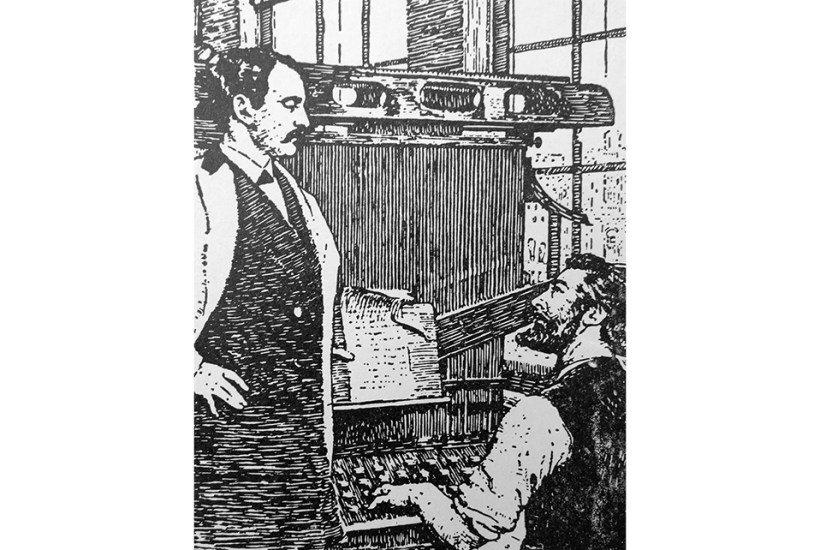
I daresay you managed to picture something resembling the third scene: a bearded Johannes Gutenberg showing off a page of type from his new invention, the printing press. I think you might have got the second one, too: a medieval monk, with quills and inkpot, copying out a manuscript in his scriptorium. Perhaps, if you’re religiously inclined, you even guessed the first: Moses receiving the Ten Commandments carved into stone. But what about the fourth scene? That’s right: it’s Ottmar Mergenthaler, in the offices of the New York Tribune, demonstrating his Linotype machine to the newspaper baron Whitelaw Reid. Of course it is.
In the 1880s, Linotype’s invention seemed as momentous as Moses on the mount or Gutenberg’s moveable type. What was it, then, and why does its inclusion in this great lineage look so quaint now? Jeff Jarvis’s Hot Type is the story of the rise and fall of Mergenthaler’s miraculous machine. Ignore the subtitle, by the way. That’s something that publishers do: make you ham up the celebrity angle. TL; DR: Mark Twain was the principal investor in a machine called the Paige Compositor, the Betamax of newspaper typesetters, and he lost eyewatering sums of money on it. The hero here is Mergenthaler; and the villain is Reid.
Over the course of the 19th century, a series of inventions radically increased the speed at which newspapers could be produced and distributed. The steam-powered press – introduced at the Times in 1814 with a kind of union-busting secrecy (hold on to that thought) – brought printing speeds up to thousands of impressions per hour; the telegraph meant that far-off news could be reported at the speed of electricity; the ability to make paper from wood pulp rather than linen rag reduced production costs; and the railways widened circulation. By the 1870s, it was clear that the last remaining bottleneck in the mass media system was typesetting. Since the days of Gutenberg four centuries earlier, every letter that was printed had to be handpicked, one by one, by a compositor standing in front of a case containing thousands of tiny metal pieces of type.
Imagine this sentence, this exact one – capital I, lower case m, then an a, a g, and so on. In letterpress printing, each letter requires an arm movement to the typecase and back. Imagine this whole article, this whole issue in fact. Or let’s say your Spectator is not a weekly but a daily, and that new stories might break urgently, perhaps just an hour before the publication goes to press. Even with a large team of (skilled, highly paid) compositors, the scale of the thing hardly bears thinking about. Newspapers of the 19th century were notably thinner than they are today, often only a single sheet folded into four pages. If only someone could take a typewriter keyboard (the Remington company had successfully commercialised their ‘Type-Writer’ machine, with its QWERTY layout, in 1873) and adapt it, so that instead of just making an inked impression on paper it would line up the metal type that could then be placed on to a printing press.
The race, then, was on, with inventors like Twain’s disastrous acquaintance James Paige trying to replicate the work of the compositor reaching to the typecase each time a key is struck. The great advantage of Mergenthaler, a young German immigrant living in Baltimore, was that he had never worked in printing and was not therefore wedded to its processes.
To a letterpress printer, Mergenthaler’s innovation seemed like a wild one. Traditionally, all those individual pieces of type were cast from molten metal at a type foundry, then purchased by printers, often by the ton. What if, thought Mergenthaler, instead of picking out pieces of type, the machine picked out the tiny moulds that the foundry used, then cast these as a single metal slug? This made a line of type (hence the name) ready to be laid out by the editor arranging the columns for printing. A Linotype machine, then, is its own type foundry. It has a pot of molten metal, and yesterday’s news can be melted down and recast into today’s.
Jarvis, the founder of Entertainment Weekly and a former editor of the New York Daily News, knows a thing or two about journalism. Hot Metal is a labour of love and a tribute to the machinery on which he cut his teeth. As a lifelong newspaperman, he understands how to tell a story with charm and wit. His chapter on the aftermath of Mergenthaler’s breakthrough – the explosion in the number of newspapers and magazines circulating, the thickening of their contents with supplements and Sunday editions, the tilt towards advertising as the primary source of profit – is as brisk and clear an essay on mass media as one could hope for.
Hot Metal is primarily an American tale, but it ends in Wapping. In 1986, the striking print unions failed to stop Rupert Murdoch from forcing through the shift from Linotype to phototypesetting, whereby a page could be printed from its camera-ready paste-up. Setting up a page of newsprint was no longer a matter of raised metal type, but of typewriter, scalpel and glue. Wisely, the NYPL resisted updating their mural. Within a couple of decades the photo era had given way to the digital. If there is to be a new panel in ‘The Story of the Recorded Word’ then surely it should be of Steve Jobs thumbing a hasty text: Sent from my iPhone.
Got something to add? Join the discussion and comment below.
You might disagree with half of it, but you’ll enjoy reading all of it. Try your first month for free, then just $2 a week for the remainder of your first year.