Last Tuesday’s Census will confirm just how disastrous the impact of fundamental changes in Australia’s housing have been on the Liberal/National Coalition’s political support and prospects – and the massive extent of the challenge to restore them. Under the heading ‘Renters reshaping politics’, early this month a detailed academic study of the latest available official housing and voting intention statistics (from 2022) indicated the falling trend since the halcyon John Howard days in both homeowners and renters voting Liberal – but with the one-third collapse in the Liberals’ renters’ vote (from 44 per cent – more than Labor and the Greens combined – to only 31 per cent) demanding urgent major policy attention. While such a large cohort continues to vote against the Coalition, the government benches are unachievable.
With renters making up almost a third of households in the last count (doubling their share over 30 years) , the eventual release of the current Census details will doubtless see the Albanese government’s housing blunders generate an inevitable increase in this huge slice of (left-trending) rental voters. Whether it is an unintended (but beneficial for the left) consequence of failed government housing policy pushing more Australians into renting rather than buying, or a deliberate anti-owner program (which fits the government’s current anti-ownership tax changes) the Census result will set a rental hurdle even higher for the Coalition. It is noteworthy that, so far, the direct beneficiary of this voting change has not been the Labor party, whose share of renters’ votes has remained steady at about one-third, but the Greens who have ballooned from under five per cent to 20 per cent – and whose share of homeowners (both debt-free and mortgaged) votes has trebled to almost half the size of the Coalition’s. With thetraditional 85 per cent of Greens/Labor preferences, this effective indirect electoral boost to Labor is an essential contribution to Labor’s hold on government at a time when Labor first-preference votes are near historic lows. Whether renters will be diverted from the populist pro-rental Greens to a home-ownership-oriented One Nation is moot.
The study says that increased home and rental prices, reduced homeownership rates and increased property ownership concentration that created a greater divide in the economic interests of renters and homeowners, had potentially shifted (or entrenched) party preferences. ‘Crucially, the data show renters have a strong and increasing tendency to vote for left-leaning over right-leaning parties in line with their housing policy. In particular, the coalition of the Liberal and National parties has historically favoured homeowners through – for example – negative gearing and tax discounts. In contrast, since the 2010s, the Australian Greens and the Labor party have progressively adopted more pro-renter stances.’
But the study notes that homeowners with a mortgage should no longer be lumped in the same pool as debt-free owners in terms of their political decisions and that the economic prospects and financial wellbeing of mortgage-holders are more vulnerable to economic instability and housing-market shocks. ‘This situation makes mortgage owners more dependent on government economic policies than outright homeowners – although not as intensely as renters, potentially shifting their political preferences towards parties endorsing more generous redistributive policies. So while mortgage holders will be more likely than renters to vote for conservative parties, they are less likely than outright homeowners to do so’, thus creating an additional policy problem for the Coalition.
This is more than a political issue; it is one of identity. As the study notes, ‘The notion of “widespread homeownership” constitutes a core component of the Australian national imaginary or the so-called “Australian Dream”. Australian house-ownership rates had, until recently, lived up to the expectations set by the “Australian Dream”, rising from 1947 to 1961 from 53 per cent to 70 per cent’ – one of the highest in the world. ‘By 2020, however, the rate had declined to 66 per cent. As a result, the share of households with renting arrangements increased from 18 per cent in 1995 to 33 per cent in 2023.
‘So change is threatening a cornerstone of Australian conservative political messaging. Famously, in 1942, conservative Prime Minister Menzies declared that saving for one’s own home was a “concrete expression of the habits of frugality”, and that one of our “best instincts” is to “have one little piece of earth with a house and garden which is ours”.’ This narrative proved to be appealing, with the centre-right LNP dominating post-war electoral politics between 1949 and 1983. More recent centre-right leaders took similar stances on housing, particularly John Howard, not only in his 11 years as prime minister but as opposition leader in his 1988 nostalgic Future Directions manifesto, with its focus on family and homeownership, that was never tested at an election when he was deposed by Andrew Peacock.
The Liberal party has no option but to stand by its principles on housing, just as it must stand up as the real defender of Western free-enterprise aspirational capitalism that is under increasing attack from the left – both overtly and by incremental stealth as governments increase their role at the cost of individual freedom – usually under the camouflage of ‘reform’ .
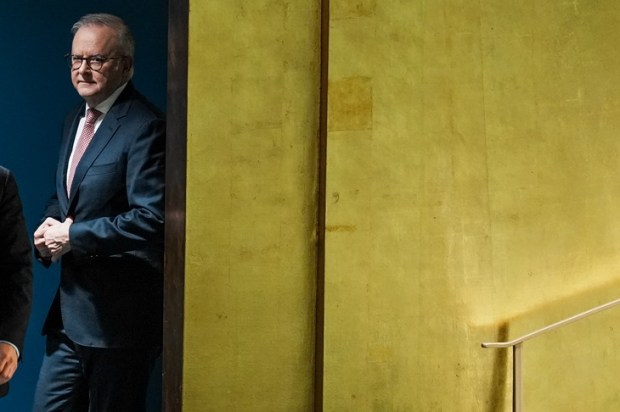
But if you thought ‘reform’ was the most dangerous word in Albanese Labor’s lexicon, try the even more deadly ‘change’. The Prime Minister ushered in the new financial year last month by announcing the delivery of ‘real change for Australians’ with more to come, confirming once again his determination to shred the few remaining elements of Hawke-Keating economic liberalism. Albanese owns the current cost-of-living crisis, falling household real incomes, housing chaos, immigration out of control with the consequential collapse of social cohesion, the housing debacle, bigger-than-ever government, towering debt, falling productivity, more powerful unions, higher taxes, more handouts as electoral bribes to voters and a litany of broken promises that have marked his four-year transition of the old Australia towards Albanese’s long-held socialist dream. It all fits in with his own words from three years ago in an interview with the Australian’s Troy Bramston in which he accepted that he ‘is leading an activist, interventionist government, enlarging its reach across society, the environment and the economy – cloaked in a traditional, process-driven approach that is masking how significant these changes really are’. He not only is determined to change Australia (‘I want to make a difference each and every day’) – his changes must be ‘aimed at transformative reforms’.
What Australia needs now is a campaign to restore what we had before all this ‘transformative reform’ changed things for the worse. Restore social cohesion, restore our cost of living, restore homeownership, restore what made Australia the best country in the world. We’ve had a gutful of Albanese’s changes. The only change needed is to change the government.
Got something to add? Join the discussion and comment below.
You might disagree with half of it, but you’ll enjoy reading all of it. Try your first month for free, then just $2 a week for the remainder of your first year.