In its campaign to preserve traditional British screen-free pleasures, English Heritage is promoting a variety of wholesome pastimes this summer, such as puppet shows and fairground and circus skills. Children will lap those up; but will they respond equally enthusiastically to English Heritage’s new initiative for 2026: to revive the habit of holiday-postcard writing?
This is the vision: that their young visitors, inspired to verbal exuberance by the castle, stately home or ancient ruin they’re enjoying, will snap up a couple of the new limited-edition postcards specially commissioned by English Heritage from the artists Nick Sharratt and Quentin Blake, and (ideally in the café) will write to their grandparents, aunts, uncles and godparents.
A morning of every holiday was spent ‘doing your postcards’ – it was an empathetic skill we all learned
It’s an attractive vision: children of the 21st century staring into the middle distance, chewing their Biro, forced for a few minutes to think of other, older people and try to imagine what they might like to read. It was an empathetic skill we all learned in the 20th century, when a morning of every holiday was spent ‘doing your postcards’.
‘All things worthwhile in life require a little bit of effort,’ says Matt Thompson, the conservation, curatorial and learning director promoting this venture. It’s ‘the physicality of postcards’, he says, that make them superior to round-robin social media boasts, ‘the smell, the feel of them’ – as well as the pleasure they bring to the recipient, touched that the sender has taken the time and trouble to write personally to them, by hand.
The longstanding postcard firm Judges (established 1902), which is printing the cards, tells me that postcards used to represent 70 per cent of their turnover, but it’s now down to 5 per cent; most of its business is now printing images on mugs, tea towels, key rings and fridge magnets. It longs to reverse the downward trend.
I wish I could say that the images on the three new limited-edition postcards were worthy of this noble vision. Of the three commissioned images (one is by Blake, and two by Sharratt, illustrator of the Jacqueline Wilson books), the Blake is by far the best. Both artists were commissioned to create non-site-specific images that could be sold across all English Heritage sites. So they couldn’t draw Dover Castle or Stonehenge. Blake’s card depicts a mounted knight in armour galloping off from a multi-turreted castle, pennants fluttering against a few wispy watercolour clouds. There’s a whiff of romance and history here, just enough to fire the imagination of a knight-loving child.
Sharratt’s, by contrast, are garish and characterless. One is of a twin-turreted keep with a damsel of colour in one turret and a knight in armour in the other, both of them children, both waving at us and grinning with smiles consisting of a ‘u’-shaped line on their circular faces. The human figures are out of scale, far too big, reducing the turrets to toy-castle status. A cartoon dog grins in the foreground. The image is as shadeless, and the colours as basic, as something from an iPad colour-your-own starter kit. Sharratt’s second card is of a non-specific stately home with three cartoon children in the foreground smiling at us – one of colour, one dark-haired and one red-haired, with a cartoon dachshund on a lead. Both Sharratt images include the English Heritage logo on a flag, a marketing component that Blake somehow managed to avoid.
I sometimes wonder whether it isn’t the relentless cheerfulness of such images promoted to the younger generation that make them all so depressed. As they browse those cards, they might well feel that if they’re not as ecstatically happy as the children in the pictures, they’ve somehow got life terribly wrong. Children have far more sensitivity, emotional depth and sheer taste than those images give them credit for. They don’t need to be constantly assaulted with happiness. It’s the opposite of infectious.
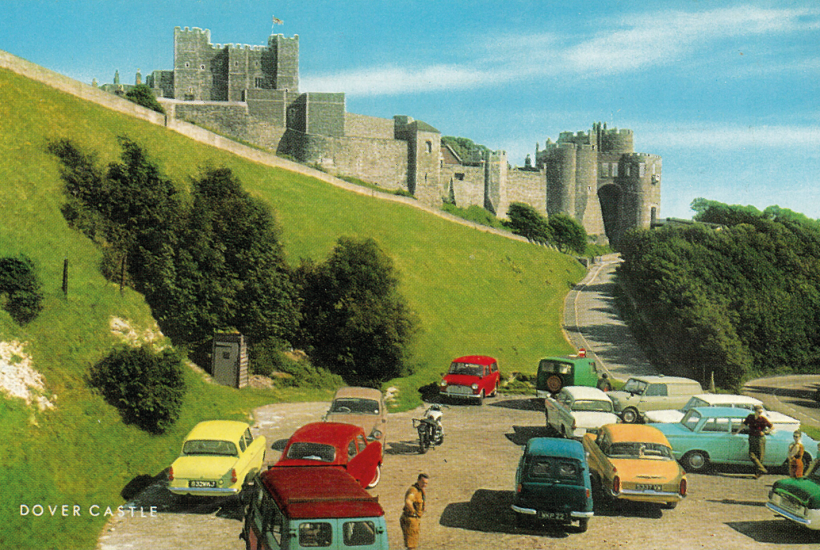
Among English Heritage’s unsung treasures is a collection of 800 old postcards of Dover Castle, amassed over many decades by its former head custodian Pat Cunningham, and stored in the archives of Dover Castle. I went to have a look at them, and was reminded of the marvellous evocativeness of postcard images at their best, and of the centrality of postcard-sending in the 20th century. Often, they were sent intra-county: from Dover to Canterbury or Broadstairs, just 15 or 20 miles away. There’s much to savour on both sides of the cards: changing visual tastes in the images, and changing social and domestic priorities in the words.
I’m pretty sure that the elder brother, Harry, who in 1907 sent his little sister Queenie a postcard of Dover Castle, would not have been remotely tempted by the Sharratt ‘happy-children’ cards. The image he chose to impress his younger sister was of the 16th-century cannon known as ‘Queen Elizabeth’s Pocket Pistol’. In his brief message, he gets straight to the chief point of interest: ‘My dear little Queenie, we saw the train come from London to the big boats and put the people on.’
It was transport and firearms all the way. That was the great thing about the great age of holiday-postcard buying. In your choice of card, both as a child and an adult, you showed off your tastes and interests to the recipient. You stood in front of the rotatable stand for ages, deciding which to go for: would it be the keep, Roman lighthouse, Norman church, Constable’s Tower, armoury room, interior of church, staircase inside keep, cars parked on grassy verge, aerial view of the whole site, or a hovercraft with the castle in the background? I used to look down on people who couldn’t decide and instead plumped for quadruple-image cards with the name of the place in the middle, perhaps along with the town’s heraldic crest.
Postcard images developed across the century, from plain black-and-white to moody, floodlit castle against orange sunsets in the 1970s. The 800 cards, in plastic albums of transparent envelopes, are arranged pictorially rather than chronologically, so you get a delightfully unpredictable variety of words on the backs, from the Edwardian housewife instructing her servant to tell Nurse ‘to collect the Baby Girl on Monday 28th September’, to a boy describing a ‘night hike’ to his grandmother in the 1960s. A surprisingly large number of the postcards remain blank, suggesting a century’s-worth of people buying them with good intentions, but never getting around to writing or sending them.
I used to look down on people who plumped for quadruple-image cards
Anyone of a nosy disposition will devour the written messages, combing them for human interest and drama. This is often in vain. An innate characteristic of postcards was that, by not having envelopes, they were public property – readable by the postman or anyone who found one propped up on a shelf. So they’ve never been vehicles for secrets or any kind of lovey-doveyness. The nearest we get to emotion in the collection is in one from 23 July 1916: ‘My darling Freddie, In memory of the sixth anniversary of our wedding day, hoping the next will be spent together. With fondest love from Stubby.’ What was the story, three weeks after the first day of the Somme? We’ll never know, and that card comes with no addressee.
The collection offers a feast of insights into two perennial British preoccupations: the weather, and ill health. About half the written cards mention the weather, sometimes with a small boast (‘a lovely day’) but more often with a downward cadence (‘cricket soon stopped for rain’; ‘sorry to say raining this morning but we must not give up hope’). A similar proportion mention illness, either at the writer’s end (‘I’ve been laid up with malaria for ten days’; ‘Wendy has been ill with her teeth’) or the recipient’s (‘I’m sorry to hear your leg is troubling you again’.) Occasionally you get two illnesses in one card: Gladys writes to her daughter in Margate, ‘I am really sorry to hear about poor little Nellie’, and ‘How is poor old Spot?’
I was intrigued by the husband who sent his dirty clothes home for his wife to wash in 1931. ‘Sorry I could not send them earlier and hope it does not give you two washing days.’ (I bet it did – poor woman.) And I longed to know who ‘Sister’ was in this from Beatrice in the 1920s. ‘I got Sister’s books before I left: The House of Prayer and Everyman’s Book of Saints.’ Was ‘Sister’ a sibling, a nurse, or a nun?
Got something to add? Join the discussion and comment below.
You might disagree with half of it, but you’ll enjoy reading all of it. Try your first month for free, then just $2 a week for the remainder of your first year.