Nearly 200 economists including 15 Nobel laureates and tech leaders this month issued a statement that warned artificial intelligence poses ‘risks, including large-scale job displacement’ and suggested that policymakers need to better understand these threats to enjoy AI’s benefits.
Within days, another 1,800 luminaries had signed the three-paragraph release titled ‘We must act now’ that described how AI ‘could drive an unprecedented transformation of our economy, larger than the Industrial Revolution’.
The statement added credibility to the hype around AI’s abilities that includes claims the technology is conscious, can reason and will achieve superhuman intelligence. Detractors, however, say large language models are just sophisticated autotext; AI is just code that offers plausible responses based on probabilities gleaned from scanning plagiarised texts or data. Unlike computers and spreadsheets, AI’s output must be verified which constrains its productivity benefits.
Such speculation surrounding what social and economic benefits and harms AI might bring in coming years often distracts from how AI poses an immediate danger to prosperity due to two connected threats.
The first of these is economic. AI is ushering in an investment boom that the Bank of International Settlements compares with the canal mania of the 1830s, the UK railway frenzy in the 1840s, the electrification exuberance of the roaring 1920s, and the dotcom boom of the 1990s. The body that advises central banks says these episodes had ‘one common trait: a genuine technological breakthrough that attracted capital in excess of what commercial returns could ultimately justify’.
Reuters estimates AI companies have announced plans to invest up to US$7 trillion to develop microchips and build data centres in coming years, a tally that includes US$1 trillion invested over 2025 and 2026 by the five biggest ‘hyperscalers’. The problem is these commitments are outpacing the earnings of these companies. To raise capital, many AI businesses have had to sell bonds – Morgan Stanley expects AI companies to sell US$570 billion worth of bonds this year – which means they have interest bills to meet.
The risk is that AI companies are making excessive investments with doubtful returns. The industry is so competitive it’s prone to price wars and loss-leading to gain users, no product holds its lead for long, the latest microchips age quickly, AI customers are questioning its worth, and political opposition to data centres is provoking delays and cancellations that increase costs. Disappointing returns could lead to a sudden stop in AI capital spending that leads to a protracted investment bust that derails a US economy that is dependent on AI investment (and government overspending).
The other economic risk is the AI investment boom is boosting inflation by placing excessive demand on advanced chips, electricity and specialist labour. Household inflation expectations are climbing and a wages-prices inflationary spiral could erupt. Faster inflation is pressuring major central banks to raise key rates and prompting investors to demand higher yields to own bonds. Interest rates could climb to levels that trouble an indebted global economy.
The second of the connected AI threats is financial. The AI mania has driven US, and thus global, stock prices to bubble valuations.
On cyclically adjusted price to earnings (the S&P 500 Shiller CAPE Ratio is 41.37 compared with a long-run median of about 16), the US bourse is more overvalued than at any time since 1881, except for the dot-com bubble of 2000. The US share-market capitalisation of about US$70 trillion has soared to about 215 per cent of US GDP, alarm levels for the so-called Buffett Indicator as readings above 120 per cent signal stocks are overvalued. Valuation readings for the S&P 500’s price-to-book ratio and price-to-earnings ratio are similarly lofty.
US stock and debt markets are thus vulnerable to an AI-induced economic slowdown that ruins company profit projections, and to higher interest rates that puncture valuations.
Any stock crash, via the reduced wealth effect, could be a bigger macroeconomic blow today than in the past because household equity holdings have ballooned relative to wealth and income in recent decades. As US stocks almost account for an outsized 66 per cent of the MSCI Global Index, any US crash would hurt global wealth and spur financial shockwaves around the globe. As public and private debt markets are so exposed to AI, any bust could shake the global financial system.
The AI unravelling might already have started. Rising yields show bond investors have turned pessimistic on AI debt, while AI stocks have tumbled on concerns China is eradicating the US’s competitive advantage by inventing cheaper and easy-to-access customised models that are as effective. Chinese models are often ‘open source’, which means anyone can use and modify them, and usually ‘open-weight’, which means users can download their trained parameters and adjust and run them on their systems.
Concerns about greater competition from China have intensified due to two events this month. On 17 July, Alibaba-backed ‘lab’ Moonshot AI released a cheap product named Kimi K3 that it claimed matched models produced by US companies such as Anthropic and OpenAI, and Chinese President Xi Jinping announced plans to compete for global AI leadership.
The previous day it was announced that nearly 30 countries including Brazil, Indonesia and Russia have joined the China-backed World Artificial Intelligence Cooperation Organisation, which aims to give Beijing the power to shape global AI governance.
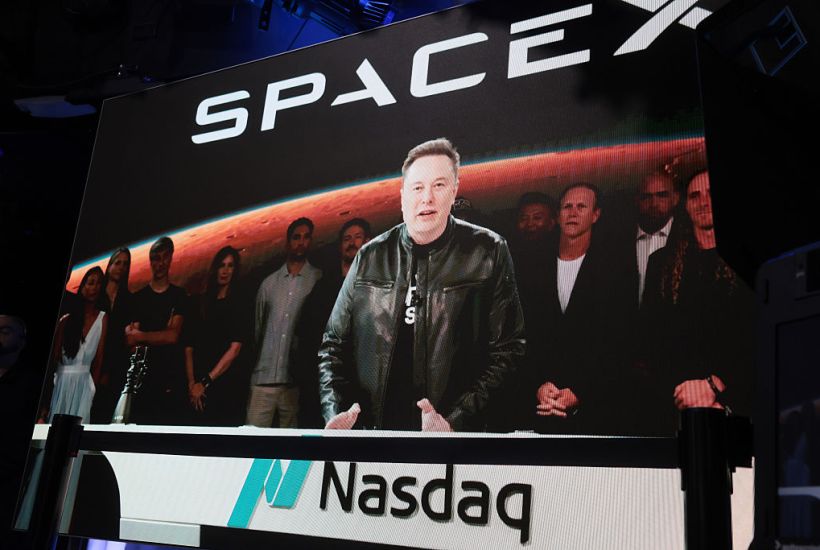
To almost epitomise the US’s vanishing lead in AI, the day before that shares in SpaceX, Elon Musk’s rocket and AI company, fell below their listing price of US$135 for the first time – they had opened 11 per cent higher at US$150 on their trading launch on June 12. SpaceX’s dive from a post-float high of US$225 threatens the US IPO market’s AI euphoria at the very least.
The likely coming AI bust centred on the US economy and financial markets will damage much more than that.
To be sure, somehow AI hype might convinces enough investors to buy AI stocks and debt that staves off a bust, but the technology is not the only threat to the US economy or the US stock market. The reignition of the Iran war, US tariffs and Washington’s budget deficit at six per cent of US GDP are boosting inflation and interest rates too. But it’s the AI mania that has driven US stocks to such crazy valuations a crash is almost guaranteed.
Those people signing statements warning about the long-term implications of AI might soon have much more urgent problems to worry about.
Got something to add? Join the discussion and comment below.
You might disagree with half of it, but you’ll enjoy reading all of it. Try your first month for free, then just $2 a week for the remainder of your first year.