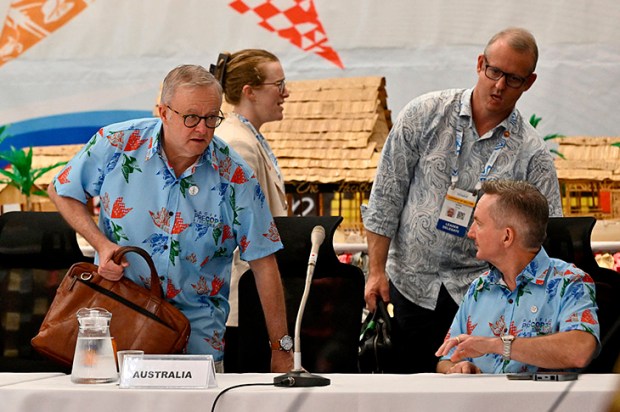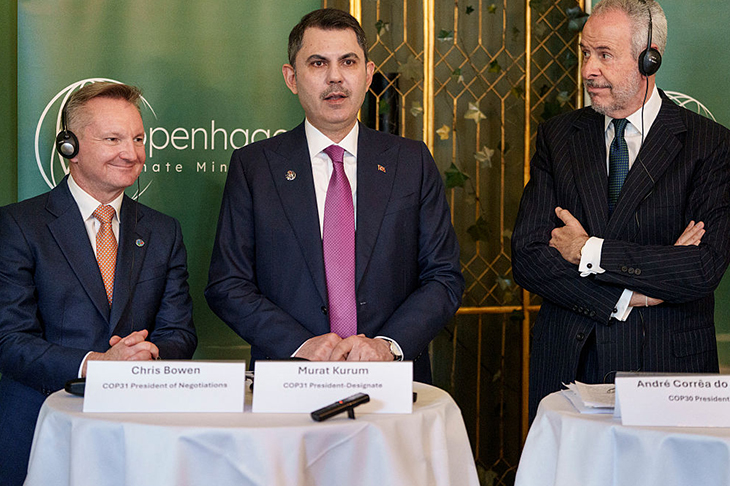
I guess it makes political sense. Having taken a second job, Climate Change and Energy Minister, Chris Bowen – B1 to Speccie readers – has been busy dampening down expectations about any impact Australia may have on global climate policy outcomes. Gosh, we are only a middle-order power, so there’s only so much we should expect.
It sounds fancy – President of Negotiations of the United Nations Climate Change Conference of Parties leading up to and including the actual event to be held in Turkey – or whatever it is called these days – later in the year.
The reality is that most Australians wouldn’t even be aware of his moonlighting. Those who are sort of aware couldn’t give a tinker’s cuss. They are more concerned about the size of their electricity bills as they land in their inboxes. The recent figures on the rising number of electricity disconnections from households unable to pay their bills are particularly alarming.
Of course, when I use the verb ‘dampening’, it’s worth keeping in mind that everything is relative. B1 has a plan to increase the global electrification rate from the current 20 per cent to 35 per cent by 2035. That man just loves a target.
Let’s not forget he is still hanging on to Australia’s emissions-reduction target of 43 per cent by 2030 from the 2005 level and to 82 per cent of electricity generated from renewable sources. He probably does realise that we won’t make these numbers, but he is currently working on the excuses. It won’t be a case of events, my dear boy: it will be reasons. Not his fault, you must understand.
One of the astounding features of B1 is his complete lack of self-knowledge. He is blissfully unaware of his abysmal ministerial performance, including the damage he is imposing on the economy because of his ideological obsessions. He seems to think he’s popular with voters, even though the survey evidence points to the exact opposite.
He remains a firm believer in the nonsense statements that renewables are the cheapest form of energy, and all the world is on board with net zero. Yeah, right. He just loves a cliché – ‘the sun doesn’t send us a bill. The wind doesn’t send us an invoice’ was one he adopted early in his ministerial term. He has now added a further clause about the sun and wind not having to travel through the Strait of Hormuz. So droll.
He is just relentless, even when he says things that are patently untrue. ‘In all my discussions with my international colleagues, there isn’t one country in the world that said, “You know what this fuel crisis reminds us is we need more fossil fuels,”’ he asserted.
He joyfully declared, ‘That conversation is not being had anywhere around the world.’ In fact, countries around the world are saying this underpins and underlines the need to keep going with things like electrification and ensuring renewable energy is an important part of the mix going forward.’
Is he off his rocker? So, the Americans are turning their backs on fossil fuels? Forget the ‘drill, baby, drill’ line of the President, B1 knows better. Canada is busily building new oil and gas pipelines. One of the main reactions of several Asian countries to the closure of the Strait of Hormuz was to fire up their coal-fired electricity plants rather than use more expensive LNG.
You really must wonder where B1 gets his information.
Having had to face the inevitable conclusion that gas must be part of the mix for our electricity grid, B1 is now walking back from his lukewarm support for a source of energy of which Australia has an abundance. Okay, it’s sitting there in underground reservoirs waiting to be exploited. B1, along with activist bureaucrats and some state governments, are doing their darnedest to keep it there.
B1 is now of the view that batteries will displace the need for gas and it’s therefore worth spending many billions of dollars subsidising wealthy households to install home batteries as well as handing over massive subsidies to overseas companies keen to invest in large-scale ones.
There is little doubt that, in most situations, batteries delay the switch to dispatchable fossil-fuel-generated electricity over the course of the day. By storing renewable energy, particularly solar, households can survive for some time after the sun sets.
But here’s the thing: designing a system for most situations doesn’t work; a system must work in all events, including relatively rare ones. One of these relatively rare events – a wind drought – occurred in mid-June.
On Thursday, June 18, there was so much wind power in South Australia that virtually all its power needs were met from renewable sources. Three days later, on Sunday, the state was essentially becalmed, with less than five per cent of its power needs generated from wind. Even though South Australia has the equivalent of three coal-fired power stations to generate wind, it’s of no use unless the wind blows.
To fill the huge gap, gas-fired plants were brought on, with power also sourced from the interconnector with Victoria. (Victoria was also short of wind power, so it did not have that much to spare.)
According to Paul McArdle, a well-known electricity market expert, ‘The recent wind lull in South Australia was the worst experienced since 2019.’
Unsurprisingly, wholesale electricity prices rose rapidly during the wind drought, with the maximum of $20,300 per megawatt-hour reached twice. This compares with the average price of $88 that had prevailed in the first quarter of the year. This higher price will eventually be reflected in retail electricity prices down the track.
But here’s the most important point of the story: battery storage, both household and large-scale, was of little use. McArdle notes that many batteries were running low as the price climbed, but around half managed to catch the first extreme price interval. However, ‘almost none was able to capitalise the second time prices spiked the next morning’.
When a wind drought lasts several days, batteries are of no use because they run low after a few hours. It’s why you need a reliable backup to call on – and this is extremely expensive, both in keeping plants on standby and in the cost of gas. The required redundancy in the system is a major contributor to high electricity prices.
Expect B1 to continue to float around the world giving political leaders – okay, minor ministers – the benefit of his wise advice. The Chinese leaders will be ecstatic because electrification is simply synonymous with more demand for Chinese-made electric vehicles, electric buses, electric trucks and other paraphernalia that goes with renewables – turbines, solar panels, batteries. How good is that?
I guess he loses the title of president after the next Cop ends. No doubt, he will be including it in his CV. It will look good for his post-political career working for cashed-up green rent-seekers, following in Matt Kean’s footsteps.
The only positive is that the next climate change and energy minister – can we just call this person the energy minister – must surely be an improvement.
Got something to add? Join the discussion and comment below.
You might disagree with half of it, but you’ll enjoy reading all of it. Try your first month for free, then just $2 a week for the remainder of your first year.