As a good Labour man, I’m sure Andy Burnham will have read his Marx (even if he is by no stretch a Marxist). And he’ll likely be aware of Marx’s maxim, “History repeats itself, first as a tragedy, second as a farce”. It’s far from always true, of course. But it’s true often enough that when we fail to learn from history we really should know better.
Johnson and Burnham are very different and have different political outlooks. But the parallels are real
Which brings us to Boris Johnson. After eight years as a mayor, he returned to the Commons in a by-election. His party then turned to him to replace the stolid, wooden prime minister who was sending its MPs into paroxysms of despair. He then set out a decade-long plan to change Britain, with regional investment his key priority.
Ring any bells? Other than Burnham having been mayor for nine years, and a general election between Johnson returning to the Commons and his becoming PM, the parallels are clear. And they are far from the only resemblances – some of which should ring alarm bells given the chaos of Johnson’s time as prime minister.
One of Johnson’s most glaring weaknesses was his lack of interest in or grasp of detail – a pretty basic requirement in a role which largely consists of decision making.
Worryingly, it is one of the first points made about Burnham by those who have worked with him. A Times profile last month cited a former Greater Manchester Combined Authority official saying, “I never got the sense that he was desperately interested in the nuts and bolts.”
When Burnham was health secretary under Brown he was said by officials, according to another profile, to be “indecisive and incurious about policy detail.”
That seemed to be demonstrated when he was asked on Newsnight last month about Rachel Reeves’ fiscal rules, to which he has said he will stick. He replied: “I’m not going to go through a discussion like an exam on the fiscal rules.”
Labour Hub, a left wing website, quotes a Manchester housing expert sympathetic to Burnham as saying: “His big weakness is a lack of grasp of policy. His policy interventions are often quite surface-level and faddy. He shoots from the hip and doesn’t always get it right.”
That’s evidenced by his record in Manchester, where auditors identified “significant weaknesses” in Transport for Greater Manchester’s financial governance. Similarly, the Clean Air Zone debacle was said to be because Burnham had not been on top of the actual details of the plan. Hundreds of ANPR cameras, costing tens of millions of pounds, were installed to enforce a daily charge of £60. But anger by small businesses and van drivers led the mayor to pull the plug on his original scheme.
More broadly, while Johnson promised “levelling up”, Burnham has focused on “Manchesterism”. The former ended up as nothing more than a slogan; Burnham seems determined to make devolution and regional investment the hallmark of his government, but at the moment there is little beyond sloganising to buttress the idea that he will deliver what he says.
He certainly took a page from the Johnson playbook when it came to not delivering on a basic election promise. Johnson gave repeated assurances that he would not return to Parliament, before doing just that in the Uxbridge by-election in 2015 (doing both jobs in his final year as mayor). Burnham said he was “committed to my third term, absolutely” – and then ran for Parliament in Makerfield.
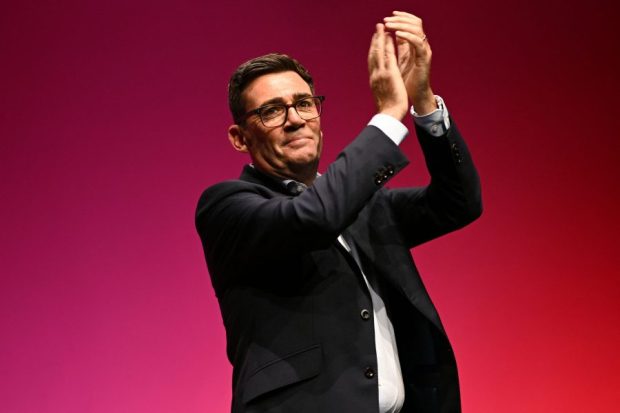
Burnham’s sudden transformation from local politician to prime minister is, of course, based on Labour MPs deciding that he alone offers the chance of winning the next election. The parallel with Johnson is not merely that Tory MPs saw the same thing in him; it’s also that they didn’t know much about him beyond the image he had crafted. Few Labour MPs have had any real dealings with Burnham – he left the Commons in 2017. They, too, have based their view on him as their saviour on his own carefully crafted image.
That image is key. Johnson went to Oxford, and Burnham to Cambridge, but they both like to present themselves as disruptive outsiders – and both have a seemingly limitless estimation of their own talents and a need to be liked.
Johnson was widely pilloried for using his ‘unique’ sense humour in almost every speech and interview but Burnham too seems incapable to starting a speech without joshing – and then does a sudden handbrake turn into looking serious.
Johnson and Burnham are obviously very different and have different political outlooks. But the parallels are real. Perhaps another quote about history, this one attributed to Mark Twain, is more useful: “History never repeats itself, but it does often rhyme”.