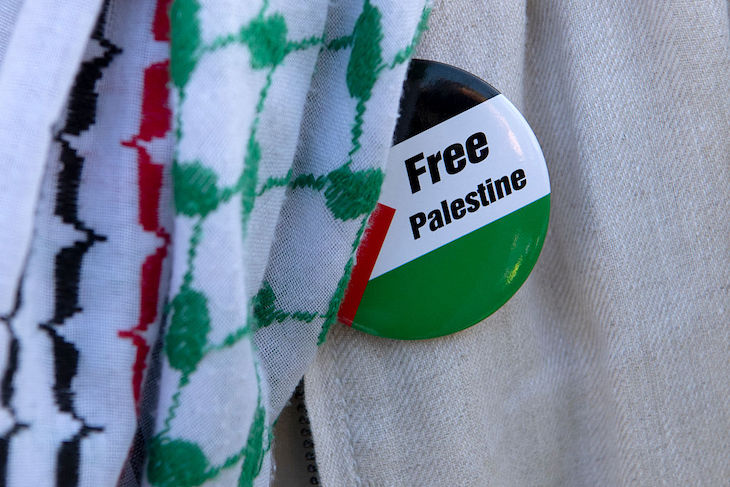
Conservative leader Kemi Badenoch says her party is the Jewish state’s “last line of defence” in British politics. Her record matches the rhetoric. Badenoch has supported a moratorium on pro-Palestine marches, backed Israel’s decision to bar two Labour MPs and condemned the UK’s recognition of Palestine as “disastrous”.
Backing Israel is not inherent to Conservative ideology. Last year, thirteen Tory parliamentarians signed an open letter calling for immediate recognition of Palestine
While Labour’s handling of the Gaza war fuelled internal divisions and a collapse in support, Badenoch has been able to rely on a comparatively pro-Israel electoral base. A 2025 survey found that only a fifth of Conservative voters defined themselves as “anti-Israel”, compared with 44 per cent from Labour and 60 per cent of Greens. Out of 1,498 councillors who signed a pledge this year for Palestine, just six were Tories.
The alliance has deep roots. Established in 1974, the Conservative Friends of Israel attracted 80 per cent of Tory MPs by 2012. Conservative Friends of Palestine was not founded until 2023 and only six per cent of its parliamentarians joined in the opening months. With the left traditionally adopting the cause, one Al-Jazeera piece posited that “Tories can never be true friends of Palestine”.
But backing Israel is not inherent to Conservative ideology. Last year, thirteen Tory parliamentarians signed an open letter calling for immediate recognition of Palestine. Every Conservative Palestine supporter I spoke to traces their views back to visiting the occupied territories. Kit Malthouse found it “a real shock.” Four decades ago, ex-Foreign Office Minister Sir Alan Duncan travelled to the West Bank. “I could see that settlers were, with impunity, bashing up Palestinians, stealing their land and knocking down their houses”, he recalls. “It was against international law. I just felt morally indignant that no-one was making a stand.”
Between 2014 and 2016, Sir Desmond Swayne visited in his capacity as Minister for International Development. “It became increasingly obvious to me that, in the West Bank, a system of apartheid was being imposed and the Israeli government had no intention of pursuing a two-state solution”, he says. “I was also very concerned about the way Gaza was being treated”.
For Martin Vickers, seeing Gaza in 2012, “you could not but feel sorry for the innocent people living amongst the rubble. We visited the university; your thoughts turn to what future these young people would have.”
All stress Israel’s right to exist. Growing up in Cairo and Damascus, Swayne saw postage stamps depicting Israel with a dagger plunged into it. “I’ve always been an advocate for Israel”, he notes. “One can understand the difficulty when surrounded by the terrorist threat and the threat of extinction. We have to proceed with the disarmament and removal of Hamas. The Palestinian leadership has been dreadful. Nevertheless, what is happening in Gaza is unspeakable.”
“It is possible to be pro-Israel at the same time as being pro-Palestinian”, Mark Pritchard tells me. “It is intellectually lazy to suggest anyone who offers support for a viable Palestinian state is somehow pro-Hamas, pro-Hezbollah, bigoted or anti-Semitic. It should not be political heresy for any Conservative MP to state: ‘the life of a Palestinian child is as precious as the life of an Israeli child’.”
Conservative values can underpin support. “If we are going to have proper democracy, which surely is a Conservative value, then there must be full civil rights for the Palestinians”, notes Swayne. “The pro-Palestinian cause within Conservative thinking perfectly allies with the views of liberal-minded, enlightened Israelis”, Duncan states. “The trouble is, all the pro-Israel rhetoric is forming an alliance with the most extreme Israelis.”
For Vickers, the issue is justice: “If the Israelis believe they should have their own state, then so should those of Palestinian heritage.”
Beyond the politics lies a more personal question of what it is like to dissent from the consensus. Malthouse explains that the response has been “more spontaneous than organised: people watching events on the ground, seeing the conflict expand, Lebanon being drawn in, exactly as many of us warned, and gradually speaking out. Collective letters tend to emerge from one MP’s initiative rather than any structured effort.”
Duncan’s views have, at times, placed him at odds with colleagues. But others confirm that the leadership did not raise their open letter, with no backlash from colleagues. Malthouse adds: “I’d have thought my position is that of the party: we all believe both Israelis and Palestinians are entitled to self-determination and the right to live in peace and security.” As Swayne puts it, “there’s always been an Arabist point of view in the party and considerable tolerance of what has historically been the minority.”
It may not remain a minority, however. As younger voters – generally more sympathetic to the cause – enter Conservative politics, they may bring those views with them. More pragmatically, the leadership may need greater openness to gain public support. The war in Gaza has, for some, marked a turning point. Polling last year found that half of Conservative voters felt Israel’s actions in Gaza had “gone too far”.
“It is possible to be pro-Israel at the same time as being pro-Palestinian”, Mark Pritchard tells me
While Hamas may compete for the title, Swayne notes that “Israel is its own worst enemy, in terms of public relations. With the attitude of (Finance Minister) Bezalel Smotrich and what happened with the last flotilla, they couldn’t make themselves any more unpopular. Since the assassination of Prime Minister Yitzak Rabin and the arrival of Benjamin Netanyahu’s government, Israel has become increasingly clear that it is fundamentally opposed to what is the bedrock of Western policymaking – a two-state solution. Frustration is growing.”
“The Conservative Party doesn’t realise that I cannot walk down the street without somebody under 40 saying ‘thank you for what you are doing for Palestine’”, adds Duncan. “They are not going to budge; they will just lose votes. Foreign policy matters in terms of voting intention.”
Gaza has proven decisive for some politicians too. After two decades of supporting Israel “pretty much at all costs”, Pritchard last year withdrew that, citing the war. “I got it wrong and I condemn Israel for what it is doing”, he said. He is not alone.
“Many colleagues agree with me, they just haven’t gone public yet”, Pritchard tells me. “Many support the party moving towards a more inquiring mind when it comes to Israel and helping to lead a new American foreign policy in the region, not just following it. There is a political rebalancing going on within the party, albeit much of it below the radar. Netanyahu’s recent policies in Gaza and the West Bank have been the main driver, not the persuasive arguments of a handful of Conservative backbenchers.”
Refusing to shift can cost support further afield, according to Duncan. “MPs do not realise that Britain’s reputation abroad is going down the plughole, partly on the back of this. In the Arab states and the wider Muslim world, we almost now count for nothing. We’re despised for our lack of moral fibre.”
With recognition issued, what is the goal now? “We cannot go on tolerating a situation in Gaza where people are living in absolute squalor and the provision of aid is being held up”, says Swayne. “A humanitarian regime in Gaza and civil rights for the people in the West Bank would be my short-term goals. My long-term goal must remain a two-state solution. But that is becoming increasingly untenable with the rate of building of illegal settlements and the way the settler movement is treated with impunity in the West Bank.”
Whether such views remain a minority or reshape thinking is open. But for those speaking out, the issue is not tribal.
“This is not a match with sides to pick. I support whatever settlement delivers peace, security and prosperity for both peoples. I profoundly support international law”, states Malthouse. “When tens of thousands of innocent civilians have been killed and the international institutions in which Britain plays a leadership role are ringing alarm bells, at what point does a country that purports to lead in the world act? I cannot stay silent and I don’t think Britain should either.”